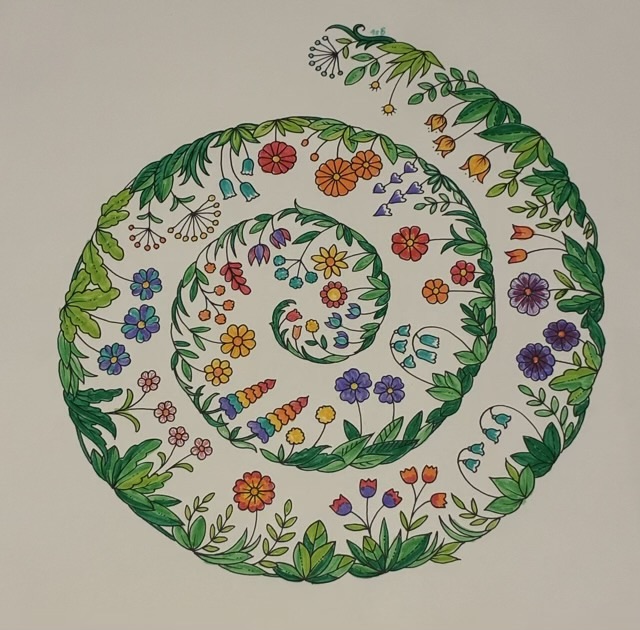
I sat and colored with my kid while we were on a call. I nearly didn’t finish because the call ended but the page still needed coloring. It takes a long time to fill in, even when the sections are tiny and there is abundant white space! But I knew if I stopped, I’d never return to it.
Photo description: spiral of botanicals colored with marker
I’m glad everyone is different. My youngest loves to sit and color for hours. It is not my zen.
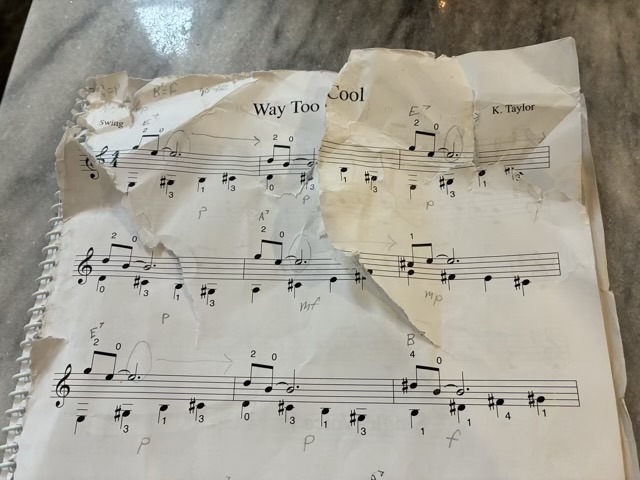
The roomba ate a page of my kid’s guitar lesson book. I’m not sure how the book ended up on the floor, but I suspect a cat.
Photo description: classic guitar lesson music with multiple messy, wrinkled tears
I ordered document repair tape, because I didn’t have any, and regular transparent tape applied at this magnitude would put further stress on the paper.
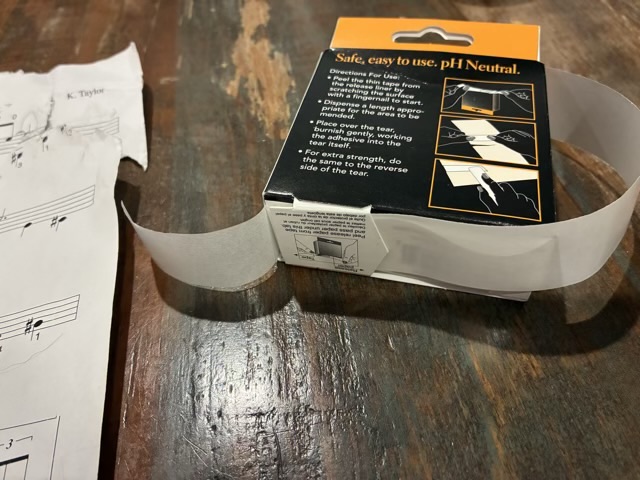
The hardest part was getting the tape away from the liner the first time. The box is conveniently set up to dispense the tape and manage the separation process. Getting is started is just a little tricky.
Photo description: paper repair tape set up with the box as the dispenser, with the tape on the left and backing on the right
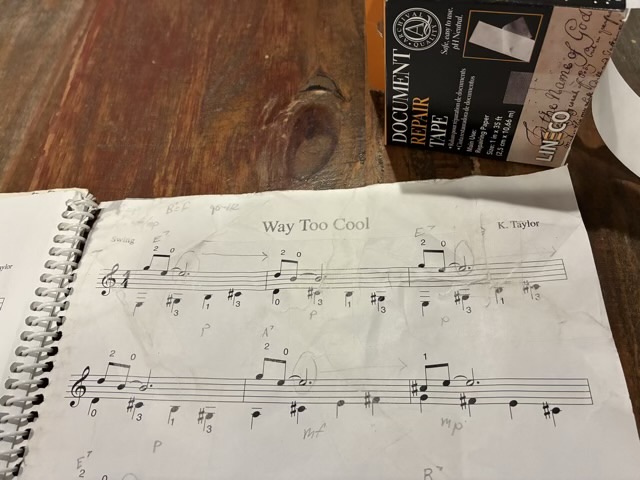
The tape doesn’t look transparent, but when applied to the paper the ink and pencil marks show through clearly. The tape is also thin, which is why it needs the backing, but is nearly imperceptible when applied. I made sure the tears lined up and where the paper split, that the ink side was visible. To reinforce the repair, I put the tape on the back of the page as well. The damage to the page was extensive, however, I was able to get it stabilized and usable, but not pristine.
Photo description: repaired page with all notes intact and readable
Overall, I can recommend the document repair tape for quick repairs on paper that is referenced frequently, or eaten by the robot vacuum.
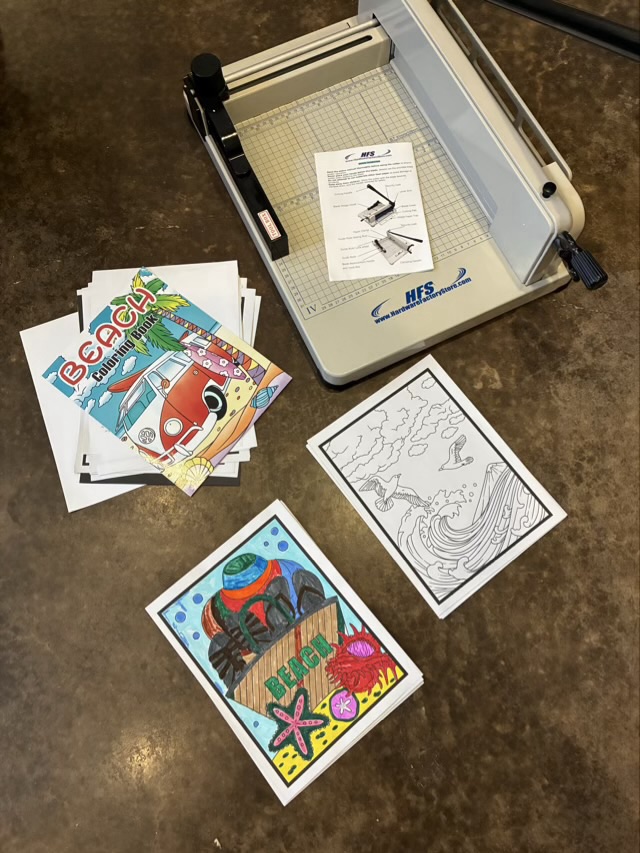
My youngest loves coloring books, but it is difficult for her to find uncolored pages in the bound books after a while. I took my heavy duty guillotine paper cutter and cut off the spine of the coloring book, freeing the pages so they could be sorted into colored and uncolored.
Photo description: 400 page capacity guillotine paper cutter with a deconstructed coloring book, with a colored page and uncolored page pulled out of the stack
My youngest was pleasantly surprised with the fresh stack of ready-to-color sheets, and I was pleased with how fast and clean the cutter worked. Tearing sheets out of a book is often messy and frustrating. By cutting a 1/4 inch off the spine, the pages are freed from the glue easily.
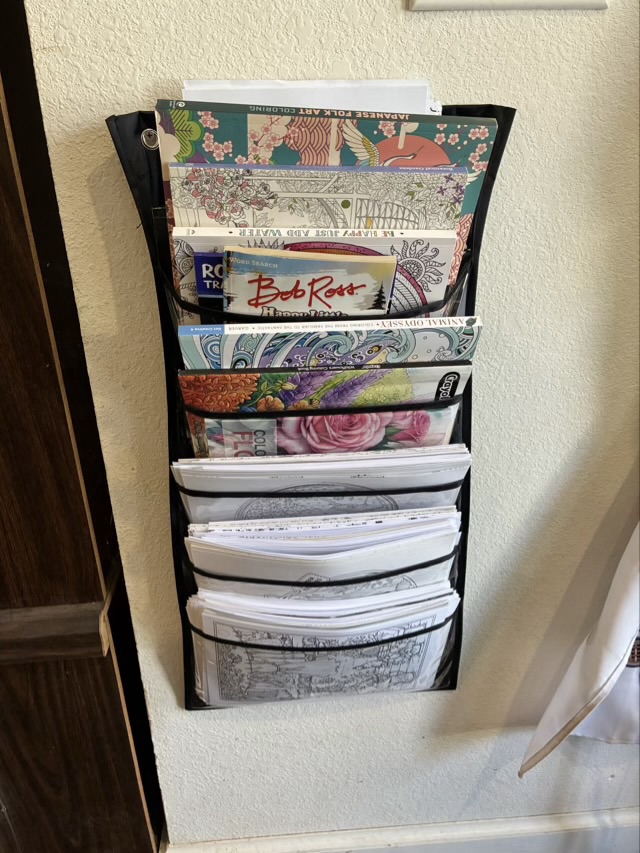
Once my concept was proved, my youngest agreed to let me process the rest of the books. Any book that only had one or two colored pages I left alone, but the books that were mostly colored were cut and sorted.
Photo description: hanging organizer with coloring books at the top and individual coloring sheets at the bottom
I now also have a stack of colored sheets that can be displayed and scanned easily for posterity.
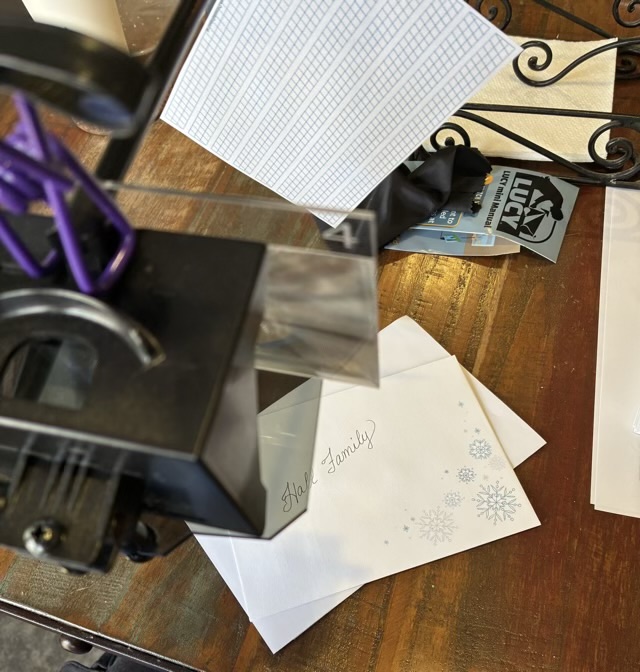
I had an idea that my daughter’s camera lucida could help me address my holiday cards by providing invisible lines. I printed a small version of calligraphy paper and put it on the enlarger attachment for the Lucy drawing tool. The clever arrangement of clear panes and mirrors gives a ghostly image when looking through the eye hole, an image you can trace or use as a guide. There is a learning curve, though, and the image moves relative to the paper depending on head angle. Despite using the edges of the envelope, and even trying to use a lined index card to get the envelope parallel with the reference lines, I couldn’t quite get everything square. The three address lines were parallel, but were mostly slightly off from the envelope, so I embraced the angle and made it obvious. Writing the “to” address at almost a 45 degree angle also went nicer with the snowflake decoration on the envelope.
Photo description: Lucy drawing tool set up as a calligraphy guide, with graph paper taped to the enlargement attachement
We’ll see if any of the cards make it to their recipients. My card list has dwindled over the years; when I get a returned card I take that name off the list, figuring I don’t have the right address. But maybe the machine can’t read the handwriting and no one bothers to have a human read it. Hm.
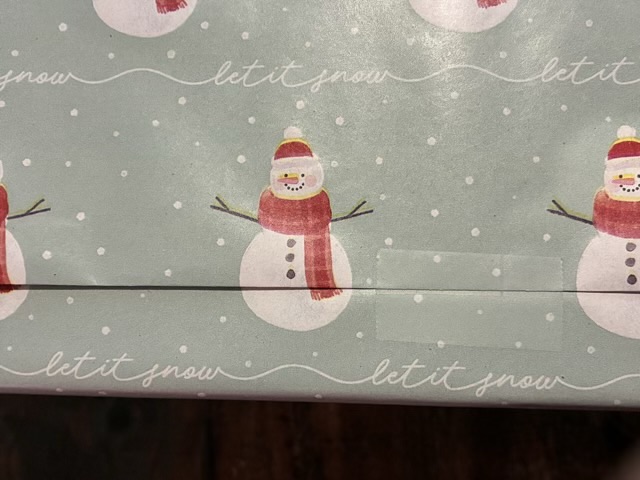
Sometimes, not very often, when I’m wrapping presents the paper pattern and the box size coincide and the fold at the back is a perfect continuation of the pattern. Ah.
Photo description: “let it snow” wrapping paper that has been wrapped around a box with the two ends meeting up to complete the snowman pattern