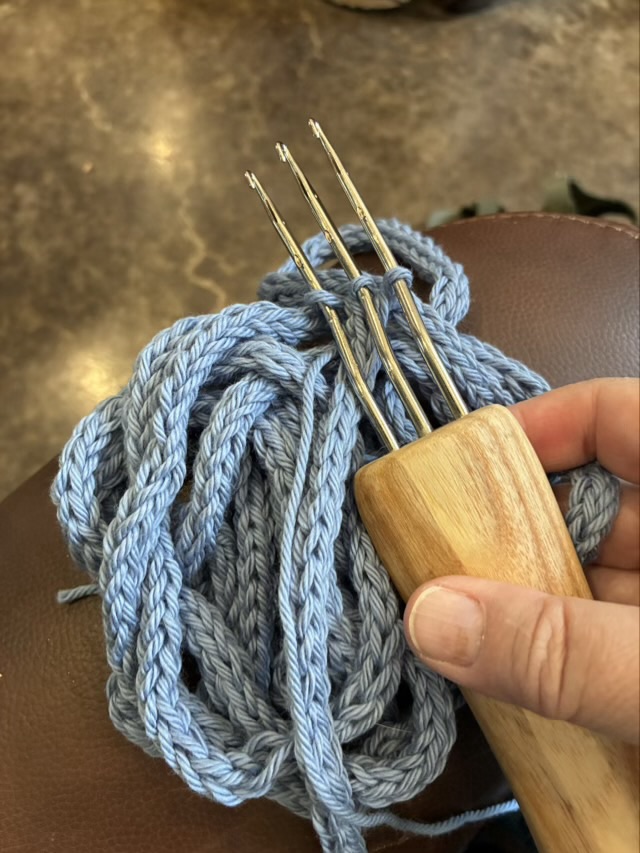
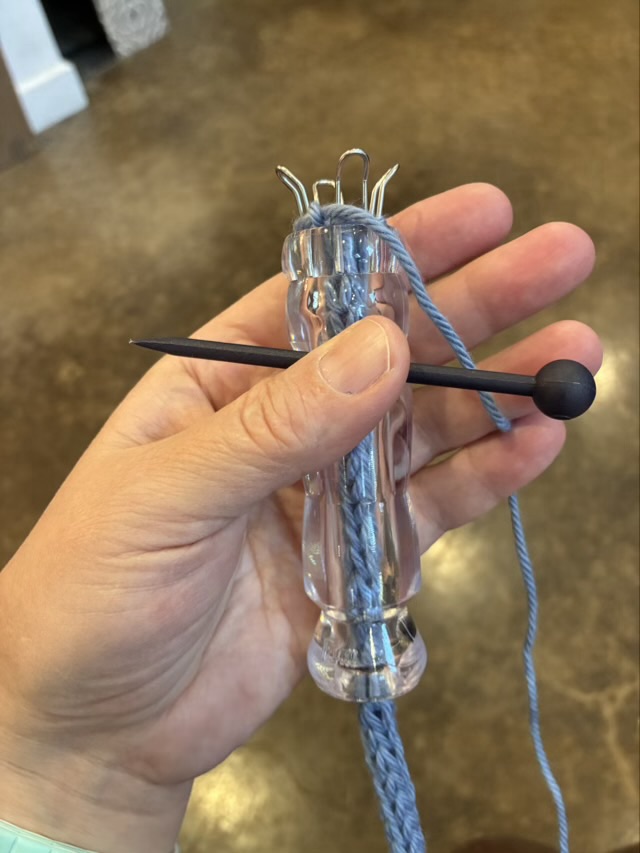
Three latch hooks mounted in a handle can make a long length of i-cord very quickly.
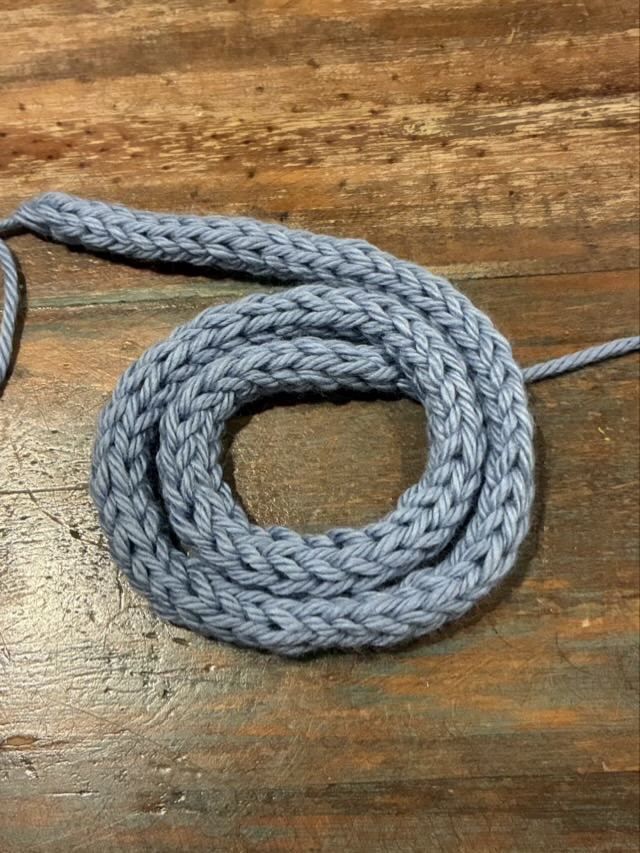
Photo description: handmade i-cord maker with three latch hooks in a hickory handle and a pile of cord made with worsted weight blue cotton yarn
In 30 minutes I made 152” of cord. The cord has a soft drape with 25% stretch (20 inches of cord stretched to 25 inches, I made my math easy.) When my attention wandered and a loop fell off, I did have some difficulty getting going again, and the cord shows an anomaly at those points.
I wouldn’t use this cord where it was a visual focus, but it makes a great filler.
While I handmade my tool, other makers have 3D printed versions made with machine knitting hooks (smaller versions of rug latch hooks) under various names.
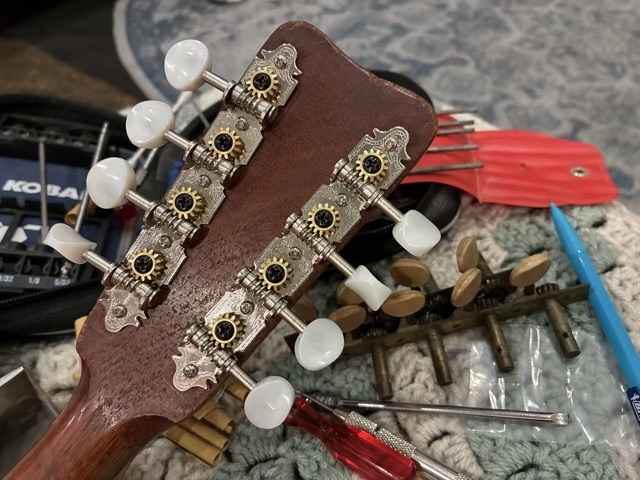
I bought new tuning peg plates for my 1895 bowl back mandolin. The original (maybe?) plates were worn and one peg in particular couldn’t hold its string tight. I purchased Golden Gate A style tuning peg plates and they were almost the right size. I had to sand out the holes to get them seated flat. The old plates came out easily and I replaced one at a time so the bridge stayed in place.
Photo description: back of the head of a mandolin with new Golden Gate A style tuning peg plates, old plates in the background
The mandolin sounds amazing and the strings are holding their tuning. I am happy that she is happy.
I do have to say that as a child of the 80s this week has been a hard hit. Dolly Parton, who was amazing angelically, Tim Curry who was amazing demonically, and Peter Cullen, the voice of Optimus Prime, who probably started my fascination with the human voice.
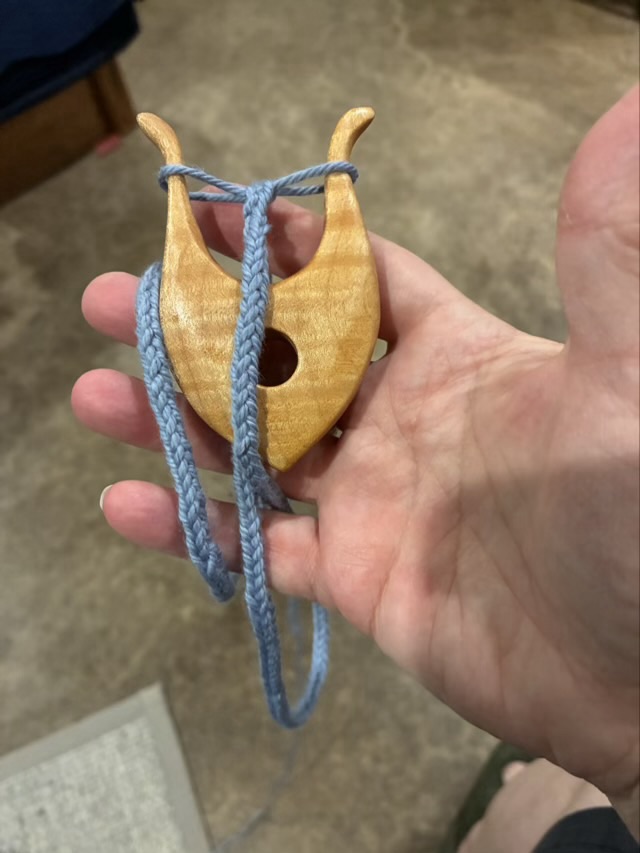
Next in my “how much can I make in 30 minutes” craft series is lucet cord. I made a lucet out of flame maple several years ago, and have a how-to video on YouTube, which I reviewed before making the cord. Getting back into the swing of making the chord took less time than learning the knitting dolly for me.
Photo description: hand made flame maple lucet in my hand with blue cotton worsted weight yarn in process to become cord
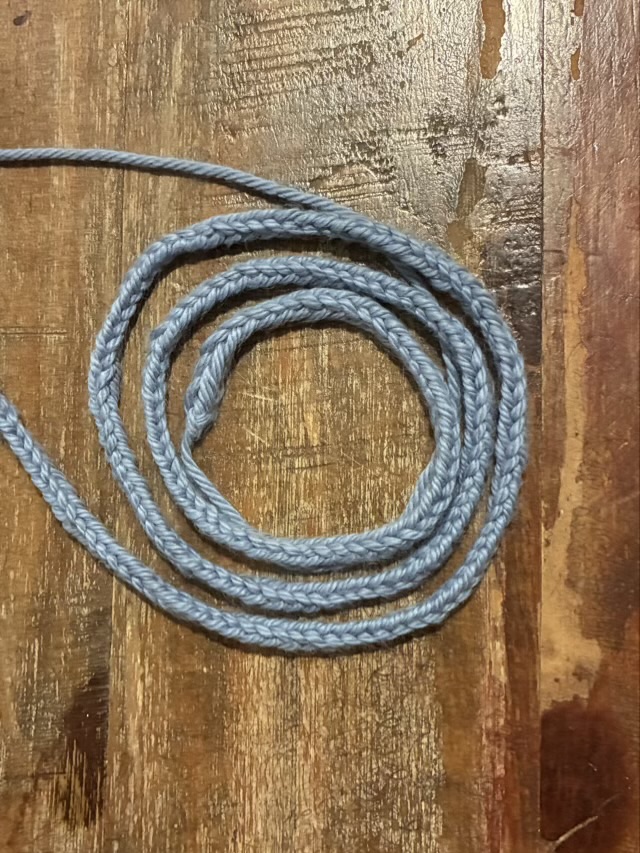
In 30 minutes, I made 29” of cotton cord. This two loop method makes a smaller diameter cord than the knitting dolly with 4 loops, but the process makes a much tighter cord. It has 20% stretch (35-29/29*100) and is square rather than round, but still quite flexible. There is some unevenness in my cord, because how tight the loops are pulled is subject to eye-balling, and my loops weren’t absolutely consistent.
Photo description: 29” of lucet cord made from blue cotton worsted weight yarn
With more practice I believe my stitch length would be more consistent, but I don’t think I would get much more length in 30 minutes.
This is a technique that can be used to make very long cords.
I’m starting a study on how much cord I can make in 30 minutes using various techniques. The idea started with my acquisition of the Prym knitting dolly, which feels like a sophisticated version of the “spool with nails” French knitter. It has a carved crystal-like body and loops instead of pegs at the top, and comes with a needle that locks inside the body of the knitting dolly for safe keeping. Why did I acquire it? Because I don’t have one. I thought I did, a kid’s version, but it isn’t in the knitting bin or the cord bin. Hm.
Photo description: Prym knitting dolly (aka French Knitter, Knitting Spool) with blue cotton yarn
I did have a bit of trouble remembering how to use a knitting dolly, I kept doing the initial twist round as I built the cord and it took a a few minutes of puzzling to figure out why my loops were twisted. It was good data, at least.
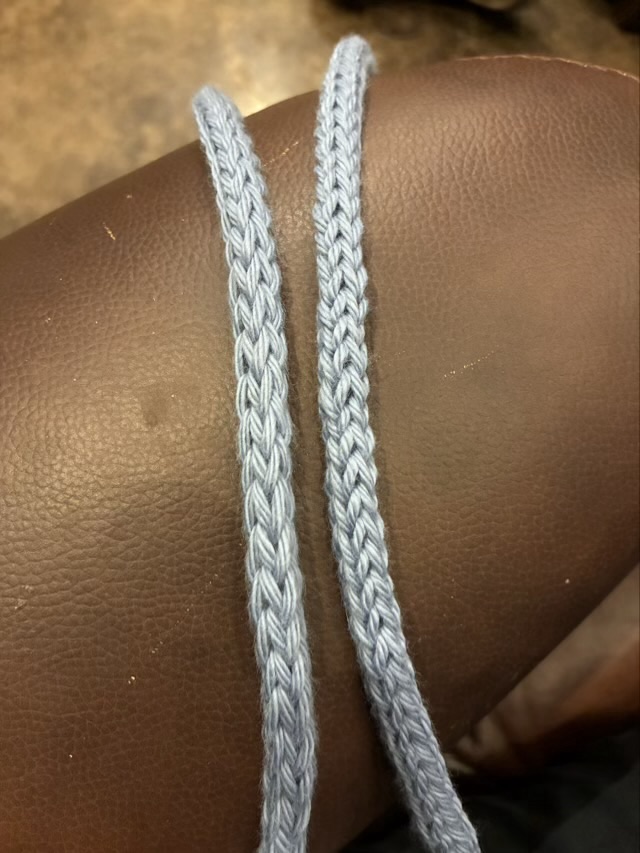
Photo description: two cotton cords, the left one made with twisted loops (each stitch the yarn was wrapped around the post), and the right one with untwisted loops (the yarn taken across the front of the post)
I started my timing once my technique was settled. In 30 minutes I made 17” of cord with the knitting dolly. This number is for my skill set at the time of knitting (I’m sure I could improve the length per time with practice), and the 4-peg knitting dolly with commercial worsted weight cotton yarn.
Photo description: 17 inches of knitted cord created with a Prym knitting dolly with blue worsted weight cotton yarn
The resulting cord is smooth and soft, with mostly regular stitches, and 24% stretch. I calculated stretch by measuring the cord stretched, subtracting the unstretched length, then dividing by the unstretched length. In this case (21-17)/17*100. This technique can be used to make very long cords.
I plan to make 30 minute samples of other cord making methods and do a comparison of both length produced and quality.
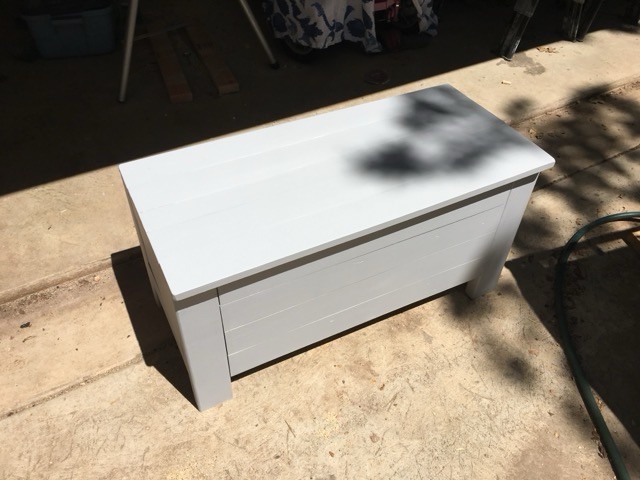
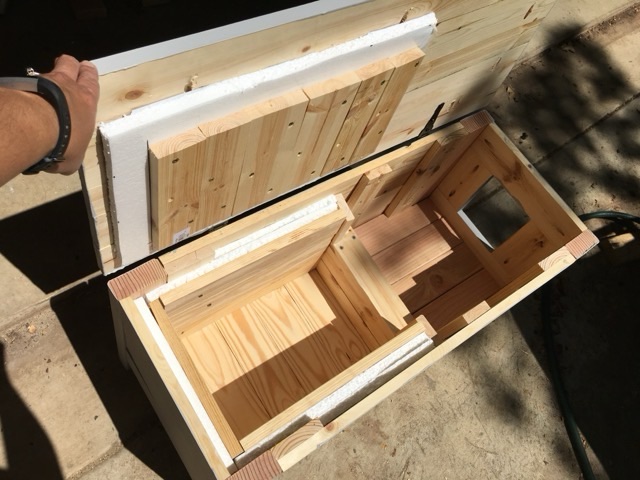
In August of 2018 I built a bench with an insulated section and a non-insulated section inside. The idea was to provide Sophie the cat a hiding place, since she was working on being part of our family.
Photo description: hand made wood bench painted grayPhoto description: same bench with the lid lifted to show the insulated section on the left, and cat door on the right
This was one of the largest flops. No cat ever used it for more than a casual inspection, and after a few years on the front porch, I moved it back behind the coop for the meadow cats, who also eschewed it. I tried cutting a secondary hole so there was an escape route, but still it was not an acceptable hide-y hole. Now, after eight years of being outside, the lid has broken, the legs are rotting, and the bugs have taken it over. Time for a something different.