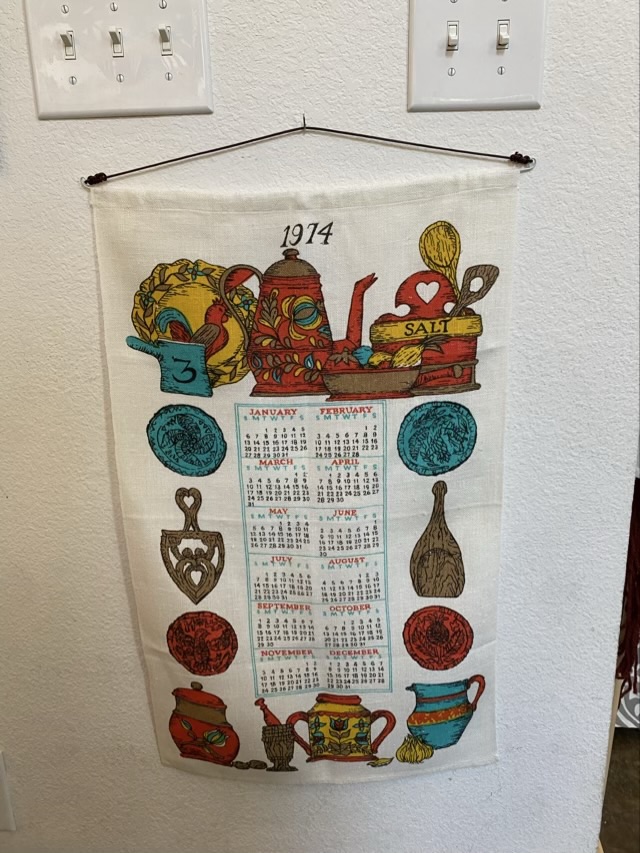
My sister brought me some linen towels from the 70s. I liked the prints on them, so decided to use them as decoration. They all had a narrow sleeve at the top, so I cut down wire hangers to make hanging rods.
Photo description: white wire hangers cut with lineman’s pliers and the ends looped with needle nose pliers
I took leather cordage and tied it to the wire loops.
Photo description: calendar towel from 1974 with wire and leather hanging hardware
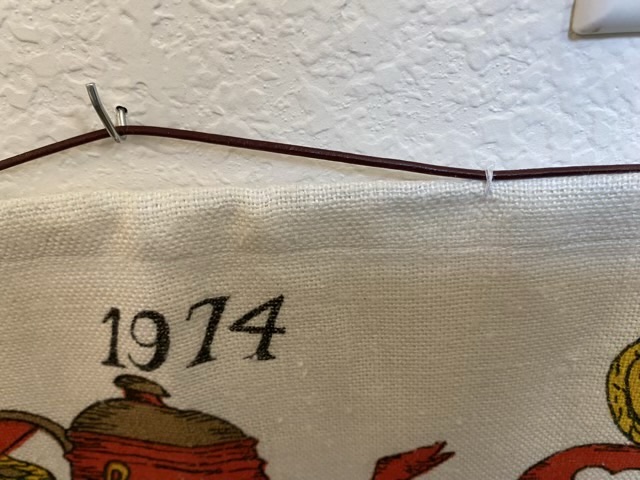
I didn’t like how the wire sagged, so I tacked the linen to the leather about a third of the way in with cotton thread.
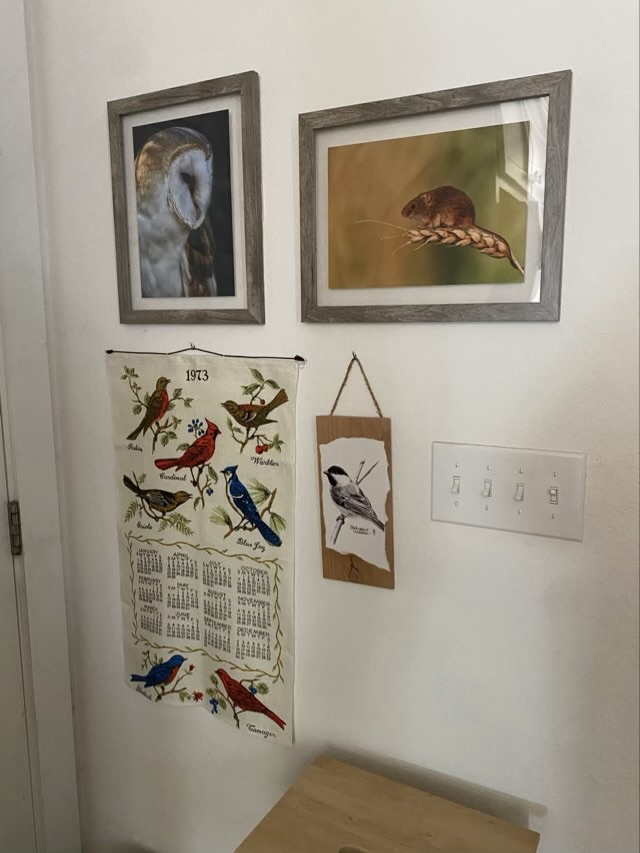
Photo description: closeup of tacked sectionPhoto description: same towel hanging on the wall, but with thread tacks and no sagging, towel has drawings of kitchen implements Photo description: linen calendar towel from 1973 with birds hanging on the wall with new hardware along with chickadee art, and photos of a barn owl and field mouse by Oliver Hellowell
The production of calendar towels began in the 1950s and was an invention of Stevens Linen Works in Dudley, Massachusetts.
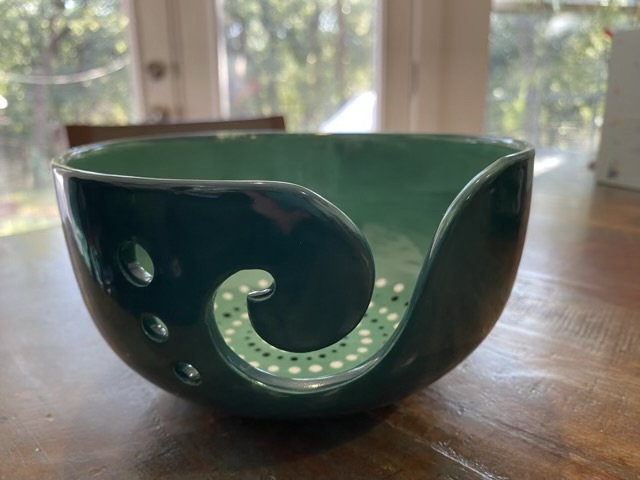
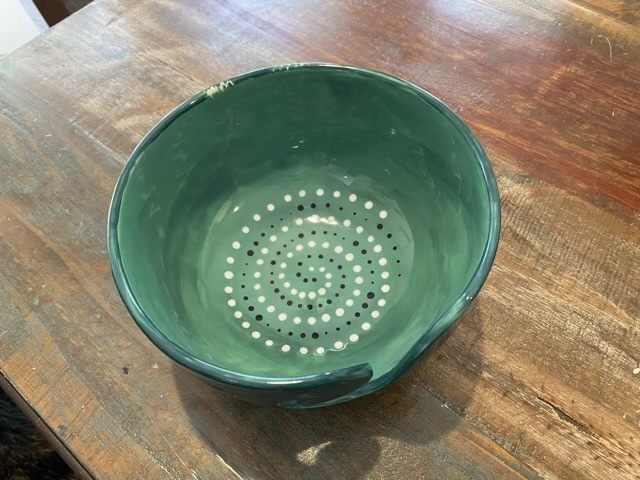
I have been wanting a yarn bowl, so when we went for another round of ceramic painting and there was an unpainted yarn bowl, I took the leap.
Photo description: green ceramic yarn bowl with holes for yarn or a hook carved in the side for yarnPhoto description: inside of the yarn bowl painted with a spiral of white and black dots
Yarn bowls are a solution to round wrapped balls of yarn. They keep the ball from rolling all over the floor. They work with other yarn preparations too.
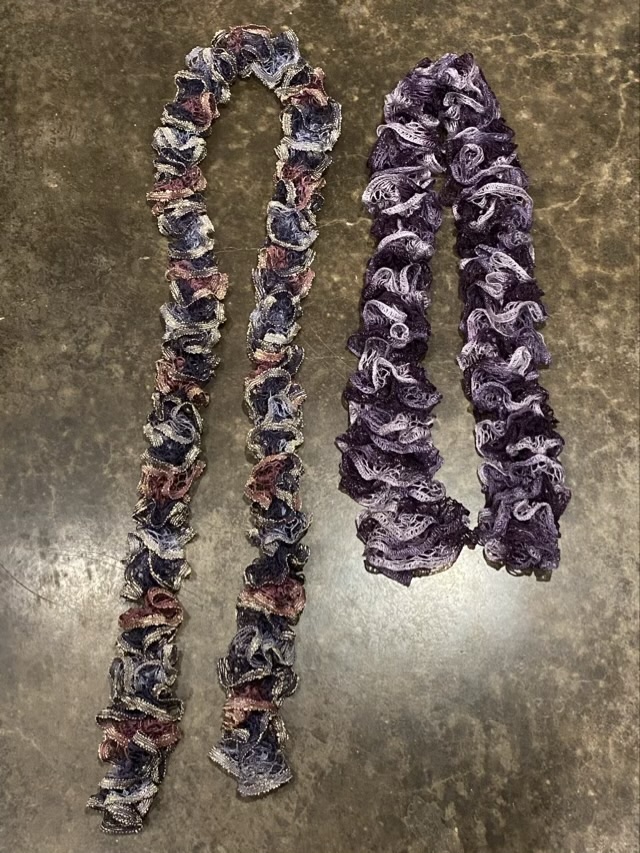
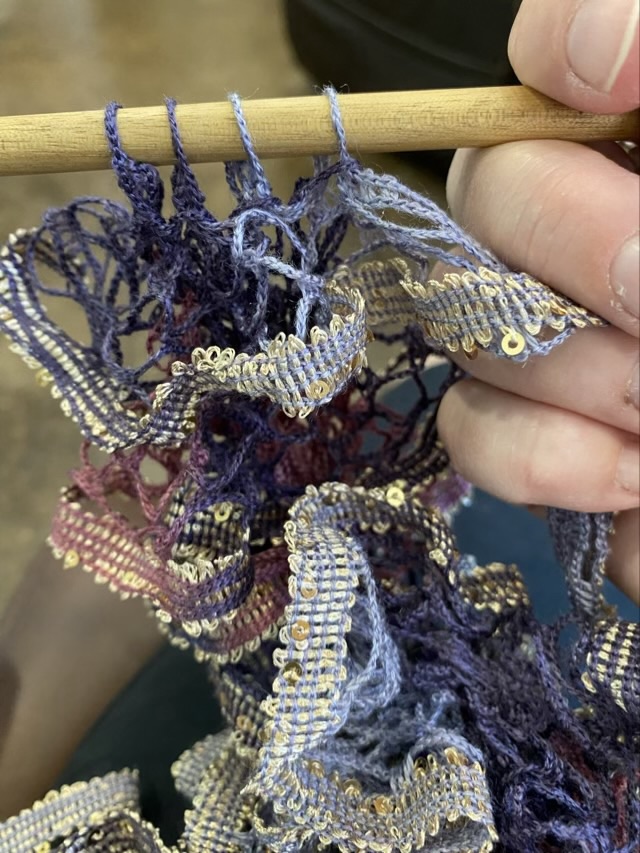
One more comment on ruffle scarves knitted from machine lace “yarn”. Here are two scarves, one using six stitches (purple) and one using 4 stitches (faded glory).
Photo description: two ruffle scarves, “Faded glory” red, white, and cream on the left is longer, the purple scarf on the right is shorter and thicker
Really it is a matter of personal taste when choosing how many stitches to use.
Photo description: in progress work with four stitches on the needle, picked up from the edge of the machine lace
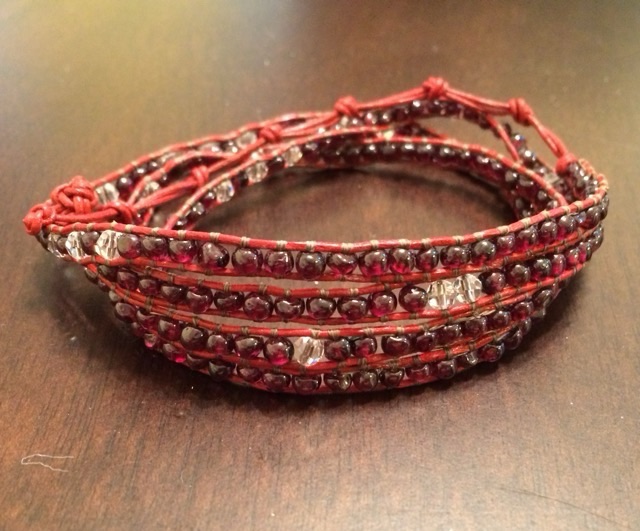
This is a wrap bracelet that I made for my sister in April of 2015. It is made from red leather cord, 4mm garnet and quartz beads, and beading thread. The remarkable thing about it is that it was sitting next to my chair next to the fireplace when the house caught on fire in March of 2015. I had been working on it and it was in a project bag. I needed to give everything a rinse to get rid of the ash, but I was able to complete the bracelet.
Photo description: red wrap bracelet with four wraps of natural garnet and quartz beads sewn between two leather cords
I really missed an opportunity to do a morse code message in the beading.
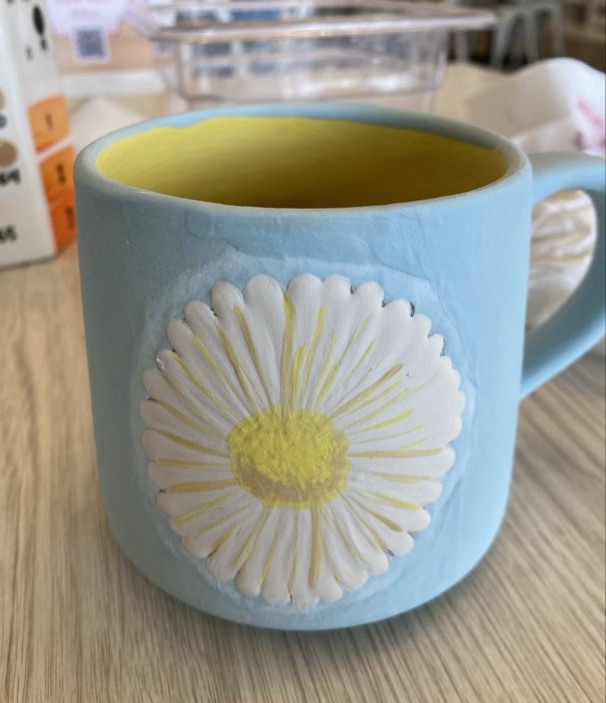
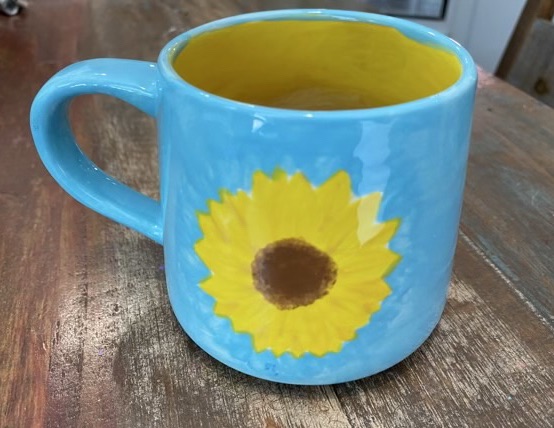
We’ve done another round of ceramic painting. This time I tried for flowers, daisy on one side and a sunflower on the other for my mother-in-law.
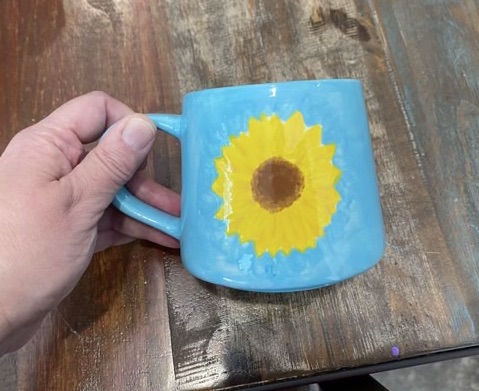
Photo description: ceramic mug painted with a white daisy on a blue background, before firingPhoto description: other side of the same ceramic mug painted with a yellow sunflower on a blue background, before firingPhoto description: sunflower side after firing, same camera angle
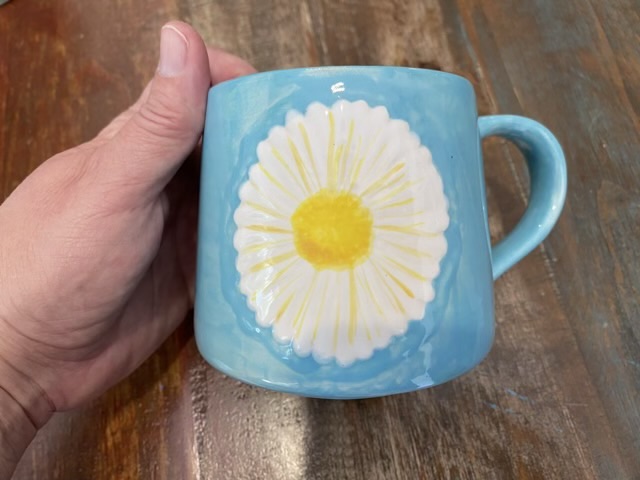
It was interesting how the flowers changed after firing, and something to consider when painting again with glaze.
The other interesting thing is the apparent shape of the mug. In the pictures above it looks like a standard straight sided coffee mug, but it isn’t.
Photo description: same mug, but photographed from the side showing the sloping angles of the sides betterPhoto description: daisy side of the mug, after firing, photographed straight on
My favorite part is the ombre interior. It really amuses me to have the inside painted like a patina of coffee has already built up.
Photo description: inside of the mug showing yellow to brown glaze gradient