I’m experimenting with crocheted flowers for my wreath. To make a mum-like flower I used four colors of acrylic yarn and made four layers of petals, each with the same type of “petal” but with different diameter centers and thus different numbers of petals.
Photo description: first three layers for the crocheted mum in shades of yellow and orange showing the difference in center size and petal countPhoto description: center layer in white acrylic yarn with no center and just three petalsPhoto description: the assembled crocheted mum with four layers of color from white to yellow to orange
To make the layers, half double crochet into a magic circle eight times, slip stitch to join.
Photo description: eight half double crochets into a magic circle, with the circle pulled tight and slip stitched into the first half double crochet
To make the petals, chain 9.
Photo description: yellow petal layer with the start of a petal with nine chain stitches
Skip the first chain and single crochet eight along the rest of the chain.
Photo description: single crochets along the chain to give the petal width
Slip stitch into the next double crochet on the round. Then make the next petal.
Photo description: four petals completed on the yellow round
For the other layers, add a round of half double crochet increases to the center before adding the petals.
I finished nålbinding handles onto my loop-and-twist linen string bag.
Photo description: loop-and-twist bag made from twined flax and finished with nålbound handles
I thought I followed the pull strings that I installed originally, which split the top loops evenly. Hm. No. Not sure what happened, but the second handle had many more loops than the first.
Photo description: side view of the same bag showing the uneven split
The handles didn’t really work out like what was in my head either. The two handles work better as one handle, with access to contents from the sides. I actually think this would be lovely to hold my onions and garlic in the pantry. So while it didn’t fit my original vision, it still will have a use.
Note to my future self: a loose row of nålbinding as a top band, then two arced handles on the sides might work, like a tote bag.
When spinning with my literal stick and my newly purchased Romney wool, I wanted to know how it would look plied, because this is the lowest twist I’ve ever put in making a yarn. This was a good opportunity to experiment with plying bracelets. A plying bracelet is made by wrapping the yarn around your hand (or other object) in a certain pattern so that when it is slipped onto the wrist, it is easy to ply from both ends without tangles. It is pretty magical, really, and worth exploring. There are several different ways to wrap a plying bracelet, here is the one I used.
Photo description: two plied yarn wrapped around my hand to form a plying bracelet Photo description: plying from both ends of a plying bracelet to make a two ply yarn
The photos are a little out of order, I forgot to take a picture of the plying bracelet to make the two ply yarn, but then took that yarn and made another plying bracelet to make a four-ply cabled yarn.
This is an interesting technique and a nice little rabbit hole to explore.
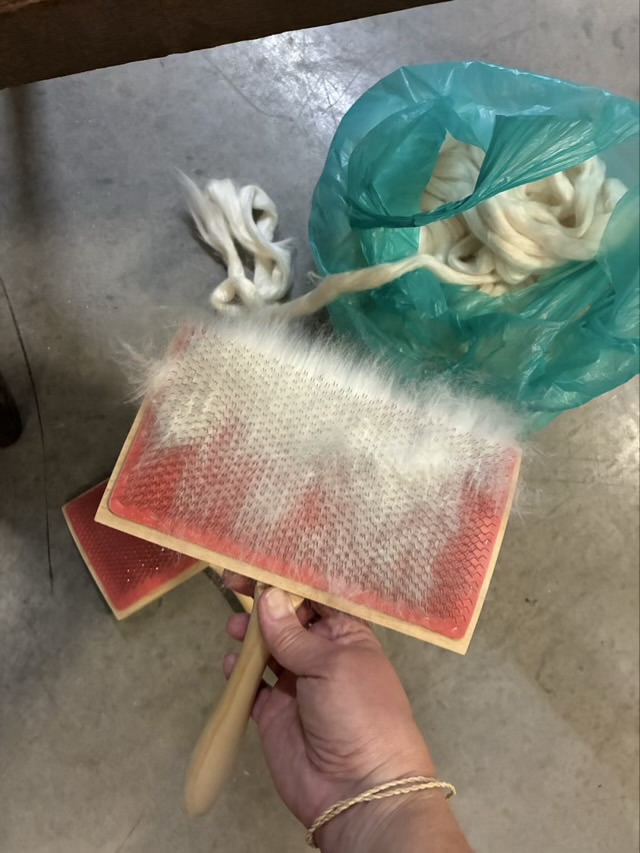
When I forgot to bring my spindle on my trip, I also left behind my fiber, which gave me an excuse to visit a local weaving shop and get more fiber. I was pleasantly surprised that the Woven Art Yarn Shop in East Lansing had some natural colored roving options, and picked a bag of Romney combed top from Dorie the sheep, who is apparently “an independent soul”, according to the label.
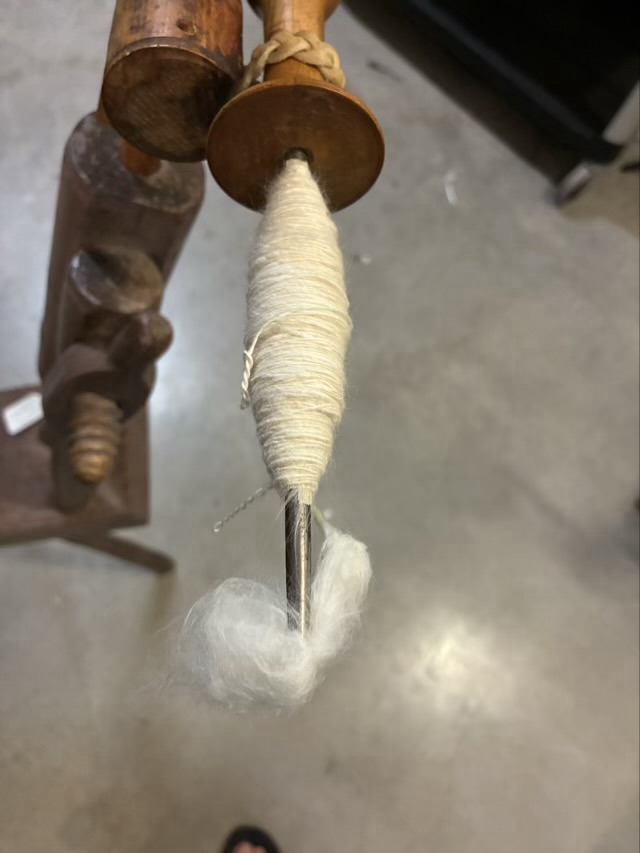
Photo description: Bag of Romney combed top fiber from Cross Wind Farms with a single spun on a stick with the bark still on and a cup hook screwed to the top
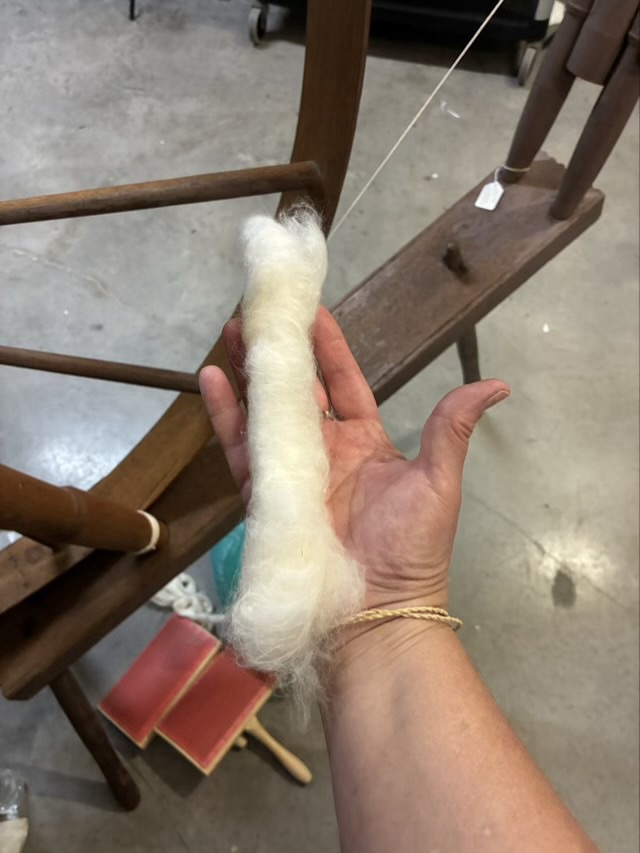
I love Romney wool, it spins up easily and is soft. Since I spun with a finger twirled stick, I made a thicker single because it needs less twist to hold together.
In February 2025 I made a turned wood pen holder for my Dad. A month later my first child was born. What is the correlation? When I saw the pen holder at my folk’s house I didn’t remember it. At all.
Photo description: cylindrical wood pen holder with turned bead accents at the top and bottom, filled with several mechanical pencilsPhoto description: bottom of the holder with a glued on non-slip ring (maybe leather?), and hand written “CJH 2005 #1”
I used the information on the bottom to find the original picture, that is how I figured out that it was a month before my first child was born.
Photo description: original picture of the turned wood pen holder taken on a kitchen countertop
There are small indents on the bottom of the cylinder which are likely marks left by the lathe. The two beads carved at the bottom and one at the top also would have been done on a lathe, because the precision is very difficult to achieve without a lathe. The wood grain looks like white oak, which is a common hardwood and one that I had access to at the time. I can’t remember how I hollowed it out, but since the piece is marked #1 and there are no others in the following month, I imagine it was difficult. I know it is difficult to hollow out a form even with a lathe. Getting the wood secured and balanced is tricky, and the angles are awkward for a beginner, which is what I was in 2005. The finish is likely to be a store bought urethane, because that is also what I was using at the time. I didn’t discover tung oil until later.
I do think it is interesting what my brain retains and what it jettisons. This is why I take pictures and mark my work.