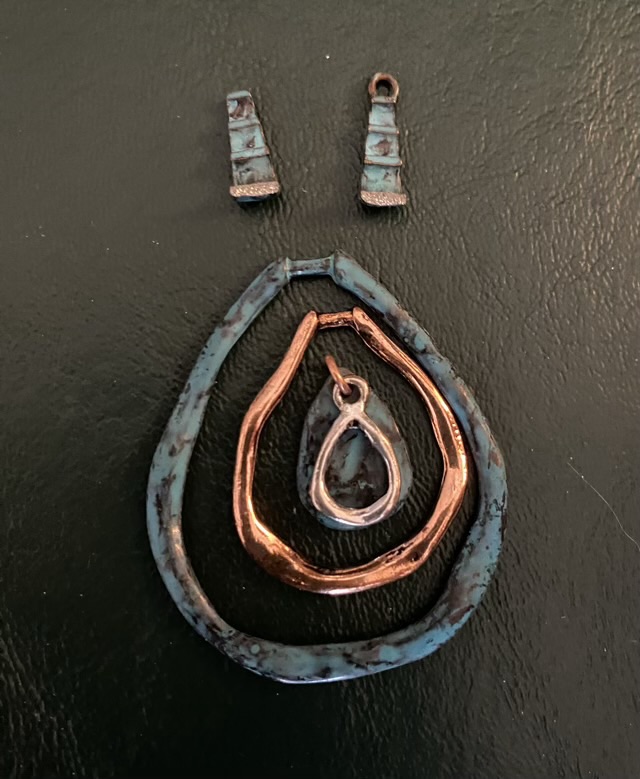
Here is another requested repair from my mother-in-law. This is a pretty nested tear drop design made from several colored loops. Here, the component holding all the loops broke in half.
Photo description: four layer teardrop pendant with broken connecting link (upside down)
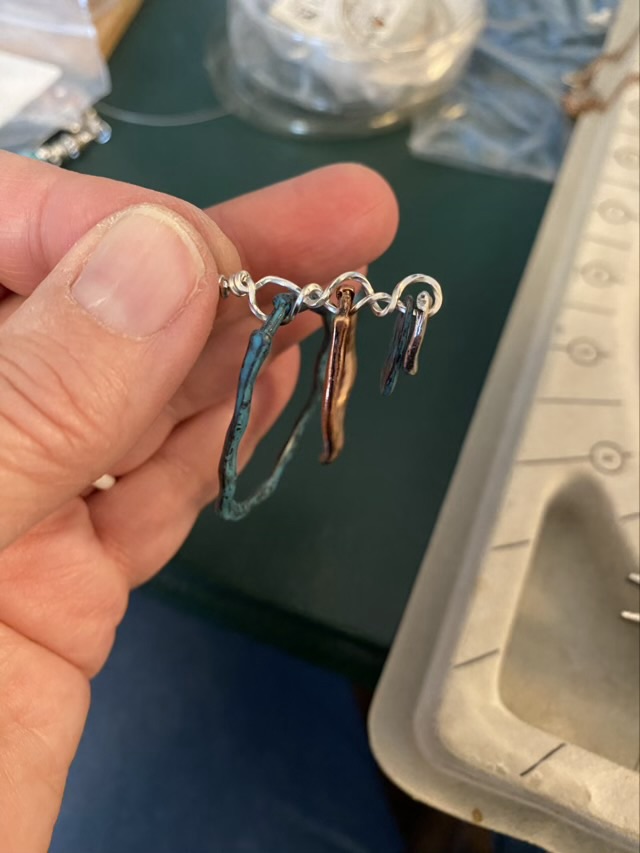
Rather than glue the link back together, which surely would have broken again, I crafted a new linkage from twisted square sterling silver wire. I liked the rustic look of the twisted wire, and how it coordinated with the existing loops.
Photo description: looped twisted square sterling silver wire holding the tear drop loops
I did accidentally break the silver colored tear drop, but a little sanding removed the burr and I was able to still use it in the repaired pendant.
Photo description: repaired pendant as it would hang on the chain
Did I remember to take a photo of the pendant on the chain? Sigh, no.
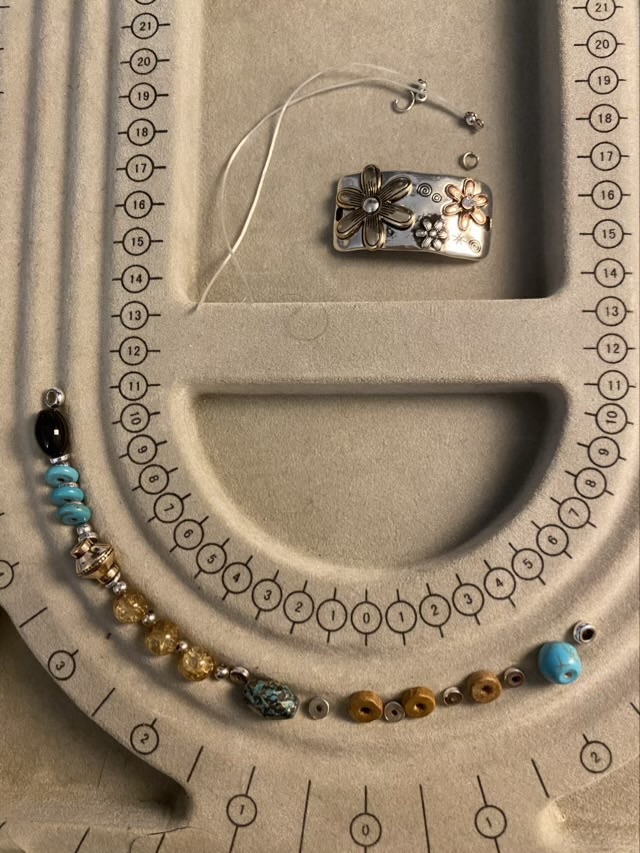
My mother-in-law asked me to take a look at a broken bracelet. It is a lovely piece with metal beads and a metal focal, that was strung with elastic. The elastic had been knotted and fitted with knot covers that then connected to jump rings, and those knot covers were where the elastic failed. Knot covers are risky jewelry components. They work well for silk strung lightweight beads with a large solid knot that will hold inside the knot cover. Elastic is hard to knot securely, especially at the end. Metal beads are also hard on both elastic and silk, and tend to fray the stringing material faster than smooth beads.
Photo description: broken bracelet laid out on a bead board with remaining components
Rather than risk another elastic mishap, I switched the bracelet to a clasp style. The focal actually works well to receive a lobster style clasp. I used 49 strand beading wire with double crimp beads for durability and added some coordinating metal beads to make enough length that the bracelet is loose when clasped.
Photo description: repaired bracelet on a bead boardPhoto description: bracelet shown clasped
I can’t guarantee the bracelet won’t break again. It is one of the reasons I don’t make and sell jewelry anymore: even well made jewelry wears out and is prone to breakage. I don’t mind this kind of fixing, though.
The other reasons I don’t make jewelry: over a third of booths at every craft show I’ve been to sell jewelry, and I don’t wear necklaces and rarely bracelets so I’m not even advertising my own work.
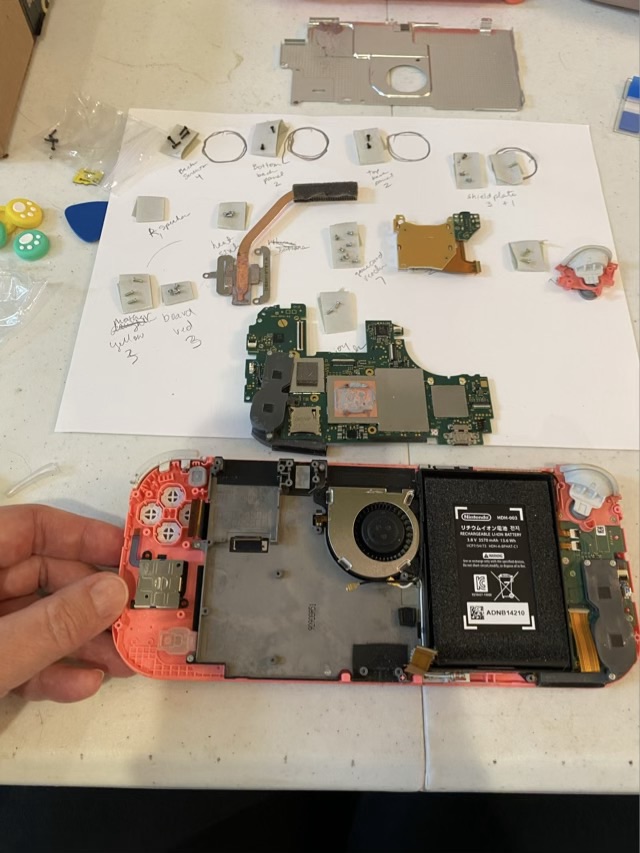
My youngest’s Nintendo Switch lite broke. The left joystick actually flopped around, not just drifted. She received a new to her full size Switch for her birthday, so the old one was a wash. Since it didn’t hurt anything to try, I bought an under $20 joystick repair kit and found directions. The directions had 28 steps just to get the joystick out, then the same 28 steps were retraced to put it back together. The kit came with two joysticks, which looked identical, except for part numbers on the back. There was no indication anywhere which was left, and which was right. I picked one. The disassembly didn’t go too bad for the left joystick, although I did break the left speaker connection because I didn’t realize that the plug was a teeny tiny white part in a slightly larger tiny white socket.
Feeling brave, and while the device was open anyway, I decided to replace the right joystick as well, after all, I had the part. Oh dear. The right joystick is a whole different set of steps, and involves removing a motherboard. I didn’t break the right speaker, and I had to replace the motherboard three times before all the cables were in the right spots, I thought. I missed the fan cable, and when I tried to retrieve it through the motherboard, it tore. Nuts.
Photo description: motherboard removed from a Nintendo Switch lite, all the removed parts placed on a sheet of cardstock and labeledPhoto description: broken end of a fan cable
Things I learned in this process: don’t force it (honestly I really should have known this, this is not my first rodeo). The engineering and durability of these devices is amazing. If I hadn’t been ham-handed, this is a doable repair. Inverted washi tape rings make great holders for tiny screws. Label everything. I saw my eldest set up for a deconstruction this way with wells embossed into card stock and it is brilliant.
The number one thing I was forcefully reminded of in this project: stop when you’re ahead.
The pieces and parts are now marked for a trip to tech recycling.
The brass manifold I use to route water to the coop and raised bed garden started to leak. I went to unscrew a hose from the manifold and part of the manifold broke loose, lodged inside the hose. It is not the first time this has happened. The hose on the top of the manifold was also corroded and frozen in tight.
Photo description: garden hose with the end ruined by a broken off manifold junction.
This time I ordered new hose ends, solid brass with a metal band clamp. I cut off the offending ends of hose with kitchen shears so I could replace the connectors.
Photo description: heavy duty garden hose cut off above the manifold, since it wouldn’t unscrew.
Pressing the connector against the fence post helped me wedge it into the cutoff hose. The female end was a little tricky with the loose ring, but attaching the male end made it stable enough to use the same technique. It really helps if you remember to put the band clamp on before attaching the new connector. Spoken from experience. I also used silicone tape in the threads this time.
Photo description: new brass manifold with repaired hose connectors.
The whole procedure was relatively painless and quick. It was definitely better than replacing the whole hose. I even replaced both ends on the hose in the chicken coop, that never did connect well.
Photo description: new hose connectors on the hose in the coop.