Fast food basket

We picked up a fast food dinner and were given a plethora of paper napkins. I had a stash of straws. Could I make a basket? (Because that is the logical thought process with excess disposable paper products, right?)

Photo description: unbleached paper napkins and paper wrapped straws

I unwrapped and split the straws by running a scissors down the length to obtain four plastic strips from each straw. I wove a square base (6×6 straw pieces). I tore the napkins into 1/2” strips and twined them around the straw “staves”.

Photo description: slivers of red plastic straws woven together and secured with paper napkin twine

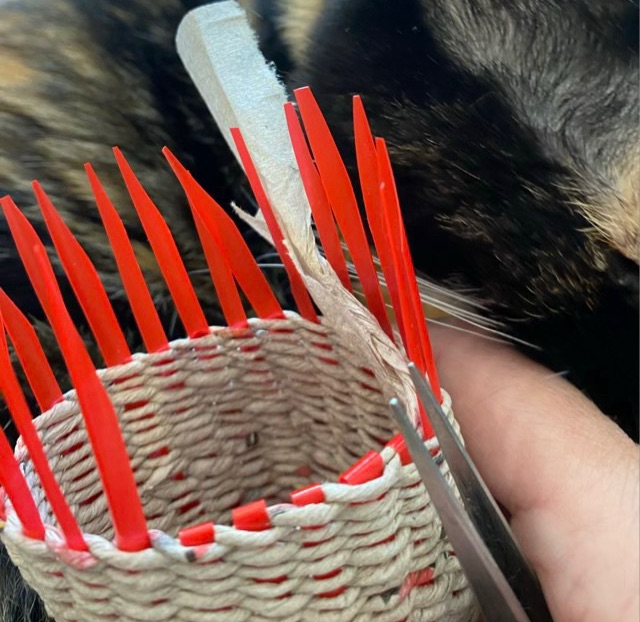
It took some time to twine up the sides of the basket. The joining method I liked best was to overlap the end of a napkin strip with a new strip, fold the sides to the middle, then secure with a good clockwise twist. The two clockwise twisted strands were then wrapped counterclockwise around each straw, which isn’t as complicated as it sounds. To finish the basket, I trimmed the end of the straws to a blunt point, and used tweezers to thread them back down through the weaving.

Photo description: in process threading of the straw staves back into the twined weave, calico cat as a background

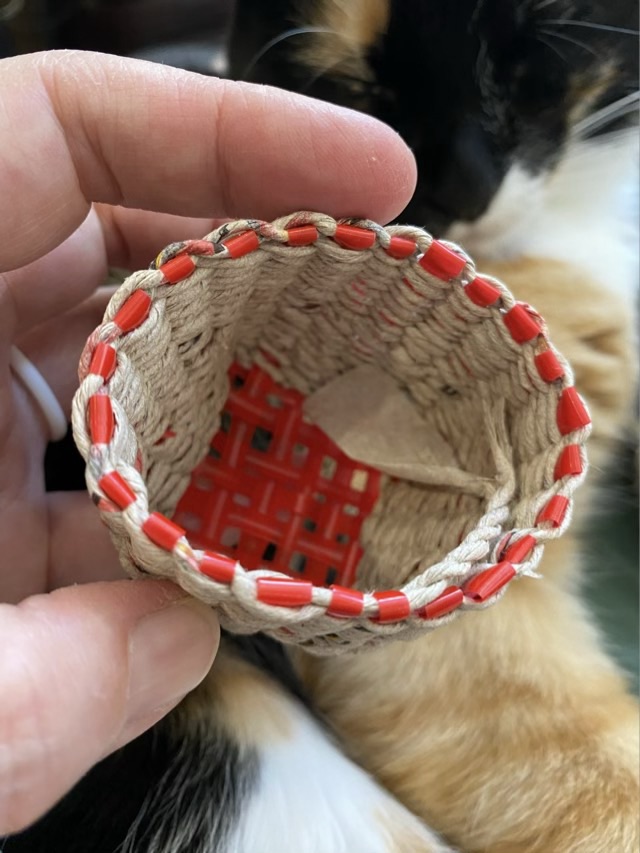
I was quite surprised that the little basket is fairly sturdy. It certainly won’t hold up to water or washing, but it is a cute little basket. I left the end of the napkin twine inside the basket to remember its humble origins.

Photo description: finished basket, top view, happy calico cat as the background
Photo description: finished napkin and straw basket, side view, sitting on a calico cat

Materials are everywhere.

Bag bow

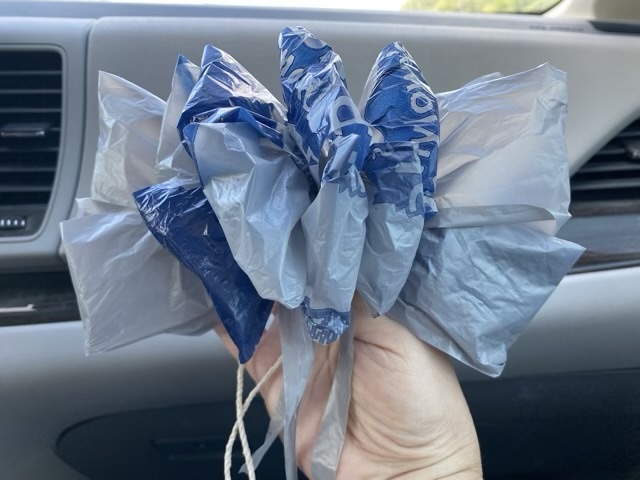
When you don’t have a bow for a present, but do have the plastic bag from the store and some fast food napkins, you can make a bow.

Photo description: bow made on the go from a Lowe’s bag and twine made from paper napkins
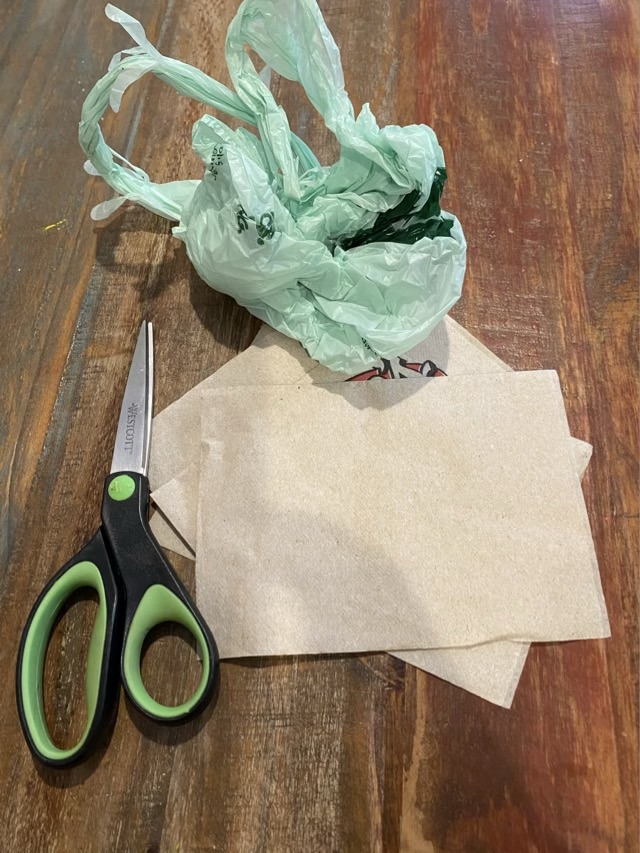
Photo description: green plastic bag, unbleached fast food napkins, scissors

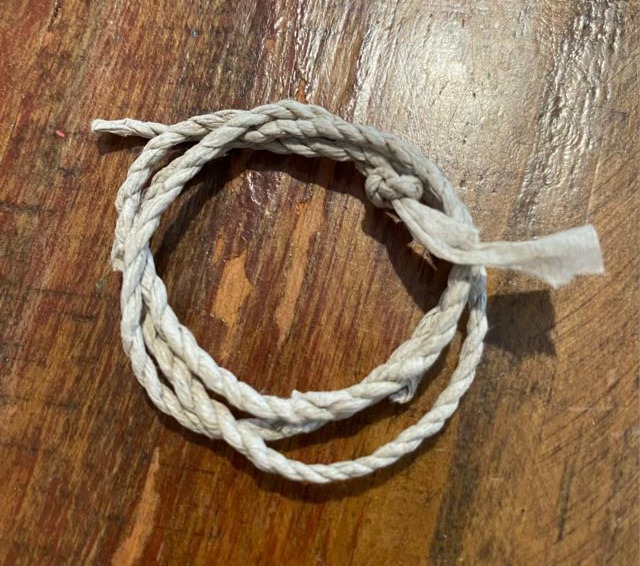
I usually have some napkin twine in my car as an emergency craft project. I prefer the unbleached napkins because the resulting twine is more aesthetically pleasing, not strong, but artful. I tear about 1/2” strips from the napkin, fold it in two, twist the single strand away from me, and twist the two strands together toward me.

Photo description: half inch strip torn from a paper napkin
Photo description: adding in a new strip of paper at the middle, between the existing strands
Photo description: a small section of paper napkin twine, knotted at the end

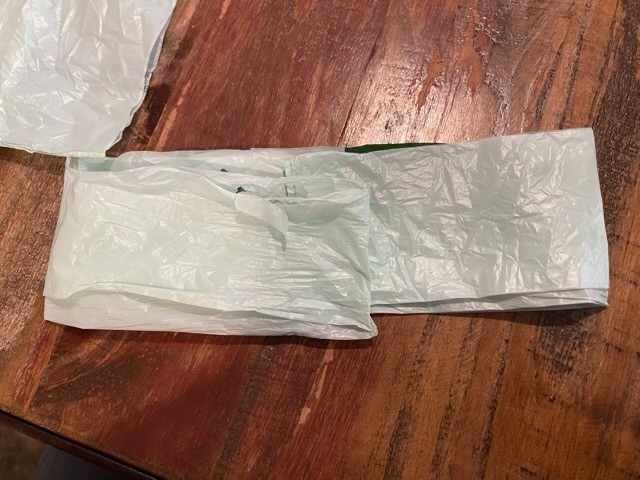
To make the bow, I smoothed out a plastic shopping bag, the kind with handles, and cut it into four equal width sections, two long, two short.

Photo description: plastic bag cut vertically into four sections

I start with the long sections and fold the ends to the middle with about a half inch overlap.

Photo description: plastic bag section folded with the ends to the middle and overlapping

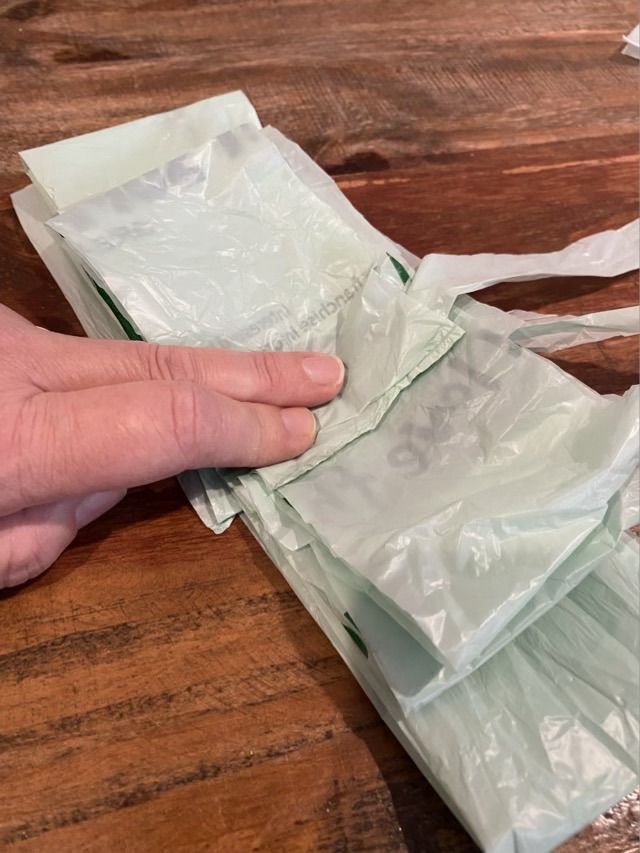
I repeat the fold for all four bag sections, then stack the four pieces with the longest on the bottom. Often, cutting the bag results in mis-cuts, sections of bag that don’t go from end to end. I pull these out as added decorative elements.

Photo description: all four sections of plastic bag folded and stacked, with some off cuts pulled out as “ribbons”

Using my paper napkin twine, I scrunch together the center of the plastic bag stack and tie the twine around using a square knot on the long side (back of the bow).

Photo description: plastic bag sections tied together with paper twine

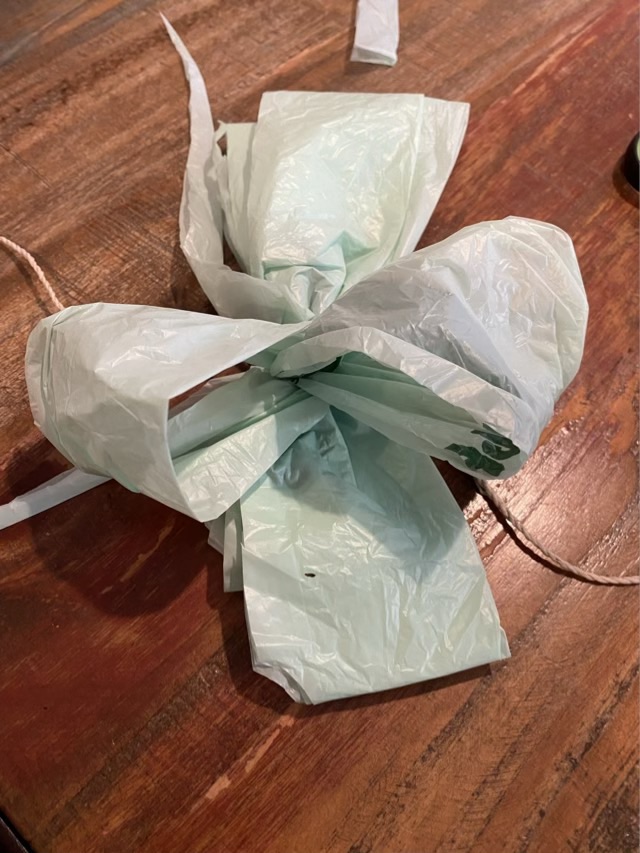
Then comes the fiddly bits (for me). Each loop of plastic from the stack gets opened up and pulled away from its partner(s). This fluffs the bow and gives it volume. I work from the back forward, and one side at a time.

Photo description: back two loops of bag separated, pulled gently 90 degrees apart, and rounded
Photo description: finished emergency bow made from a shopping sack and paper napkin twine

Fiber page: Shetland lace

The Baize Shetland wool was the first Livestock Conservancy Shave ‘Em to Save ‘Em fiber I purchased. I bought a 13 oz batt, and have been spinning it at demonstrations and fair booths. I’ve been quite remiss in actually making a fiber page! That is now rectified, and this wonderful fiber has a page in my sampler book.

Photo description: Post card from the breeder (top left), single spun and two ply yarn (top right), unspun wool as purchased scoured and carded (middle left), crochet round (middle right), two Shetland lace knit samples (bottom left), nålbinding (bottom middle), and a woven swatch with combed fringe.
Photo description: same page, but with the samples folded up to show the descriptions

Shetland wool is a joy to spin, and is definitely on my “will purchase again” list.

Mossarium: Adding birds

I love my little mossarium, and keep looking for tiny things to add: little plants from the yard, lichen, birds. Birds! I cut out flying bird silhouettes on my Cricut from black cardstock, and hung them from monofilament attached to a wire mobile.

Photo description: more card stock black bird cutouts than I needed in four sizes on a green Cricut mat

I used 22 gauge black coated copper wire to hang a fishing swivel on the inside of the terrarium.

Photo description: small fishing swivel connected to black wire with a closed loop

I made a circle of wire with a cross bar and loop, and hung it from a banana stand so I could balance it as I added the birds, which had monofilament strung through the body area. I only needed seven of the smallest birds I cut, the rest will be saved for other projects. I used super glue to tack the line onto the wire because I didn’t want the line to slide along the wire, and I didn’t want to add weight by making wire loops.

Photo description: tiny bird mobile hanging from a banana stand, terrarium lid in the background
Photo description: mobile in place in the terrarium lid, showing the wire circle hanging from the fishing swivel attached to the peak of the lid and the birds hanging down
Photo description: terrarium lid in place over the moss covered mini landscape

Here is a 5 second video of the birds “flying”. I put the terrarium on a small lazy susan, so when I turn it, the birds turn at a different rate, and will continue to spin briefly when the turntable stops. The swivel doesn’t spin as freely as I would like, but this is a happy start.

Happy Mother’s Day

Happy Mother’s Day to all those that mother! I did some experimentation with Copic markers and stencils for Mother’s Day cards this year. Fun things, Copic markers. Expensive, but for good reason.

Photo description: two cards with “Happy Mother’s Day” written in blended inks from red to green, Copic markers in the foreground, Cricut cut stencil in the background