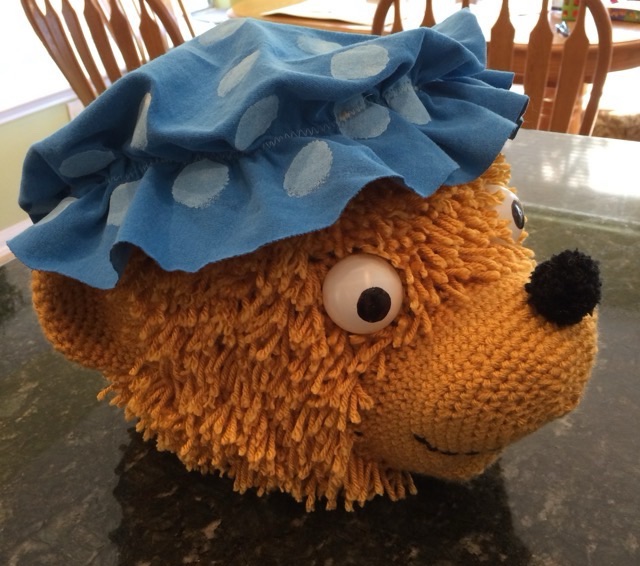
Going back to a pumpkin contest in 2016, here is my hand crafted pumpkin cover of Mama Bear of the Berenstain bears.
Photo description: crocheted bear head with latch hooked “fur”, half ping pong ball eyes, black pom pom nose, and blue mop hat sewn from an old t-shirt hand painted with polka dots
It probably really isn’t in the spirit of pumpkin carving, but at the time we lived in such a humid environment that pumpkins started rotting on day 1. The library would host an uncarved pumpkin contest (paint and glued decorations only) to avoid the rot. I rather like the crocheted cover, it is reusable.
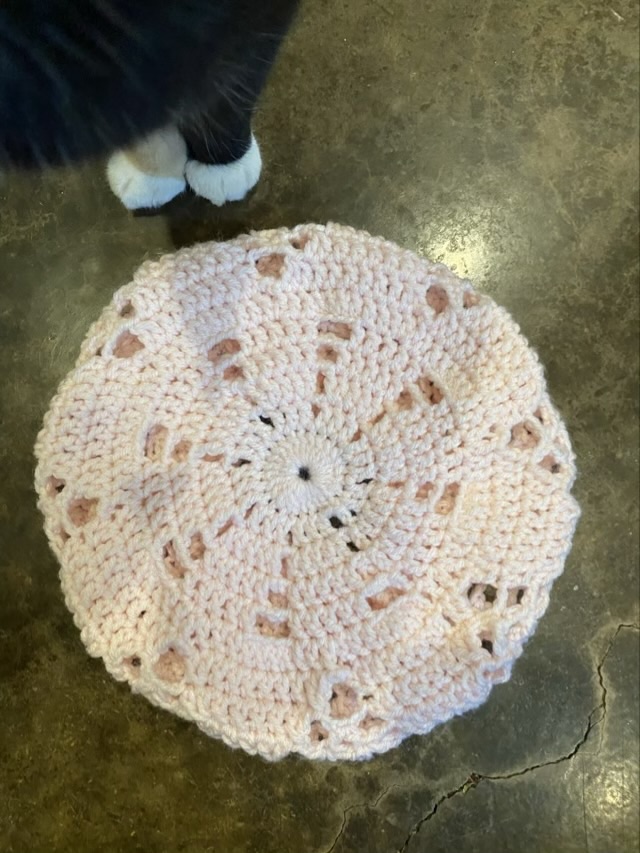
So doilies are round and flat, and berets start out round and flat, so if I find a pretty doily pattern that might work for a beret, right? Um, depends. I found a pattern with a flower center that was quite attractive as a doily. When translated to larger yarn, I had the necessary width before the center flower was done, resulting in a beret with symmetrical holes, rather than a lovely lace.
Photo description: light pink beret top with deliberate holes, sort of in a star pattern, cat feets for the photo bombPhoto description: brim side of the beret with single crochet ribbing
Back to the drawing board. I’m starting to see the end of the bag of gifted acrylic yarn though!
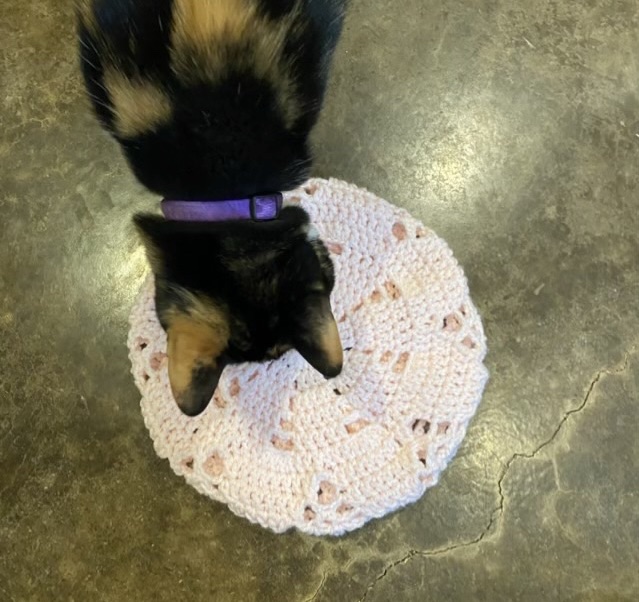
Photo description: cat photo bomb of the light pink beret, she went to sniff the hat when I put it down. Must have been close to feeding time.
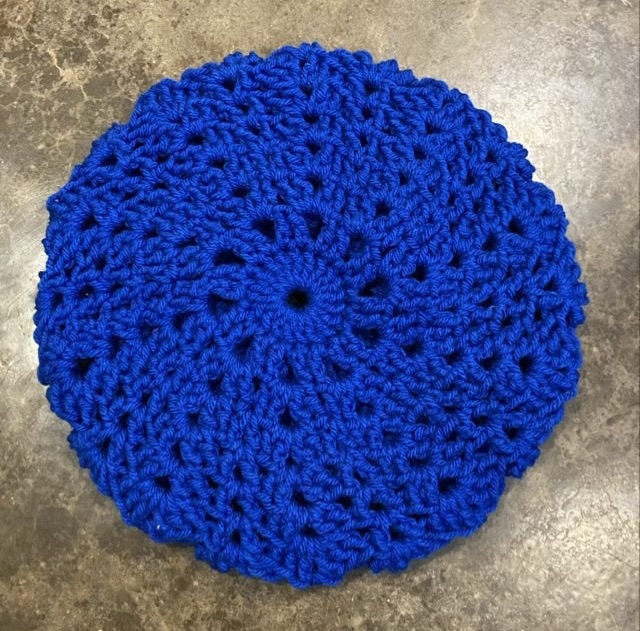
I’ve intentionally made a beret this time, rather than another beanie mishap. The idea was a lace beret with a solid band, like a head band with a lace topper. It is Texas and it just doesn’t stay cold for long, so this would be something to stylishly keep the ears warm. I started with my favorite crocheted lace coaster pattern, then instead of finishing it off with shell stitches, increased it using a mix of V stitches.
Photo description: top of the blue beret showing the radial lace pattern
I finished the beret with a single crochet ribbed band.
Photo description: underside of the same beret showing the open lace against the solid ribbed band
This was a try-as-you-fly kind of project, so I’ll work on a written pattern with another go. I really am pleased with how it came out.
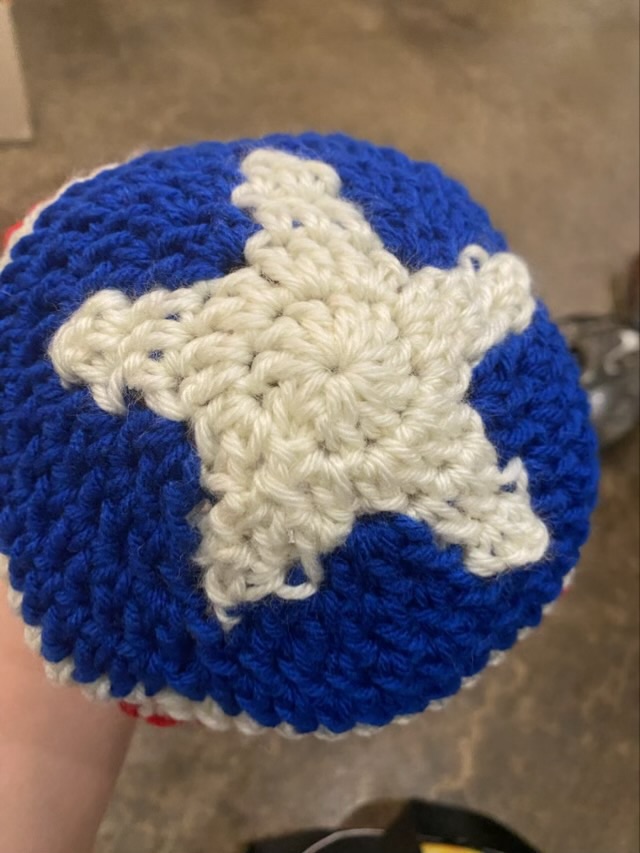
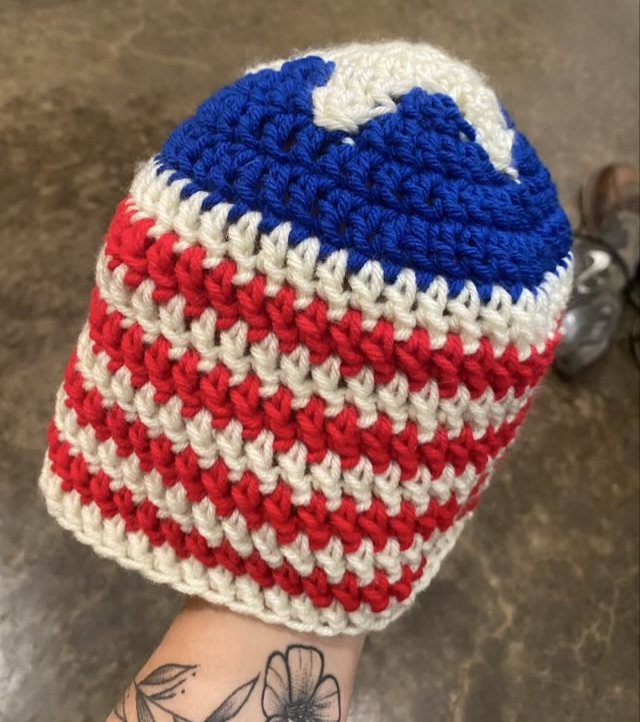
I’ve made a star topped beanie that I’m pleased with. The star has some aesthetically pleasing sparks, and it definitely reads as a star.
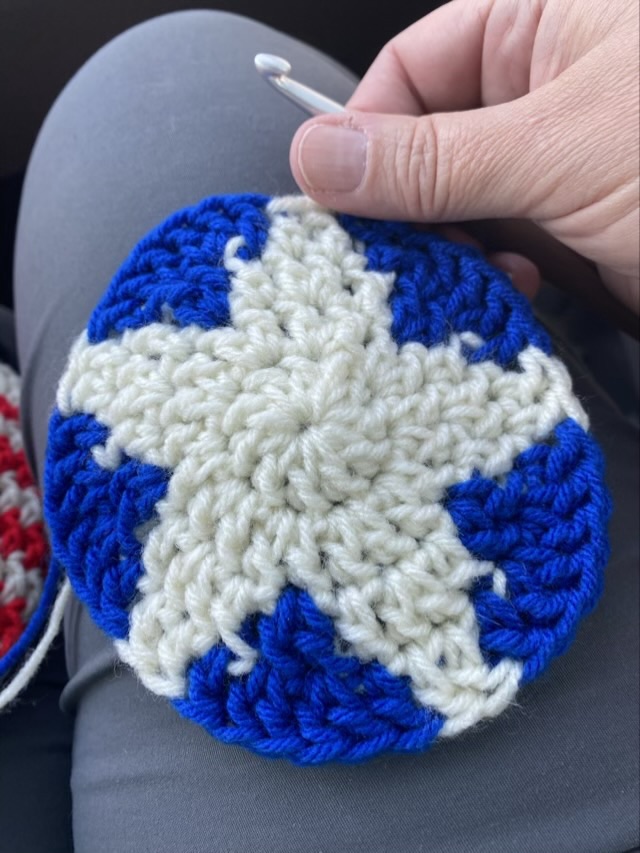
Photo description: rows 1-3 of the crocheted star
American notation
Row 1: 10 double crochet (dc) in a magic circle, slip stitch (sl st) to first dc (count is important for these rounds)
Row 2: Chainless Double Crochet Start (CDCS, Moogly has the tutorial where I learned this stitch) Increase (inc: two dc) in each previous dc. 20 stitches.
Row 3: CDCS in white, inc in next sc, 1 dc add in blue on last move of the dc, *inc in blue add in white on last move of dc, 1 dc, inc, 1 dc add blue, * repeat from *, inc in blue, join to CDCS with blue. Carry off color around by stitching in.
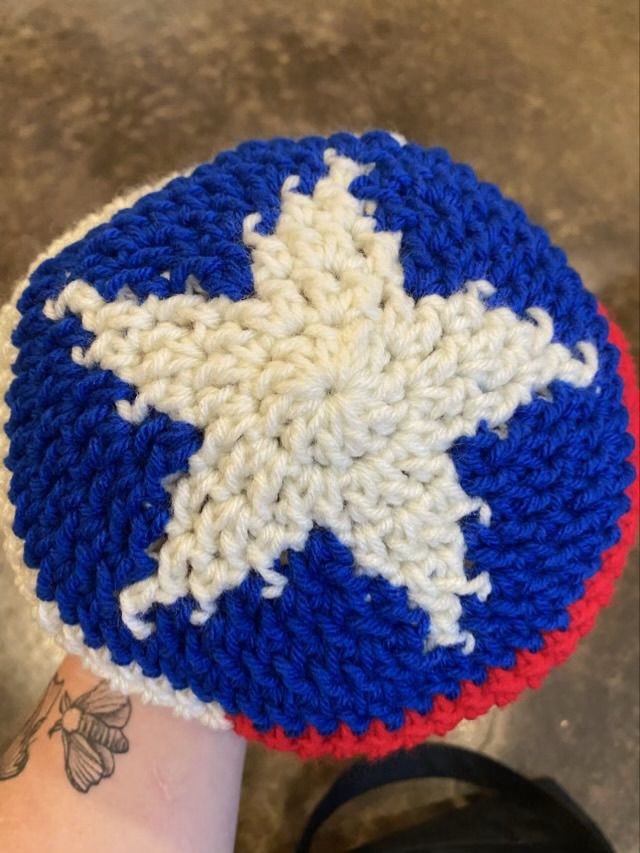
Photo description: rows 1-4 of the crocheted white and blue star
Row 4: CDCS in blue add white, *dc in white, dc in white add blue, dc in blue, inc in blue, inc in blue, dc in blue add white* repeat from * sl st in CDCS in white
Row 5: CDCS in white add blue, *dc, inc, 3 dc, inc, dc add white, dc in white add blue*, repeat from * dc, inc, 3 dc, inc, dc, sl st in CDCS in blue.
Row 6: CDCS in blue, dc around, don’t carry the white, but don’t cut it. The diameter of the circle will be the size of the hat, add rows of blue, increasing as necessary.
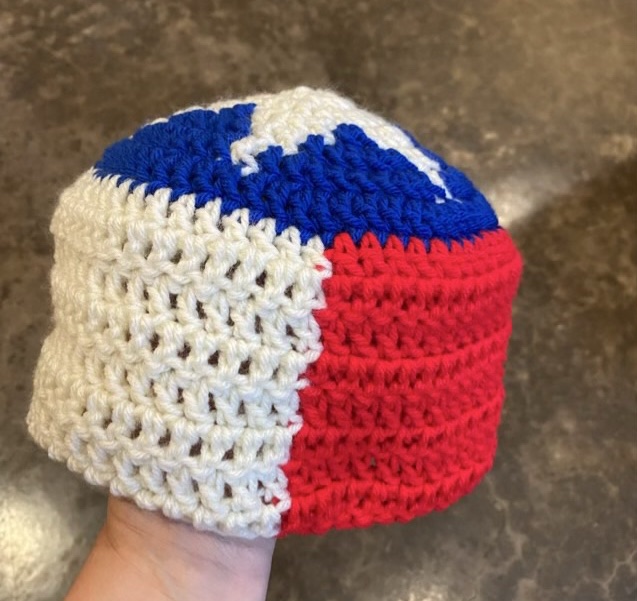
Sides: no increase stitches, work half the stitches in white, switch to red, join the white at the other side, chain 2, turn the work, and do the red back to the white, pick up the white and stitch to the red.
Photo description: top of hat showing sparked star surrounded by bluePhoto description: finished hat showing red and white sides
Looking at the embroidered star I posted about a couple days ago, I wondered if I could crochet the star into the top of a hat.
Photo description: crocheted white star with blue background
I started with ten stitches in a magic circle with white yarn, and did the second row still all in white, increasing each stitch. On the third row I added in the blue for the background and did the increases for the round in blue. I carried the white and blue yarns around, and switched color on the last move of the prior stitch. I finished with a row of blue, then made alternating rows of white and red down the sides. (I actually managed to make a beanie this time, instead of a beret, because I found the white yarn that matched the weight of the red yarn.)
Photo description: alternating rows of white and red crochet for the sides of the hat
I think I can make the star better. The nature of crochet makes it twist a little left, I think I can use that trait to make the points pointier.