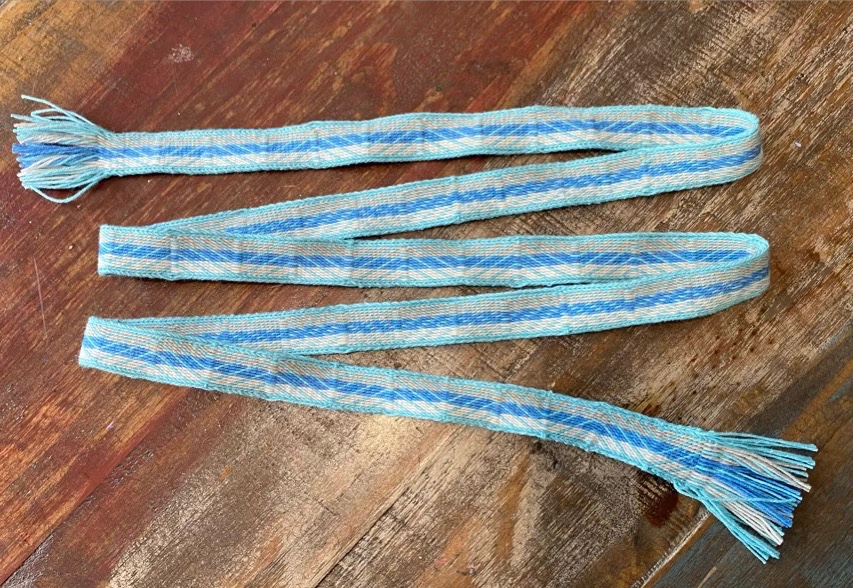
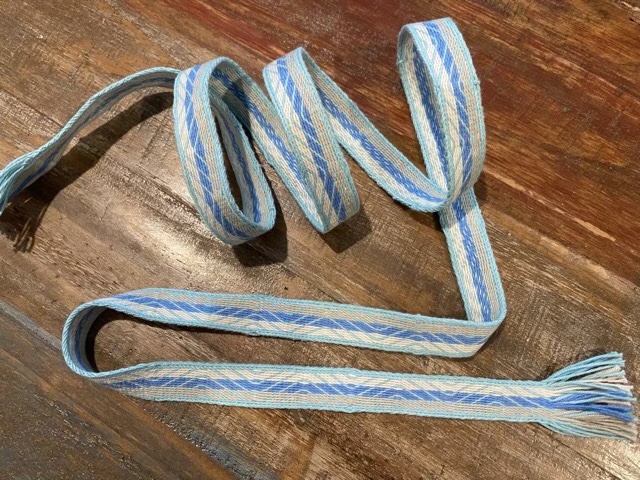
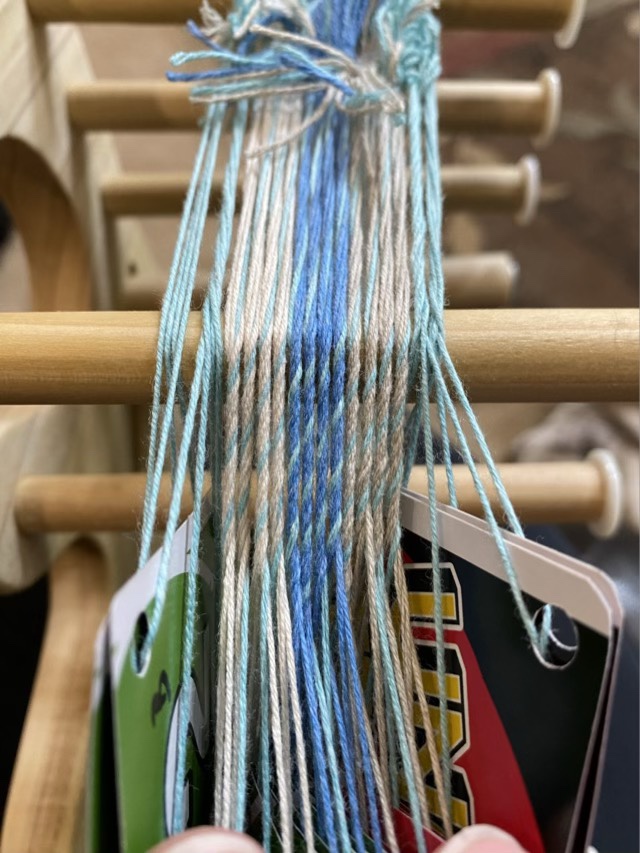
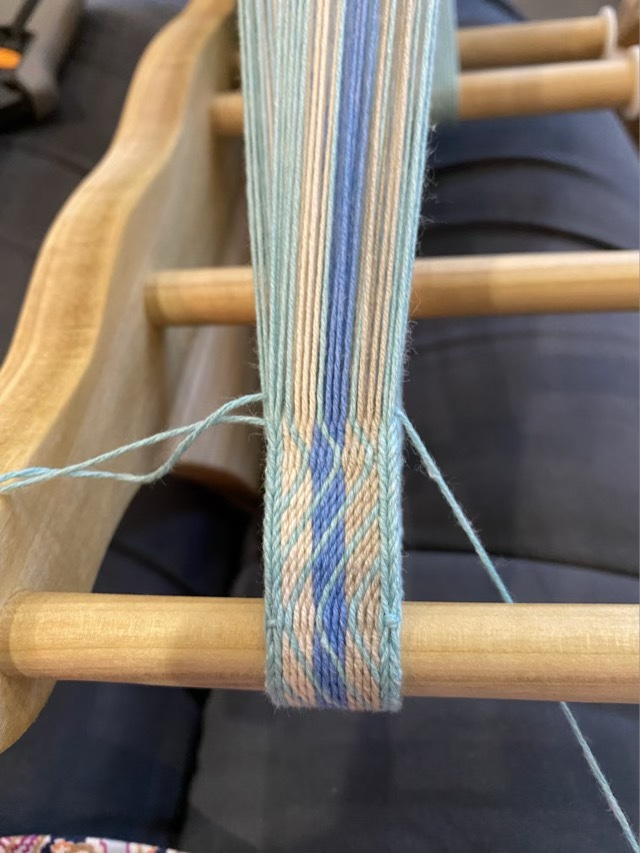
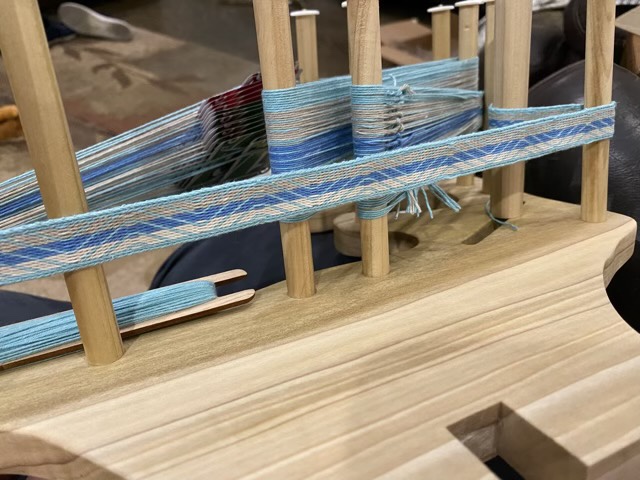
I finished my second tablet woven band, and the first one where I used an inkle loom as a support. The finished weaving is 51” without fringe, and 3/4” wide. It was made with 56 warp threads. I locked in the end by running the weft back through the weaving utilizing loops of thread (I found this advice on several blog sites).
Loops of scrap thread laid in the shed
This second band is an improvement from the first, but still shows a change in skill from the beginning to the end.
Start of weave (left) and end of weave (right)
When I took the band off the loom it had a definite ripple, so I ironed it. I don’t care for the double wide area that happens at the change of direction in the pattern. More study is needed regarding this phenomenon.
Woven band fresh off the loomWoven band after ironing
This is still weaving that I enjoy, so continuing to build my skills will not be a chore!
It cracks me up when I see the chickens dust bathing. They shake, and roll, and lay in odd positions, all to get the dirt down into their feathers and dislodge oils and critters. Even funnier is when two chickens are trying to dust bathe in the same spot. Here’s a video.
Hens dust bathing
Apparently I really do find it funny, here is a video from 2 years ago. It is probably the same two hens warring over dust in the same spot.
Time to start watching the roads for migrating turtles! Really, I always watch out for turtles, but spring and fall are the big moving days. Turtles are creatures of habit and go back and forth between sites cyclically. I have read that moving a turtle outside their known stomping grounds could send the reptile into a lifelong circle of trying to find its way home. I don’t know if it is true, but it is heart wrenching to think about. Herpetologistsrecommend not removing the animal from the area, and if it is in physical danger (road, cars), move it straight across the road in the direction it was headed. Here is some good advice from the US Fish and Wildlife site.
We have a turtle that crosses our property. We have seen it on the trail cam, and on occasion it makes its way under our fence and into the yard. This year the dogs found it first, and after I took them inside and let the turtle have some time to move on, I found that it had cornered itself behind the catio. Hm.
Izzy the cat watching a turtle
Since I wasn’t about to take the turtle through the house, I put it outside the fence near where the dogs found it. My eldest watched it for a time, but the turtle knew it was being watched and didn’t move. We gave it space for about twenty minutes, and when we checked, it was gone. Like, gone, gone, can’t find it anywhere. It is amazing how far they can go when they are on a mission.
By the way, I have “stop for turtles” vinyl decals on my Etsy shop. Yup, I’m that kind of person.
Time to test my inkle loom! I picked a tablet weaving pattern that had an easy 12 turns forward, 12 turns back progression for my test. I warped the loom with a cotton blend yarn in four colors. There are several ways to warp an inkle loom. For this first test, I did four strands at a time (one for each corner of the card), and used a square knot to tie the ends together.
Inkle loom warped for tablet weaving
I started the weave with four slips of card stock, as recommended by several weavers, both to get an even start and to leave room for fringe. I wove the tail back into the first few passes to lock it in.
Starting to weave
One of the big issues when tablet weaving on an inkle loom is the buildup of twist.
Twisted warp threads
Traditional tablet weaving with a backstrap allows the weaver to comb out the twist (which I would still find an irritating process). Modern weavers will make use of swivel hooks and chase the twist out to the swivel, or use a balanced pattern the has the same number of forward twists as backward twists. I also found a card flipping method that allows turning to continue in the same motion, but flips the twist. However, it flips the diagonals on the weave as well. With a solid color border this change in direction is harder to detect, but I can still see it. Hm.
Borders of the tablet weaving showing a change of diagonals (at the wooden post)
Aside from the twist issue, the weaving is going well. The tension post works, the pegs are solid (I have one peg that didn’t come out perfectly straight, but it doesn’t seem to harm the weaving at this width). Now to weave for awhile (but not too long because it goes fast).
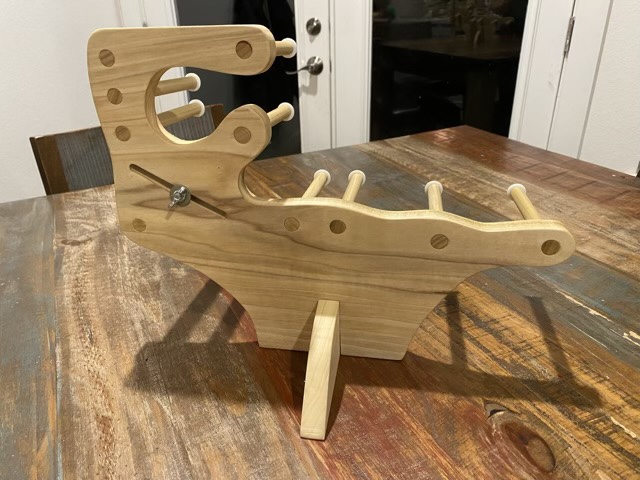
I’ve made the body of the loom, secured the rods, and finished the loom with tung oil, so it is done, right? Well… I saw another loom with knobs turned onto the end of each rod. While I didn’t want to turn each rod on the lathe with this project, I did like the idea of stops on the ends of the dowels.
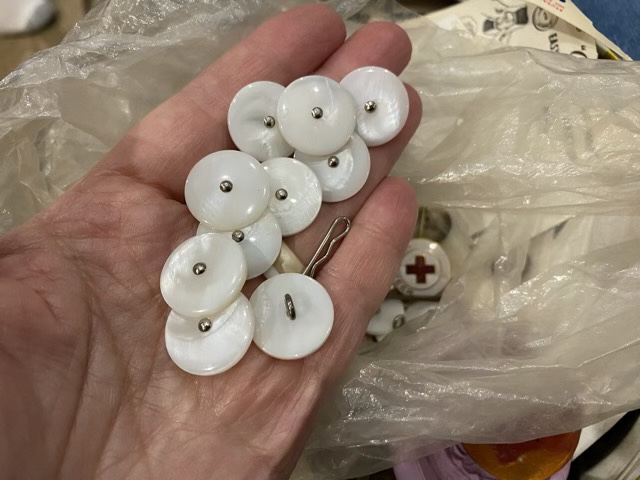
Clip on buttons
In my stash of buttons (hm, apparently I have four containers full of buttons now), I found my grandmother’s old clip on buttons in a bag with her red cross volunteer name badge and pin. These clip on buttons have a single central hole with a pin through and a loop behind. They clip onto garments with a small steel pin. The buttons are made with a pearlescent material that is quite lovely and they are just over a 1/2” in diameter.
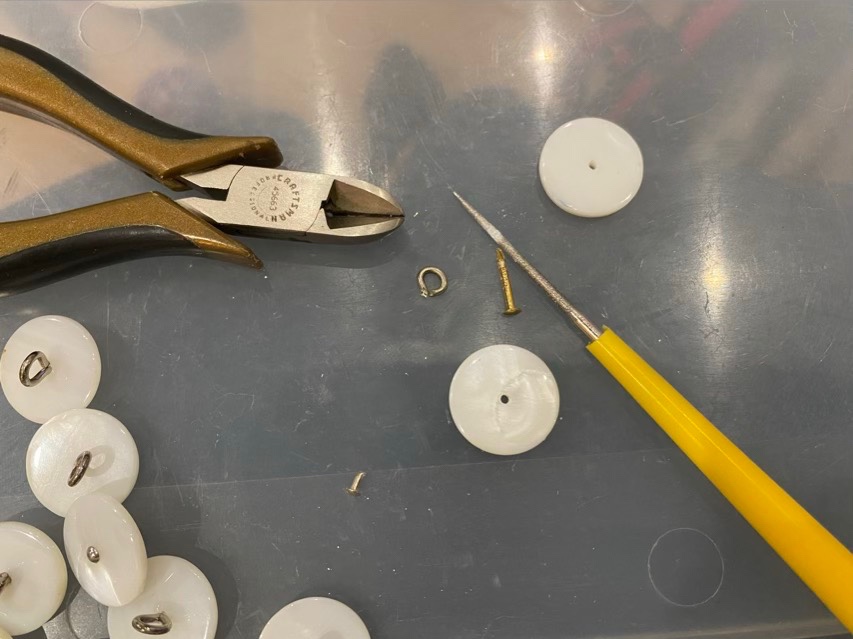
Button to tack conversion
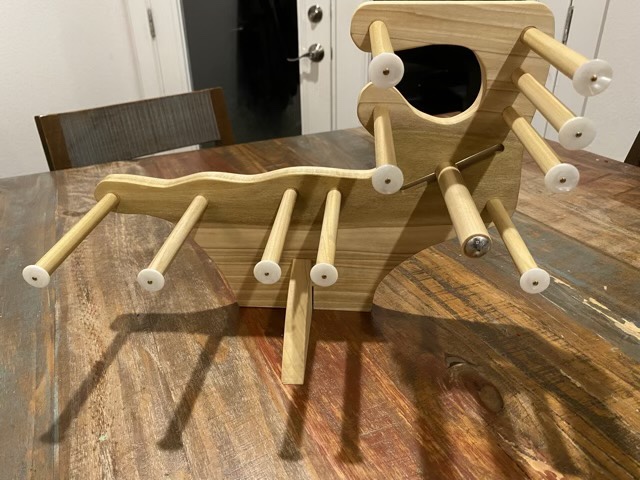
I cut the looped pin off the buttons, and reamed out a few holes that were slightly too small for the small brass nails I had. I drilled tiny starter holes in the end of each dowel and used a tack hammer to attach each button.
Inkle loom with button stops and tension rod installedBack of finished loom