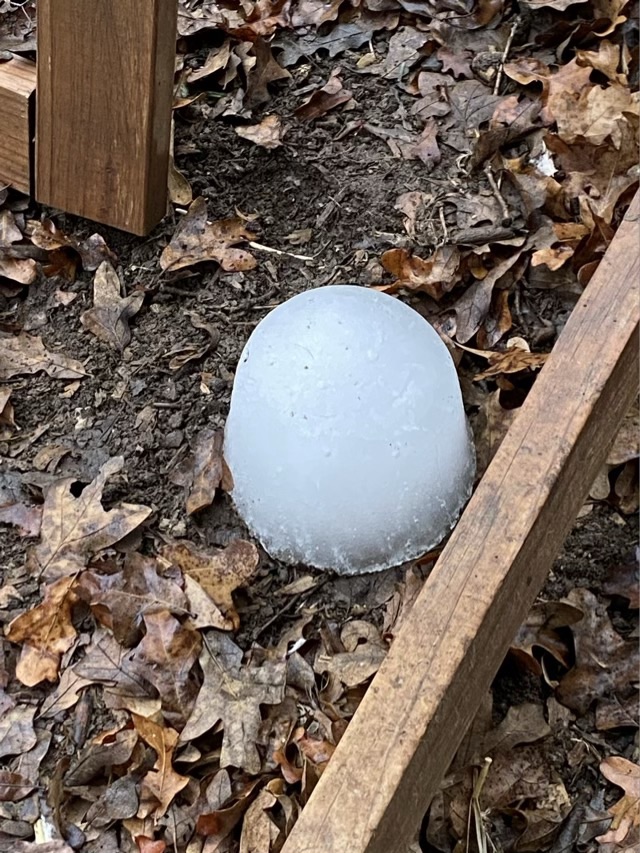
Our back door deadbolt started to stick (most likely with how incredibly dry we are this summer). The bolt was rubbing on the top of the strike plate. I’ve dealt with this many times since owning a home, and it usually takes me half an hour of swearing and adjusting and fetching tools I forgot. This time I grabbed my 1/2” chisel, mallet, and the electric screw driver and had the plate off, a few millimeters chiseled out of the wood, and the plate back on in about five minutes. I’ll take it.
Photo description: Strike plate for a deadbolt moved up a fraction of an inch
The fix isn’t gorgeous, but it is functional. The deadbolt now slides smoothly into place.
My youngest has a favorite shirt that was getting snug. To prolong the life of the shirt and make her happy, I added a gusset to the sides and up through the arm. First I picked out the side seams about to the elbow.
Photo description: Gray knit material with blue thread and a seam ripper, showing a partially picked seam.
I had her try on the shirt at this stage to see how wide the gusset needed to be cut. Then I cut long rectangles of a similar weight black knit fabric and tapered the end by the elbow.
Photo description: Gray t-shirt on a white table with a black rectangle of fabric laid on top. The top of the rectangle has been cut to a point.
I put the right sides together, and starting at the arm, sewed in the gusset with a stretch stitch on the machine. To finish the bottom edge, I folded up a hem to match the sides and stitched across with black thread.
Photo description: Gray Oklahoma Thunder shirt with sewn in black gusset, side view.Photo description: same shirt but laid in the table flat showing the front view of the gusset up to the elbow.
I was quite pleased with how the modification came out. The shirt fits better and looks like it was originally designed that way. My youngest is happy because the shirt is now much more comfy.
The Ingeo corn top was an interesting addition in my plant fiber sample bundle. It feels like cotton, but has a much longer staple length (the length of the individual fibers). I spun it up on a drop spindle and made a two-ply yarn.
Photo description: clockwise from the top left: Hearthside Fibers description card; paper bobbin holding the single; paper bobbin holding 2-ply; crocheted round (size C hook); four selvage woven sample(Clover mini loom); knit sample (size 4 needles); un-spun fiber in a paper drawer
I perused an internet search on the fiber, and liked the semi-science description (although it is still marketing speak) from Paradise Fibers:
“Extract dextrose from plant fibers, ferment, distill, and extract lactic acid into a polymer, creating silky, lightweight roving. Ideal for garments, biodegradable, breathable, high wickability, and flame resistance. Crimp and resilience make knitting easy. Low odor, good moisture management, fast drying, and soil release. Dye just like a protein fiber and marvel at the results! Renewable, natural, and simply divine.”
Some other sites also say that it is a good fiber for people with sensitive skin. I would certainly wear it. The samples I made up felt wonderfully soft. This is definitely a fiber I would buy in larger quantities to make full-sized project.
Photo description: White long-haired cat laying in the foreground, black long-haired cat laying behind on an old wool rug fragment surrounded by fallen leaves. Both looking at the camera.
Mr Tom and his Shadow still come over to get brushed. I use a small wire pet brush to remove the burrs and give them a good once over. If they had it their way I would spend all day brushing them. At least the matts on Mr Tom’s belly are down to just a couple small clumps under his arm pits. And I know I did this to myself, working so hard to get them accustomed to the brush. Now if Momma cat would let me help her, although of the three, she does the best job grooming her long fur on her own.
I finished another fiber page (really I did three together, but I’m going to spread it out in this blog). This page is about hemp. The hemp top, combed hemp fibers, came in a collection of plant fibers as a gift from my sister. I spun the singles on a drop spindle, then made a two-ply yarn using a different drop spindle. The fiber was nice to spin, but the resulting yarn was stiff and scratchy, even after setting the twist by boiling. Hemp is usually used to make rope and strong fabrics, certainly not anything you would want next to your skin. I made a knitted swatch with size 4 needles, a crocheted round with size C hook, and a woven sample with four salvages using a Clover mini-loom and doubling the warp threads. Even though I wouldn’t make clothing with this yarn, I think it is the neatest page I’ve done so far.
Photo description: Clockwise from top left, card from Hearthside fibers, three bobbins with single, 2-ply, and set 2-ply yarn, crocheted lace round, woven not-quite rectangle (still working on my weaving tension), knitted rectangle, and a card stock drawer with hemp fiber.