Happy/sad octopus

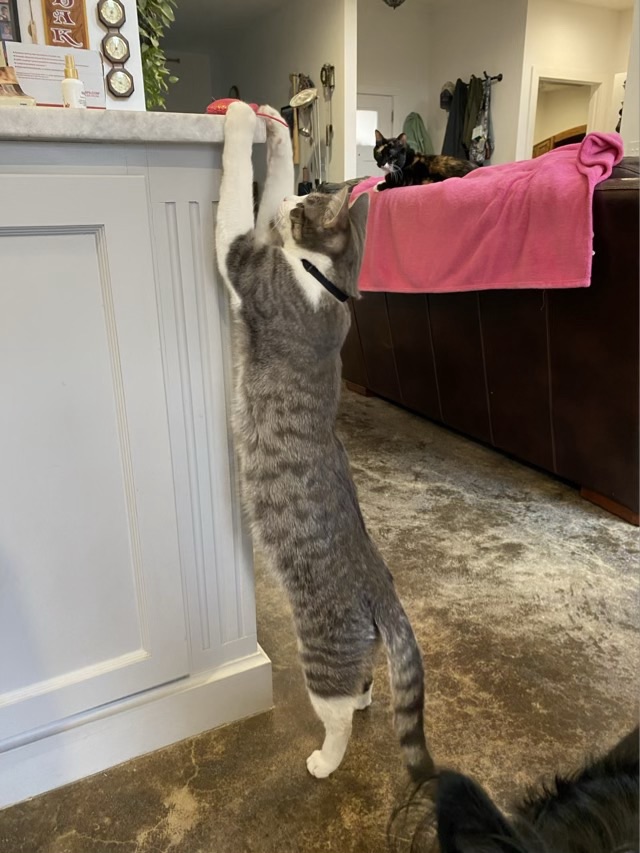
I have taken to throwing small stuffed animals into corners for the kitten to find. He likes to carry them around the house, drop them, then chase them like they just tried to make a daring escape. The octopus toy makes me laugh; it has a happy face outside, then is reversible to show a sad face. I caught a video of Thor the kitten playing with it, and it started off happy, and ended up sad, as the playing inverted the toy. Here is the video.

Photo description: Video still of a young gray tabby cat carrying a gray stuffed animal. The shadow shows the cat’s ears.

Flax page

I finally finished my flax page. This is internet-sourced combed top flax, which is an unusual preparation. It is the short fibers left over from processing the long fibers, combed together. This particular sample was also dyed, probably with nettle dye. There was very little information from the seller (buyer beware). I did manage to spin it in on a drop spindle, using a sponge to wet my fingers. Linen yarn needs to be boiled to set the twist and soften the fibers. When I boiled mine, I used tap water, which has traces of iron. The soft green color turned to a soft orange. The picture below shows the color change especially across the paper bobbins.

Photo description: 12×12 page with floral paper binding; the original fiber label top left; paper bobbins holding the yarn as a single, a two ply unset (green), and two ply set (orange) top right; unspun fiber in a paper drawer middle left; plain weave sample middle right; knitted sample bottom left; weft-faced weave bottom right.

I did a knit swatch on size 4 needles. It isn’t precise, probably due to the variations in yarn thickness, and has a bias, probably due to over twist of either the single or the ply. Still, it isn’t as rough as I thought it would be and has some nice drape.

I obtained a Clover brand mini-loom to make the woven samples. The first weaving (bottom right) I followed directions on warping the loom and ended up with a weft-faced weave. Interesting, but not what I wanted. The second time (middle right) I wrapped the warp completely around the loom and doubled the number of warp threads. This brought the epi (ends per inch) up and let me do a plain weave that showed both the warp and the weft.

I swear I did a crochet swatch too, but I must have stashed it somewhere safe. I do still want to spin traditionally prepared flax, but I’m not likely to buy combed top flax again.

Bath

It was definitely raccoons using up the water and leaving a dirty sludge in the water bowl. How? They were climbing in the water bowl.

Photo description: Black and white night picture of two raccoons on a table, one is inside a large bowl.

They managed to knock the bowl off the table, so I cleaned it but refilled it on the ground to prevent breakage. The next day the water was still in the bowl. Maybe they only like elevated baths? Or they found someone else’s water dish to bathe in. Or our long-awaited rain shower refilled their usual puddles. The rain was glorious. I sat outside and just watched.

Testing for lead

The cabinet of my 1907 model 27 Singer Sewing Machine is yellow. Hm. Pinging online groups, there is a general consensus that they didn’t come in yellow. Prompted, I looked at the hinges, and yes, the hinges and screws also had yellow paint, so someone, during the life of the machine, had thinly painted it yellow. Sigh. The next question, how long ago? Was there lead in the paint? I purchased a lead test kit, followed the directions, and happily, no pink. If the swab or surface turns pink or magenta, it indicates the presence of lead. Since it isn’t lead paint, and it is not original, when the weather cools off here I’ll strip the paint and refinish.

Photo description: Antiqued yellow wood surface showing a wet round area and a yellow swab.

Burrs

Griffin the dog loves to run and bark in the backyard, and fill his face with burrs. Each time I think that surely he has gathered all the burrs in the yard, but the next day, he comes back with more.

Photo description: Black shaggy dog with twenty plus small cream-colored seed pods on his face.

The best way we’ve found to remove the burrs is to use a small wire pet brush. The burrs stick to the brush and come easily away from the dog fur.

Photo description: In the foreground, a small green brush with wire tines tipped with white, full of black hair and burrs. In the background two black dogs looking at the brush.

He knows what to expect when I grab the brush, and he sits and waits for me to brush out the hitchhikers. These particular seed pods are also known as “sock destroyers” because they easily attach to fabric and are devilishly difficult to remove.