Aging paper just a little

My eldest needs a journal as a prop for a play. The play is set in the 1920s and we didn’t want bright white crisp paper in the leather bound journal (I’ll get to the assembly of the journal in another post). I searched the internet and only came up with tea and coffee stains (and one that recommended burying the paper in the ground for two weeks). I needed eighteen sheets of paper aged; and the paper won’t hold up to handling when wet (we tried the tea method, no go). We also tried using a flame to slightly singe the paper, which was also time consuming with spotty (literally) results. I remembered a science experiment with invisible ink made from lemon juice. Could that work to slightly brown the paper? Yes, yes it can.

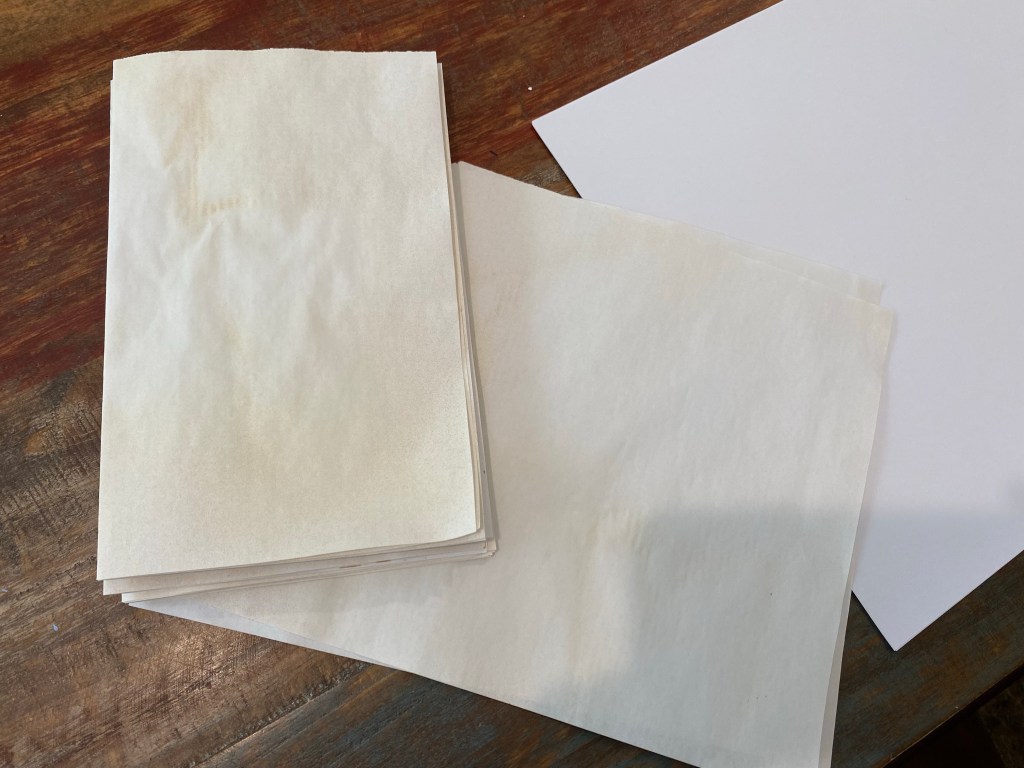
Aged paper folded into signatures (left) versus original paper (far right)

The method I found that worked best was to heat the oven to 350 degrees F, put a large cookie sheet in the oven, lay one piece of paper on the cookie sheet and mist it with a 50/50 mixture of lemon juice and water, and leave it in the oven for 3 minutes. I then flipped the paper over, misted again, and baked for 3 more minutes. An eye cleaner spray bottle works great for mist. The technique also wrinkles up the paper, so I needed to give the sheets a quick iron to get it to lay a little more flat. The results were exactly as I hoped! Now to finish the cover so I can assemble the journal.

Jar candle hack

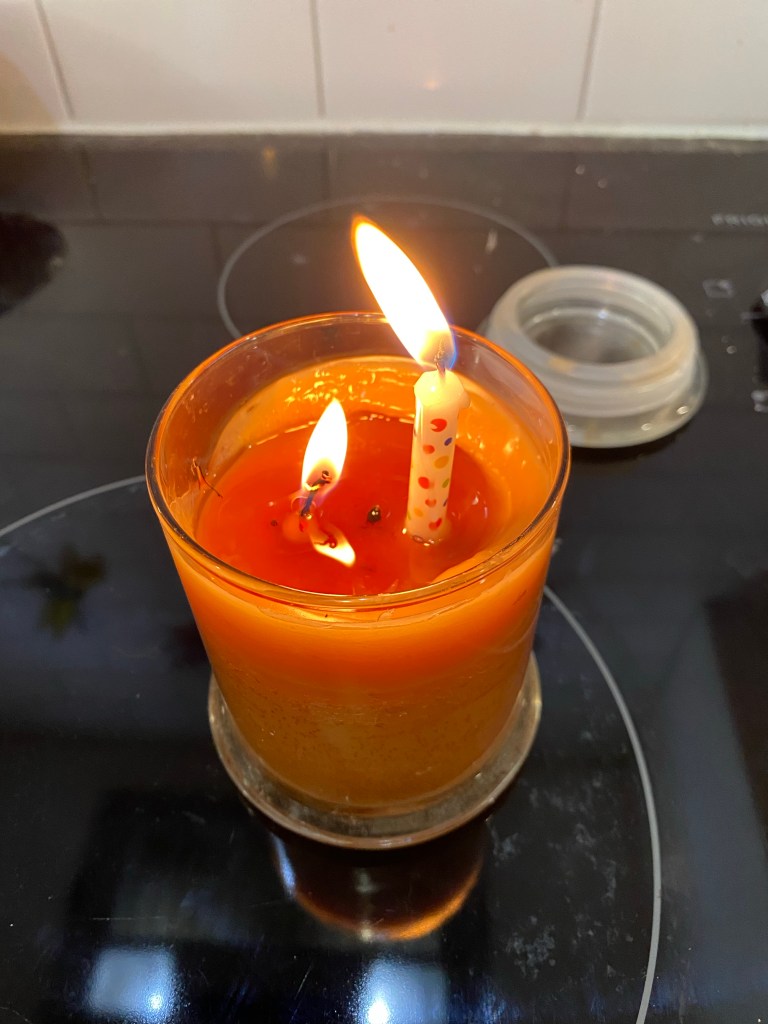
I don’t let my jar candle burn for very long; mostly just long enough to seal the end of cut ribbons. Because the wax doesn’t have a chance to volatilize much, the wicks get lower and lower. I tried running the molten wax along the edge to get it away from the wick, but that just made deep holes around the wicks. Then I had an experiment that needed flame for a little longer and the melted wax enveloped the wick and put out the flame! Oops. So to fix it, I buried birthday candles down into the soft wax. Not only did I have flame again, but the wick from the birthday candle could draw wax from the jar candle when it was low enough. Two new wicks rather than throwing out the candle! And quicker than melting the wax and re-pouring the candle.

Birthday candles buried in the melted wax of a jar candle to replace the wicks that were too short

Blocking holes

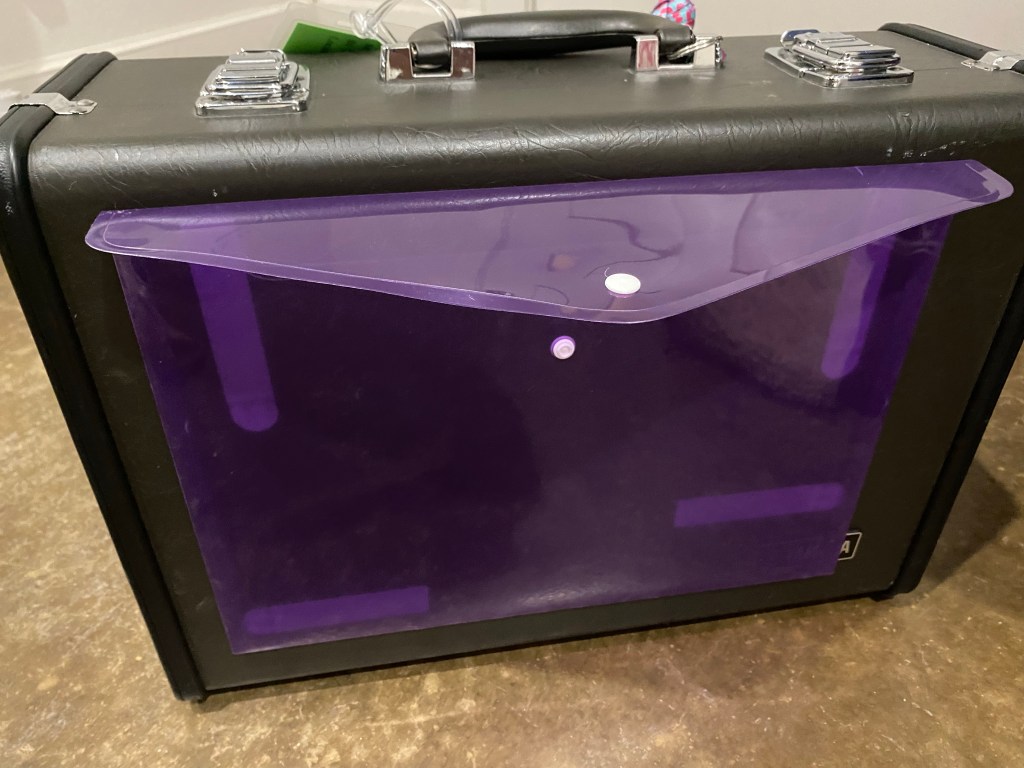
My youngest has taken up the coronet in band. Her case for the instrument is well made, but has a mysterious hole under the instrument that devours small items. Once a bottle of valve oil slips into the depths, it is really hard to retrieve. The hole is big enough to hold music, but the angle of access prevents putting a lesson book in. Truly mysterious. So I plugged it. I made a small pillow from black fabric in my stash and stuffed it into the hole. At first I tried a stuffed tube, but it didn’t hold well, so tried a rectangular pillow the length of the hole and about four inches wide, then stuffed it to get an inch and a half of depth. It is removable, does no damage, and keeps the case from eating tubes of slide grease.

Home made block for hole in coronet case
Block installed flush

Hm. I think I may have figured out the purpose of the hole. When the block is installed, and the case is carried, the small items end up all around the coronet. So the hole is a catch to keep small things from banging against the instrument. Ok, well, it is still too deep. So I pushed the pillow farther in, to make a shallow hole just deep enough to catch the bottles. The same effect could be accomplished with a small folded towel, I suppose, but little pillows are easy to make.

Add-on bag strap

My youngest enjoys taking her lunch to school, but the lunch box can’t go in her bag, she feels she must carry it. She has a rolling bag because the amount of stuff the kids need to carry (no lockers here) can’t be good for their backs. So she has a roller bag handle in one hand and her lunch in the other. This year she has chosen to learn trumpet and be in band class. She has run out of hands. I tried hooking the lunch bag to the rolling bag, but that was not acceptable. It either fell to one side as she walked, or made it hard to get into the bag. What to do? How about wear the lunchbag? It is the lightest item, after all. I bought a length of nylon webbing (marketed in the craft store as belt material and usually by the ribbons and notions), and measured across her shoulder and down to her hip. I sewed loops into each end and added lightweight carabiners to each loop.

Add-on strap prepared

Then it is just a matter of clipping the strap to the top of the lunch box and she has a cross-body bag! And two hands available for her trumpet and the rolling bag. Thank goodness the band room does still have lockers and she doesn’t have to carry it to every class. This solution is working well for getting to her first class, and getting back home. Yay!

Add-on strap attached to lunch box

Calibrating

Old thermometer, barometer, hygrometer (left), goes well with the circular calendar and botanical sketches in the kitchen

I found an old thermometer, barometer, and hygrometer at a neat local upcycle shop. It reminded me of something my grandparents would have had, and I thought it was in the style that my husband would like. The owner said she wasn’t sure it worked, but I assured her it was OK, if it didn’t, I would take it apart and see what I can do, (especially for only $6.) At home I cleaned it up and found the adjustment screw on the back of the barometer. We looked up the local pressure and set the dial hand to that number. The next day, the barometer hand had moved and still matched the internet reading! Hurray! The thermometer had settled in and seemed to be working, but the hygrometer didn’t have an adjustment screw and the reading was way too high.

Hygrometer mechanism

I took the hygrometer apart. The case was plastic, so the piece isn’t that old, but the tabs were in good condition so I was able to pop it open with little fuss. The mechanism of the hygrometer is fascinating. It is just a strip of metal (I’m guessing brass because of the color) with paper on one side (it could be hide, but I think I can detect fibers), wound into a coil. As the humidity in the room rises, the organic material absorbs more water and swells, which forces the coil open slightly, which moves the dial hand. I did give the coil a slight tightening, then removed the clear cover and set the dial according to my eldest’s snake hygrometer.

Testing the mechanical hygrometer with two digital hygrometers

After observing for a couple days, the hygrometer on my found piece seemed to work! I had also brought in the chicken thermometer from the coop, and we determined that it wasn’t giving a good reading anymore. I ordered a new outdoor thermometer/hygrometer for the coop, and hung the decorative one in the kitchen. I’m not planning on making scientific measurements with it, but it is interesting to see the changes In barometric pressure and humidity. I’m hoping my weather obsessed youngest takes some interest!