Washing mohair

I am almost giddy with excitement. I found a local farm that has angora goats and sells fleece (that is the hair from an animal, not the already finished fabric). I bought some to practice spinning!

By the way, the fleece from an angora goat is called mohair and the tensile strength rivals steel. Fun fact I learned from the book “The Art of Washing Wool, Mohair, & Alpaca” by Mary Egbert, which the grower recommended. Good book, which I very much recommend if you try washing fleece.

Fleece from an angora goat named Dottie

I like the book because the author has done her research and experimentation, so I don’t have to! I followed her advice on how to scour (clean the lanolin off) my new fiber.

I used my softened water from the water heater
Added the soap, then the fiber, and kept checking the temperature to keep it above 100 degrees F
I squeezed the soap water out of the fiber and put it in a hot rinse bath with a little vinegar
I kept the temperature of the rinse above 100F by adding small amounts of near boiling water
After the rinse I squeezed out the water and put it on my drying rack
Dirty fiber on top, clean fiber bottom right, flicked fiber (brushed) bottom left

And now I have soft fluffy local fiber to spin. And I even know the goat’s name: Dottie! That just tickles me pink.

The universe wants me to spin, who am I to say no?

In progress

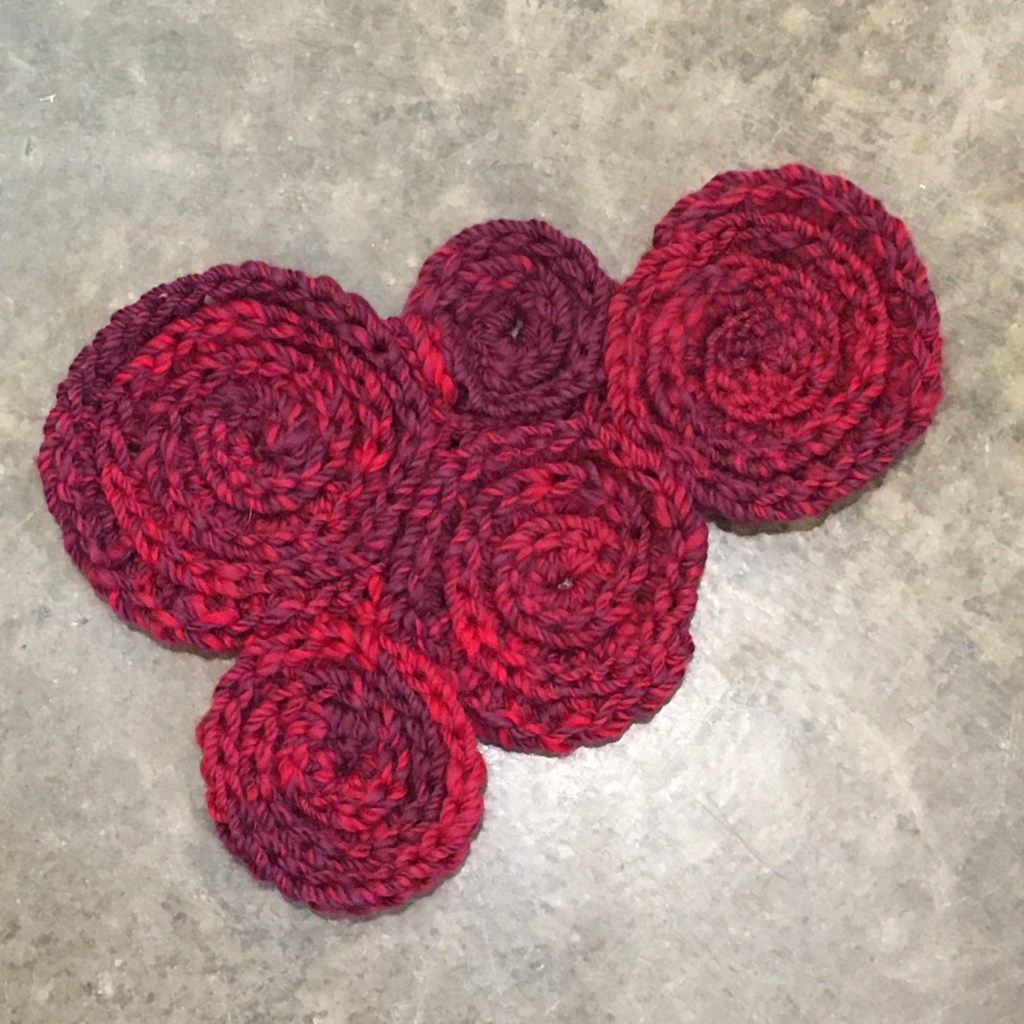
Nålbinding rag rug

I have a new car rider line activity. We had a king sized sheet wear out, and I decided that I wanted to try my new nålbinding techniques to make a rag rug. There are many different ways to construct a rag rug, such as sewing braided lengths together, crocheting, or using half hitches.

For this one I’m using a Finnish 1+1 stitch. I tore the sheet into 1” strips, and made each strip into a small bundle so they wouldn’t get tangled in the bag. To join strips, I sew the ends together with a few straight stitches. I am doing something a little different than traditional increases on the curves; Instead of making two stitches into one previous stitch, I’m making the increase stitch stand alone (like a chain stitch in crochet). I like the texture of the fabric better with this method.

I’m about half-way through my bag of torn strips. This one is going to take awhile, but it will be interesting to see how it comes out!

Turkish Drop Spindle

After learning how to twine by hand, I started to want to know more about spinning yarn (next logical step, yes?) I didn’t want to jump into buying a spinning wheel, but I saw many Pinterest posts about drop spindles. I admit, I attempted to make a drop spindle from a hooks, a dowel, a screw, some play dough, and the bottoms of aluminum cans. I used the bottoms of two aluminum cans filled with play dough to give it weight.

First attempt at a DIY spindle. I tried spinning strips of cotton fabric.

It was functional, but very wobbly. After perusing more drop spindle designs, I found reference to a Turkish spindle, which is assembled in such a way that you made “turtles” or balls of yarn as you spin. This seems much better than spinning to a spindle, then winding from the spindle to a ball.

So I made one.

Turkish Spindle made from Roman Olive Wood

I had left over Roman Olive Wood from a spoon I had made, so I planned out my spindle design, used the bandsaw to rough cut the shapes, a drill press to rough cut the slot and drill the spindle holes, and a chisel to refine to slot. I then sanded the whole thing first with a belt sander, then by hand. I finished it with Tung Oil (which took several days, argh, the waiting!).

Unassembled Turkish Spindle

It doesn’t spin perfectly (I can’t get it to spin like a top), but it works much better than the dowel and aluminum contraption. I ordered some Merino wool roving (I read that was better for beginners) in wild colors, and set out to learn to spin. There is definitely a learning curve; my yarn width is still inconsistent, but it is interesting and another good survival skill.

Second attempt at a chunky single ply yarn (the first attempt was abyssmal)

Twining

How have I never learned to twine? I happened across a video on how to make twine from grass and roots, and had to try it, but didn’t have grass at hand (and it is over 100 degrees out, I’m staying inside), so used my daughter’s hair.

Twined principles applied to hair

I had a cute little machine when I was her age that would twine doll hair in a similar fashion, but it turns out you don’t need a machine; it is possible to twine by hand.

Next I took a 1” strip of old sheet and tried again. So fun!

Twined cotton sheet

I really feel that this is life changing; that I have the ability to make rope from nearly anything (even paper!). At the very least it is a good survival skill.

Repurposed roost

I added some chicken enrichment to one of the runs: a repurposed toy organizer! (Given to me by a friend, thank you again!) I removed some of the rails to give the chickens more room, and they appreciate the gesture. I have seen up to three chickens sitting on this, but wasn’t able to get a photo.

Repurposed toy organizer