Twining loom

I finally made myself a twining loom, after returning my neighbor’s to her. I tried other shorter methods, but having the warp hang freely makes it so much easier to twine.

Photo description: bag twining loom made from 1×4” boards and two 7/16”dowels

The boards were in my scrap pile and 18.5” long. I used my band saw to cut one board down to 1.3”, then clamped them together and drilled seven 7/16” holes, four on one side, three on the other so I could always tell how the boards line up. The wider board on the bottom gives stability. The multiple holes give me options on bag width. Ironically, the dowels have a slight bend, and line up with nonparallel holes. Hm.
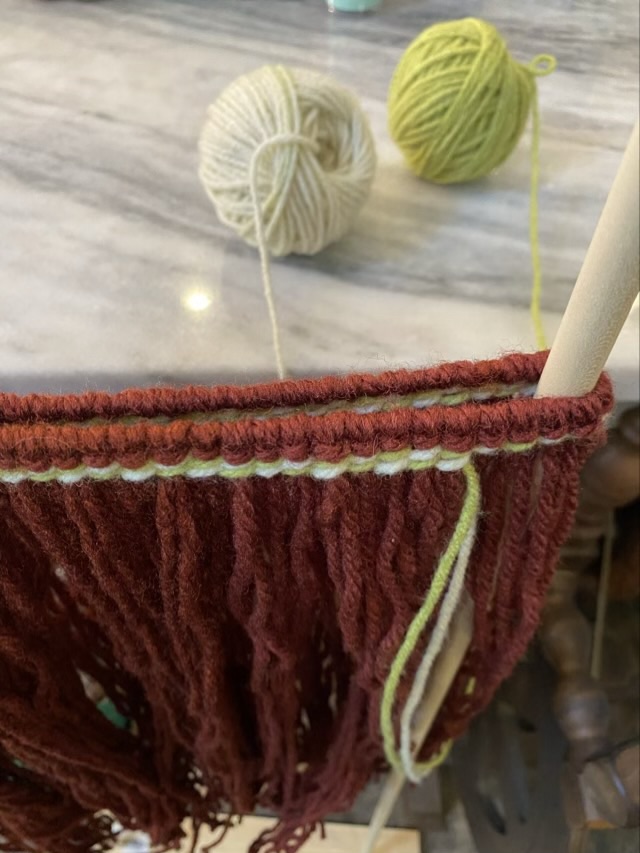
Photo description: twining two colors around free hanging warp threads in twos

My eldest gifted me some pretty green wool blend yarn for Mother’s Day, so I thought it best to make something for myself. I can never have too many project bags, and I like twining, so I just needed a loom. I had some synthetic rug yarn in my stash that was a pretty rich brown, so I used that for the warp to maximize the variegated green yarn available for the twined weft.

This will not be a quick project, but it will still be an enjoyable one.
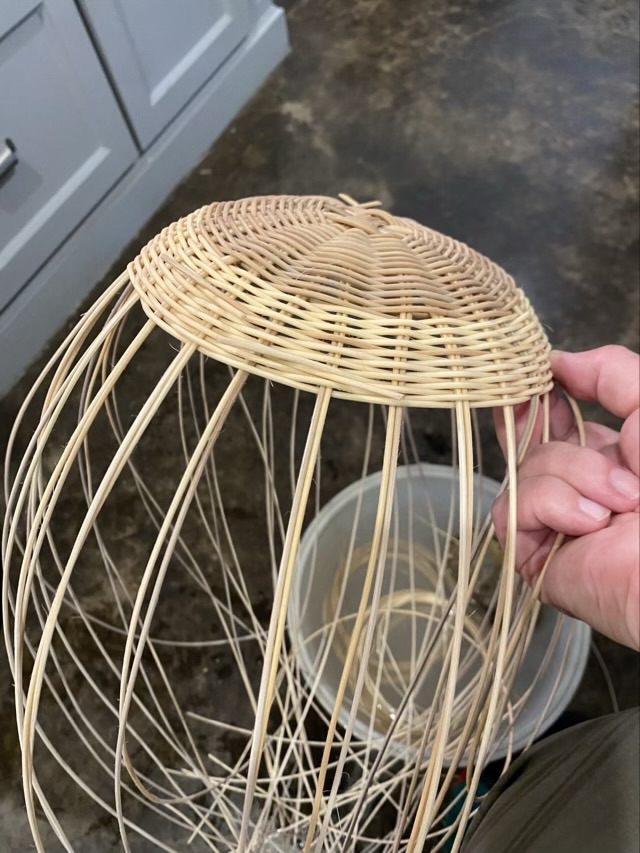
Concave double walled basket

This is my third double walled basket and I can definitely see my skill improvement. I wanted a larger, concave shape, and I was able to achieve the shape I wanted.

Photo description: starting the inner wall of the basket with added stakes, my next weavers soaking in a bin of water at my feet
Photo description; the stakes turned and weaving the second wall, again I chose to take the spokes at an angle
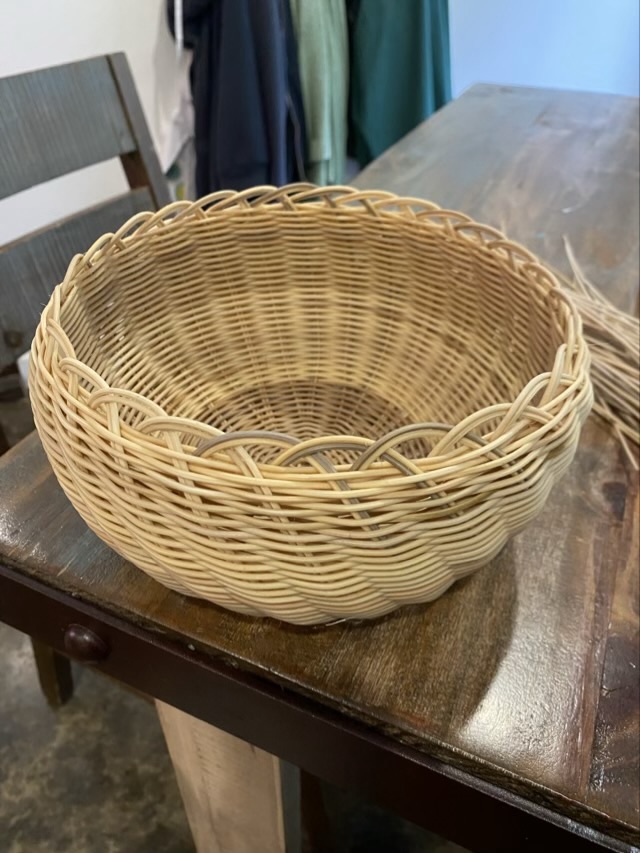
Photo description: finished double walled #2 round reed basket
Photo description: bottom edge with each stake woven behind, over, behind in a continuous braid, my best finish yet

I love these baskets. Now I want to experiment with different materials.

Reed coaster

I was so excited about learning to weave baskets that I bought a pound of #2 round reed made from rattan palm. As I prepped stakes and weavers from the coiled bundle, I had shorter lengths left over. My weaver friend told me how to make coasters, so I saved the “waste” reed and used it as the stakes for a small weaving.

Photo description: coaster woven from #2 round reed
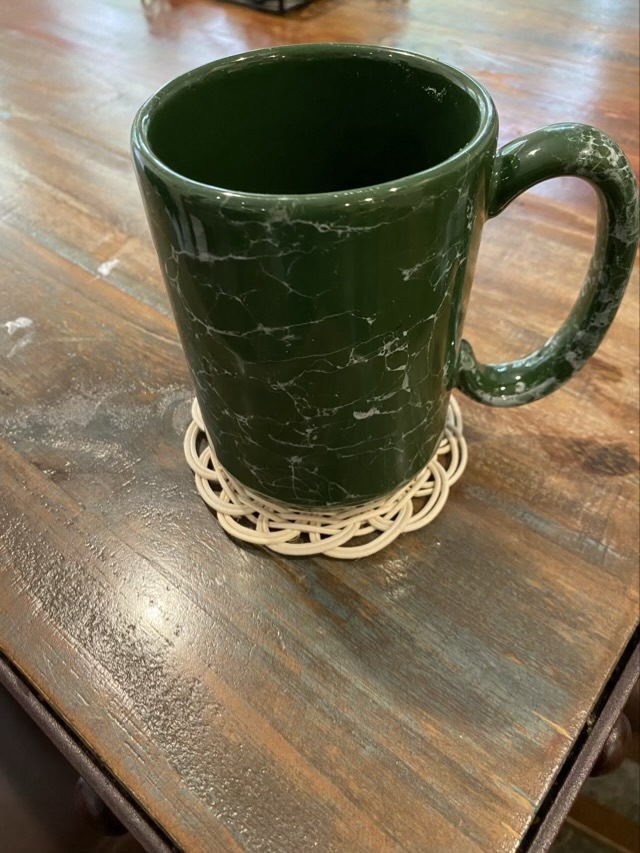
Photo description: coaster in use, with a coffee cup sitting on top

These coasters use shorter lengths of reed for the stakes or spokes, and one long weaver that weaves around the middle. It starts the same was as a double walled basket, but stays flat. They don’t take as long to weave as a full basket, and they seem to make excellent little mats for coffee or tea.

Double-walled basket

I attended a double-walled basket class taught by my wonderful weaving neighbor. I spent a morning winding #2 reed round and round, happily seeing how to turn at the top, and finish off the bottom. It is my first double walled basket, but I have ideas on how I would do different shaping. One of the other students had a beautiful curve to the sides of her basket!

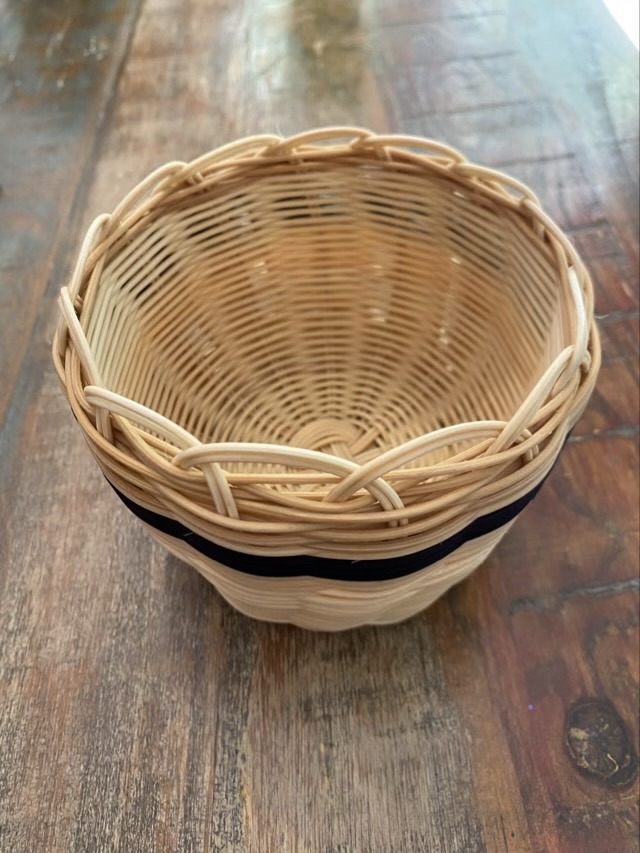
Photo description: the side of a double walled basket with accent stripe
Photo description: same basket viewed from a top angle
Photo description: same basket, bottom view, showing the two walls

I’m obsessed.

Rose top fiber page

Photo description: rose top card from Hearthside Fibers top left, single spun, two ply, and cable ply yarns top right, unspun fiber middle left, twined swatch middle right, crochet cables swatch bottom left, knitted cables swatch bottom right

The Rose Top fiber sample was nice to spin, and working up the swatch projects was satisfying. Even though this fiber is produced in a similar way to Tencel, only using rose stems and leaves rather than wood pulp, I found this easier to handle.