Unexpected resistance

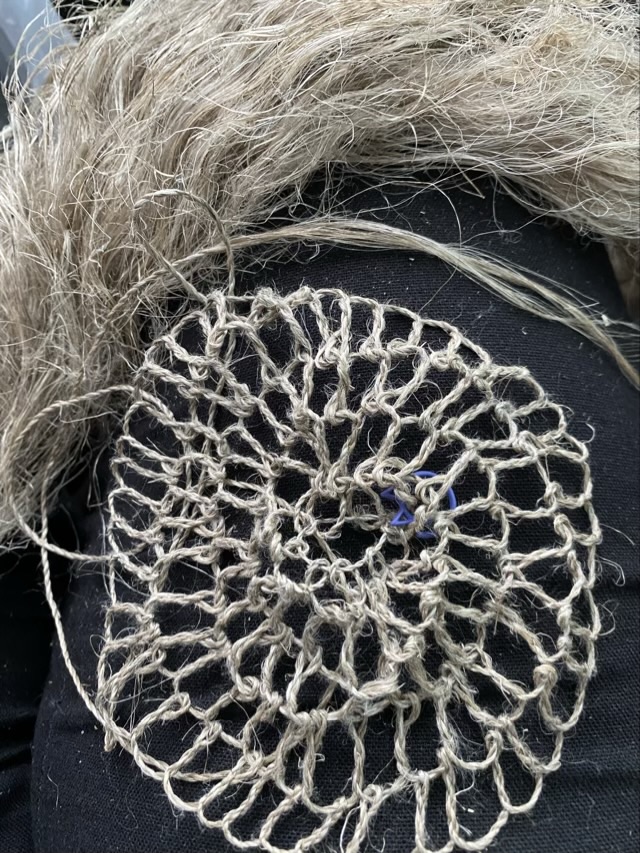
I went to rinse and block my small twined cotton bag and was a little shocked when it held water. It wasn’t completely water tight, there was a slow drip, but it didn’t absorb water like I expect cotton to do. My hypothesis is that because I hadn’t washed it at all to this point, there may be some natural water resistance on cotton bolls. Not enough to keep the harvest safe from rain (as this cotton farmer describes), but some. Or the twining is tight enough and thick enough to resist the water for a short time.

Photo description: small twined cotton bag holding water over a sink

I’ll file this under “things that make me go hm.“

Twining loom

I finally made myself a twining loom, after returning my neighbor’s to her. I tried other shorter methods, but having the warp hang freely makes it so much easier to twine.

Photo description: bag twining loom made from 1×4” boards and two 7/16”dowels

The boards were in my scrap pile and 18.5” long. I used my band saw to cut one board down to 1.3”, then clamped them together and drilled seven 7/16” holes, four on one side, three on the other so I could always tell how the boards line up. The wider board on the bottom gives stability. The multiple holes give me options on bag width. Ironically, the dowels have a slight bend, and line up with nonparallel holes. Hm.

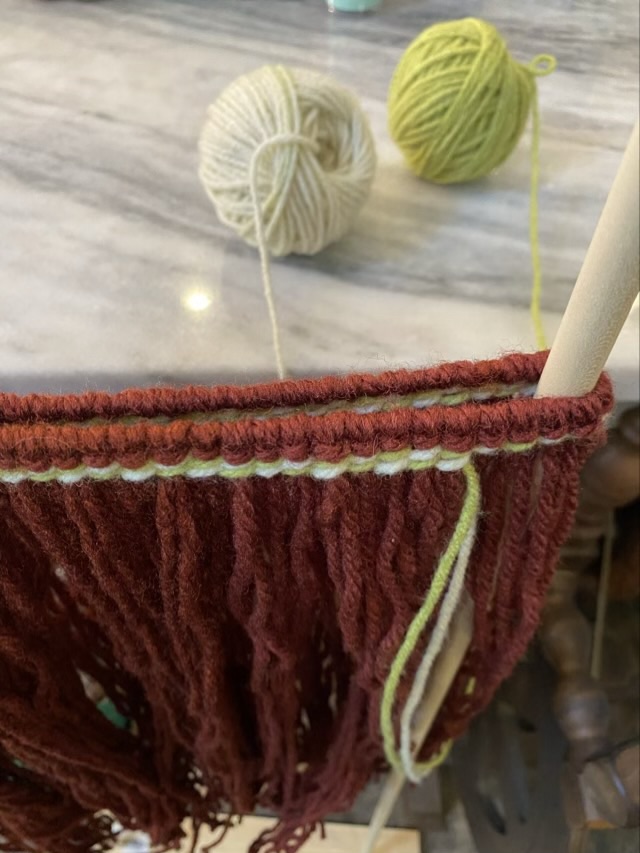
Photo description: twining two colors around free hanging warp threads in twos

My eldest gifted me some pretty green wool blend yarn for Mother’s Day, so I thought it best to make something for myself. I can never have too many project bags, and I like twining, so I just needed a loom. I had some synthetic rug yarn in my stash that was a pretty rich brown, so I used that for the warp to maximize the variegated green yarn available for the twined weft.

This will not be a quick project, but it will still be an enjoyable one.

Tips

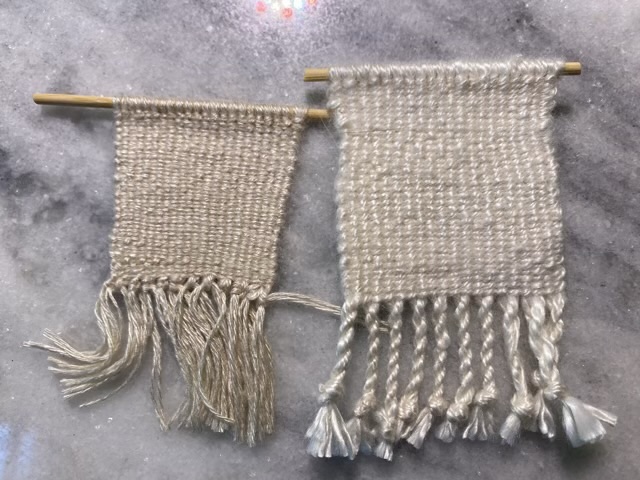
I was struggling with the sides of my twined weaving coming in and not staying straight. My neighbor, who is an accomplished Cherokee weaver, and who taught me how to twine bags, suggested that I flip the work for each row. I had been working from just one side, going right to left, then left to right. For my rose fiber swatch I followed her advice.

Photo description: left twined weaving made with hand spun mint infused cellulose, right side twined weaving hand spun rose fiber

Flipping the fabric worked, the sides of my swatch are better than my previous attempts. They aren’t perfect, but my skills are improving. It is those little tips and insights that make learning from accomplished crafters so valuable. YouTube is great for general knowledge and diving down rabbit holes, but the knowledge we can gain when working with another crafter is invaluable.

Egyptian cotton swatches

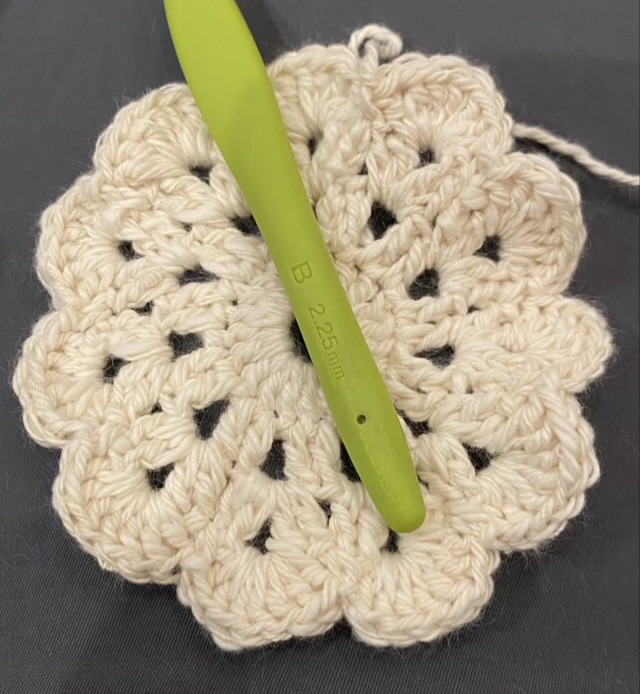
I made my swatches for my fiber book from the Egyptian cotton that I spun on an Ashford Traveller spinning wheel.

Photo description: knit square in moss stitch with size 2 Prym circular needles
Photo description: crocheted round coaster made from Egyptian cotton with a size B Clover crochet hook
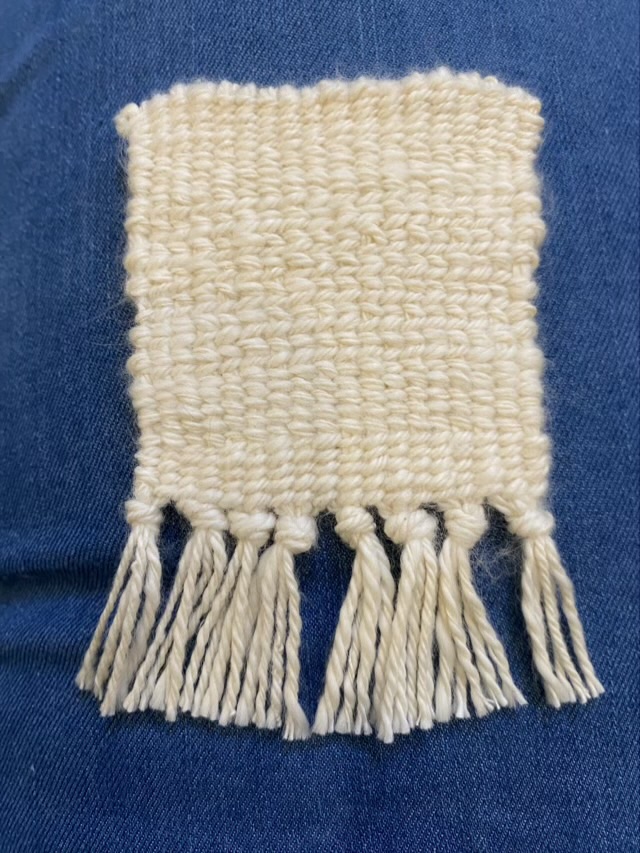
Photo description: 3 salvage twined swatch with knotted tassels

I still love the twining weaving technique with open ended warps. This was my first swatch, but the sides are less wonky than my other weaving attempts.

Twined bag 1

I have finished my twined bag. Yes, I was obsessed with making it and spent three days working on it. (Should I have been doing other things? Oh yes, but this was fun.)

I experimented with the weave as I progressed, not only doing stripes, but changing twist direction and number of twists between warp threads to control which color was on top, using this project as sampler.

Photo description: body of a twined bag made with natural jute and hand spun orange and white wool showing different styled stripes

To make the strap, I threaded long strands of jute through the top edge of the bag, then used more hand-spun wool to cover the jute, reversing twine direction on each row, so as not to introduce bias twist in the final strap.

Photo description: starting the strap, with the excess yarn wrapped onto recycled plastic bobbins

I felt the other end of the strap needed some adornment, so I cut a slice of antler and drilled two holes to make a decorative button. It is sewn on, not functional, but I think it came out nice and coordinates well with the natural jute.

Photo description: antler decorative button attached at the other end of the strap.

I finished the bottom end of the bag and the end of the strap with tassels lashed with wool.

Photo description: finished twined shoulder bag made with jute, wool, and antler

I absolutely love this weaving technique. Want to learn more about twining a bag? There is an excellent book called “Twined Bags: A Historic finger weaving craft of the Native Americans” available from Livingston Press, written by Monica Newman Moore.