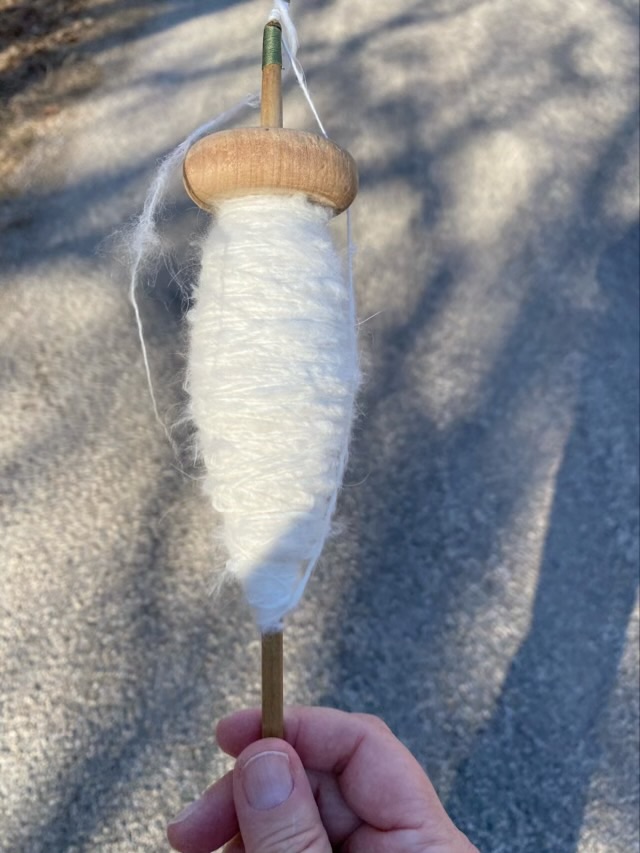
Photo description: single spun angora rabbit fur on a wood drop spindle, asphalt in the background
I finished spinning the angora rabbit fur I purchased from a Texas rabbit farmer. I didn’t wash, card, or comb the fiber, just took it out of the bag and started spinning, which resulted in a more uneven spin, but was worth the experiment.
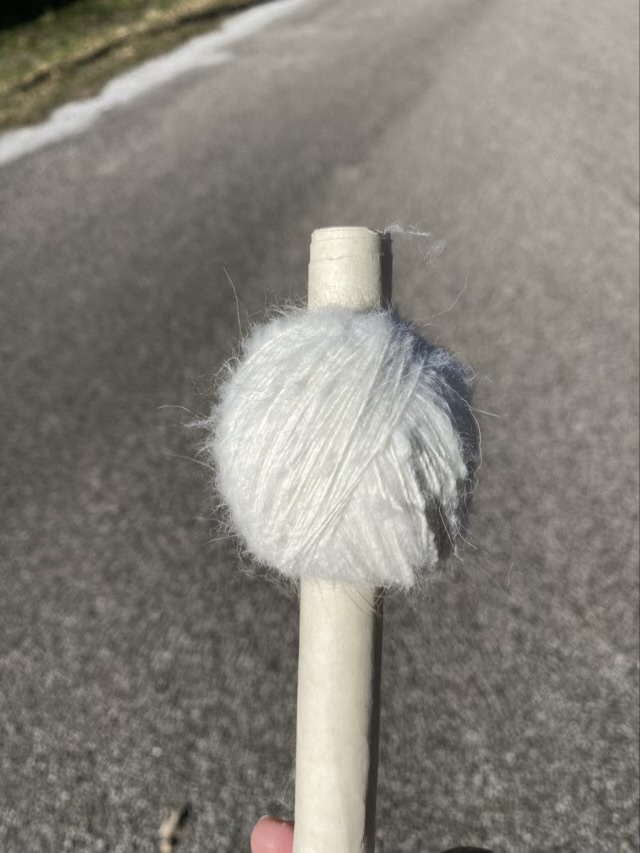
Photo description: single spun angora yarn wrapped into a center pull ball
The next step is to ply the yarn. In preparation, I wrapped the yarn into a center pull ball.
Crochet cables are an entirely different beast than knit cables. Rather than just switching the order of a few stitches, it involves at minimum three different stitches, and different placement. I ripped out my swatch twice trying to get my brain wrapped around the technique. I finally made myself a rough chart, which helped, and religiously counted stitches on each row.
Photo description: hand drawn crochet chart with non standard symbols, a size G (4.0mm) crochet hook, and the cabled swatch made with hand spun two ply rose fiber yarn
I used a combination of single crochet, double crochet in the front post, and treble crochet in the front post. I have not puzzled out how to reverse the cable twist, although I suspect it involves some pretzel like moves.
If you don’t have a swift or a nostepinne (or don’t want to go upstairs then get them), the back of a chair and a roll of paper work fine to take yarn from skein to ball form.
Photo description: skein of hand spun cotton hung on the back of a wood chair, and center pull ball of yarn started on a roll of card stock, black dog looking on in the background
I rolled up two skeins of hand spun cotton this way. This is the cotton that I spun from raw bolls then three plied two ways: crepe and chain ply.
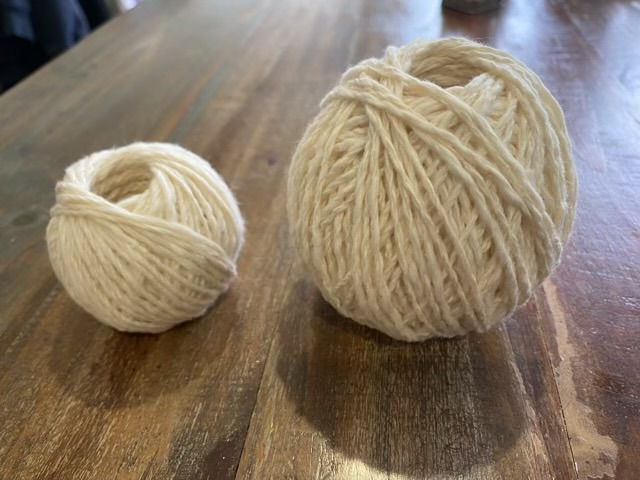
Photo description: two nostepinne style balls of cotton yarn, chain ply on the left, crepe on the right
I’m most interested in how these two preparations knit up. Yes, I’m looking forward to swatching. I’m weird like that.
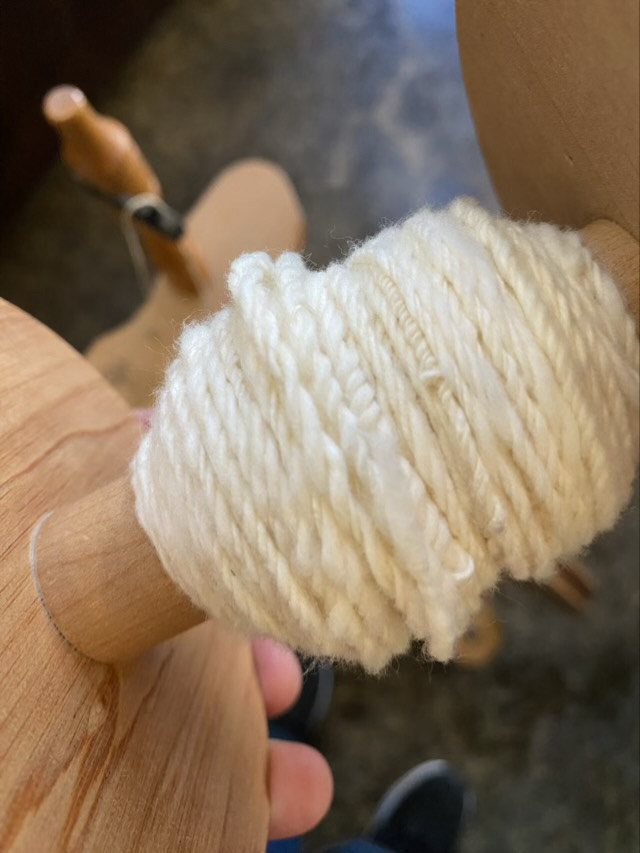
Since I had more spun cotton single than I needed for my crepe yarn, I tried chain plying it to make a three ply yarn sample. It did not go well. The cotton single was difficult to handle and kept breaking if the strands rubbed together. The resulting yarn is very haphazard with sections that coiled mixed in with the smooth ply.
Photo description: three ply cotton yarn on a wood bobbin
The chain ply and the crepe yarn don’t look that different on casual observation because of the irregularity of the single spin. The variations in width cause more visual texture than the plying techniques. I will have to try this comparison with a different fiber preparation.
Photo description: crepe yarn (left) and chain plied yarn (right) on a PVC niddy noddy
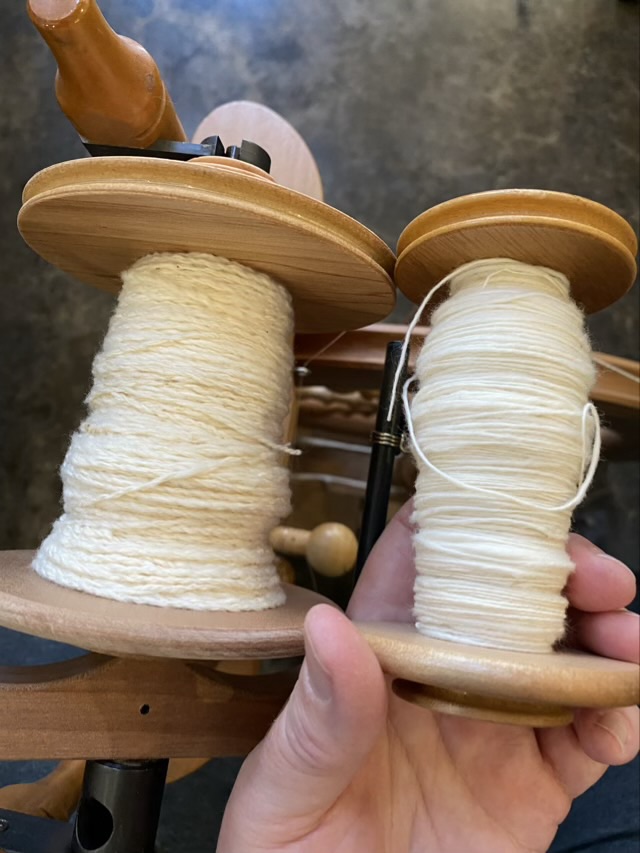
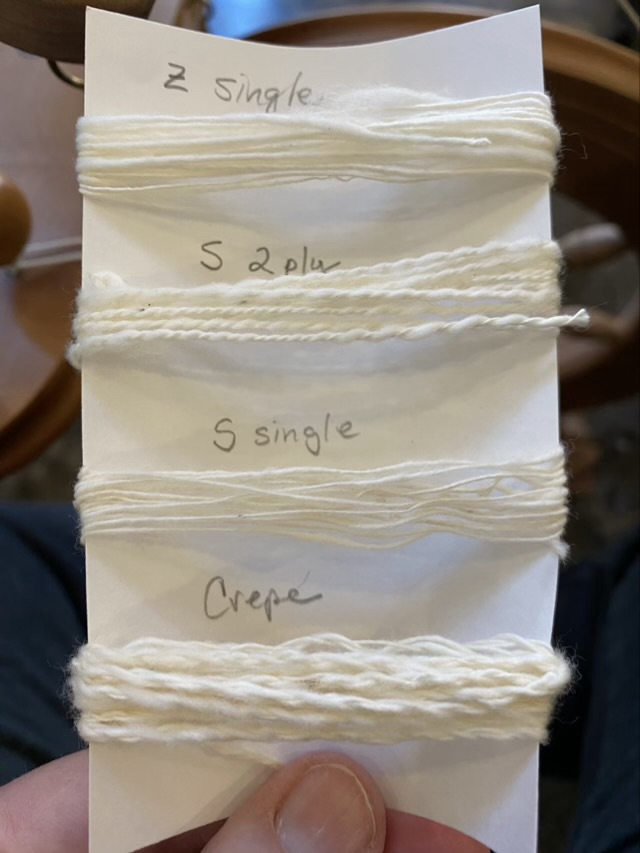
I found out about crepe yarn, which is a three ply yarn with a different construction. A single is spun in the S direction, then two plied in the Z direction. Then another single is spun with a Z twist, the plied with the two ply in an S direction. The resulting yarn has an interesting texture. I decided to try this method with the natural cotton I am spinning on the Ashford Traveller wheel.
Photo description: two bobbins full of spun cotton, the top is a Z twist two ply, then bottom a Z twist singlePhoto description: three ply crepe yarn on a jumbo bobbin on the left, and leftover Z twist single on a regular bobbin on the right
I grossly misjudged the amount of Z twist single and ended up with way more than I needed to ply the three ply. Sigh.
It will be interesting to see how the yarn knits up. It does have more texture than a standard three ply, but because my cotton was spun from raw bolls that had not been carded, the yarn already had a variations in the spin.
Photo description: four hand-spun cotton yarn samples, from the top down: Z twist single, S twist 2-ply, S twist single, crepe three ply