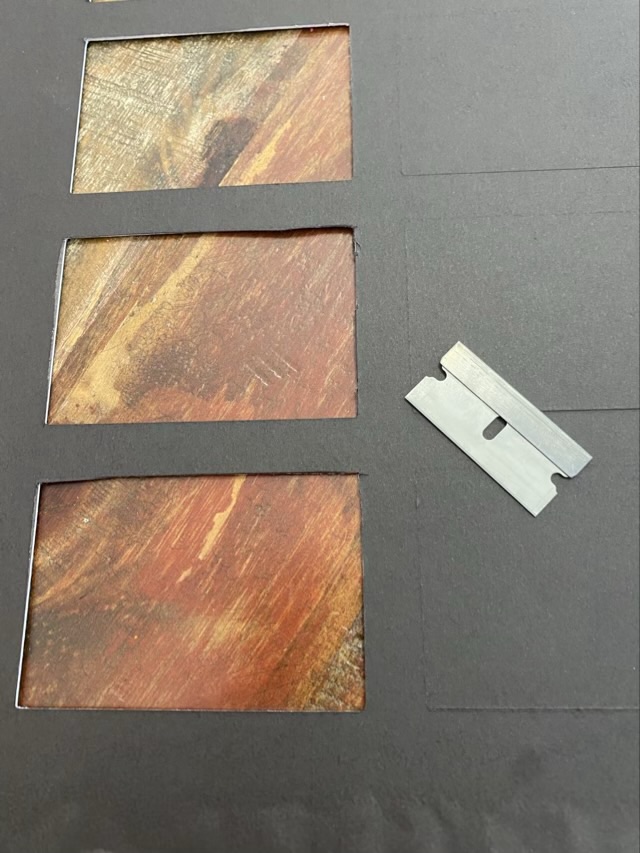
I took my Cricut cutter to extremes to cut a photo mat. The material is a little thicker than recommended. I used the deep cut blade, a 12×24 inch mat, more pressure, and a setting that traced the pattern twice. It didn’t quite get all the way through the mat board, so I used a safety razor blade to finish the cut.
Photo description: using a safety razor blade to finish cuts in mat board, the matboard cover lifted a bit when removed from the Cricut mat, but it is on the back
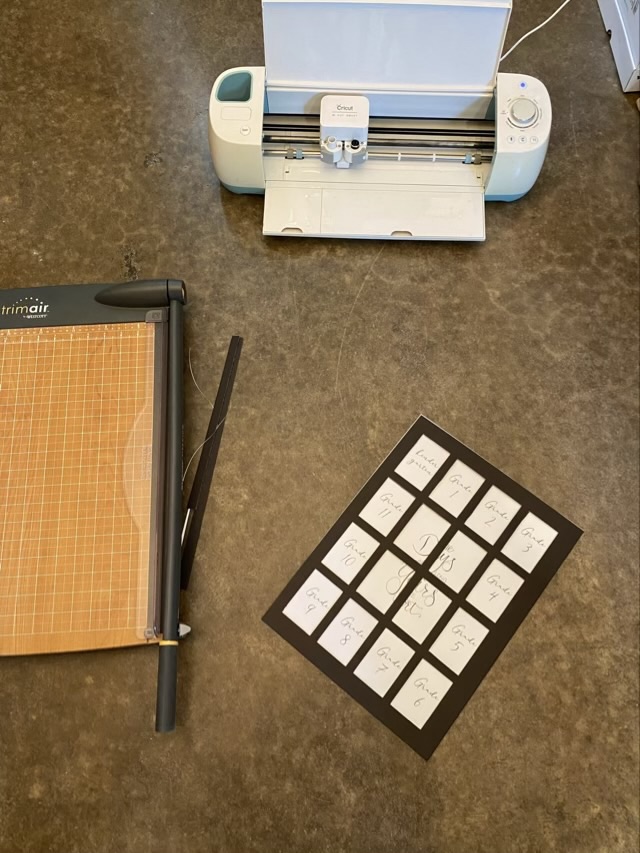
The resulting mat has spaces for 16 2×3 inch photos for my youngest’s school photos. All the commercially available mats only had 13 spaces, kindergarten through 12th. I needed spaces for preschool too. I bought mats larger than the frame, which allowed me to trim down the outside with my paper cutter and make sure the Cricut cut rectangles were centered.
Photo description: finished mat over the original 13 space backing to show the new divisions, my paper cutter and my Cricut on the floor because that is the only space that can accommodate a 24 inch cutting mat (not pictured)
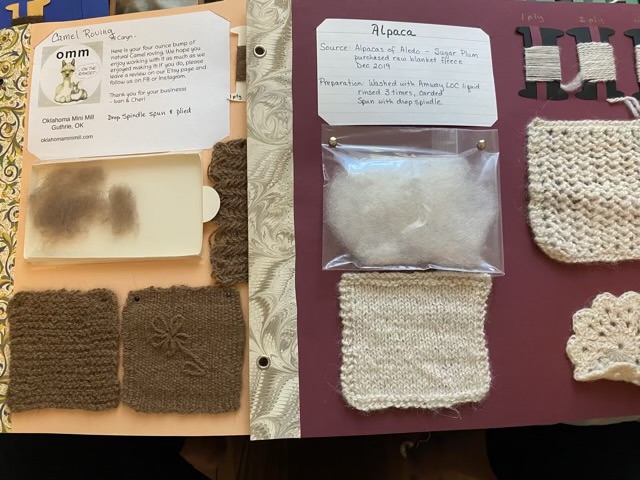
For my fiber study, I’ve been making fiber pages that have a small amount of fiber, then examples of spun, plied, knitted, crocheted, and woven fiber. I designed a small drawer for the natural fiber with the idea that it would protect the fiber from getting flattened and felted, but would still allow access to touch the fiber. It was a neat idea, but didn’t function the way I hoped. The drawer was too tall even at a quarter inch, and the stack of drawers took the brunt of the pressure and crushed, flattening the fiber. Hm. So I switched out the drawer for a plastic bag. The fiber can at least still be seen, and if necessary, the bag can be opened for closer examination of the fiber.
Photo description: two fiber pages, the one on the left shows the original drawer design, the one on the right shows the plastic bag
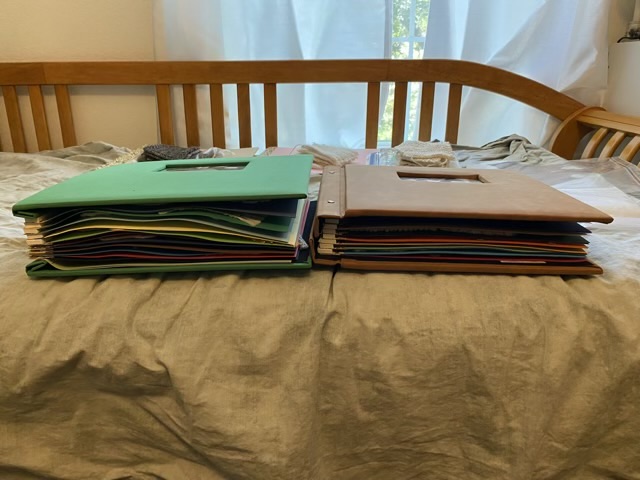
The advantage of the plastic bag to hold the fiber is that the pages lay nicer when stacked. The thickness of all the samples is similar and the pages lay flatter.
Photo description: two fiber pages books, the one on the left has distorted pages from the drawer stack, the right one shows how much neater the pages are when the drawer is replaced with a plastic bag.
I secure the bag to the page with brads. By keeping all the connections mechanical and avoiding glue or adhesive, it should give the pages a longer life.
I kept the foam spacers at the post side, and also added space for a 12×12 sheet after each fiber page, where I plan to put a description of each fiber, and some of the blog posts I wrote when spinning each fiber. This is definitely still a work in progress.
I recently attended a paper weaving class co-taught by my fabulous weaving neighbor at the local library. We made a woven heart from two-sided paper strips, the glued it into a card frame. The pattern is called a Cherokee Chief‘s Heart, but of course those of us without registered Cherokee heritage were making these weavings in the style of the pattern, as a learning exercise. My neighbor is a registered Cherokee and an awarded weaver and artist and is so generous with her teaching and knowledge.
Photo description: woven paper heart made from strips of paper that are green on one side and white on the otherPhoto description: opposite side of the same weaving, showing an inverted heart
We did have to use copious amounts of glue to keep the unwoven sections of the sampler in place. The weaving is neat in that the back image is the same as the front, just with the lines going a different way.
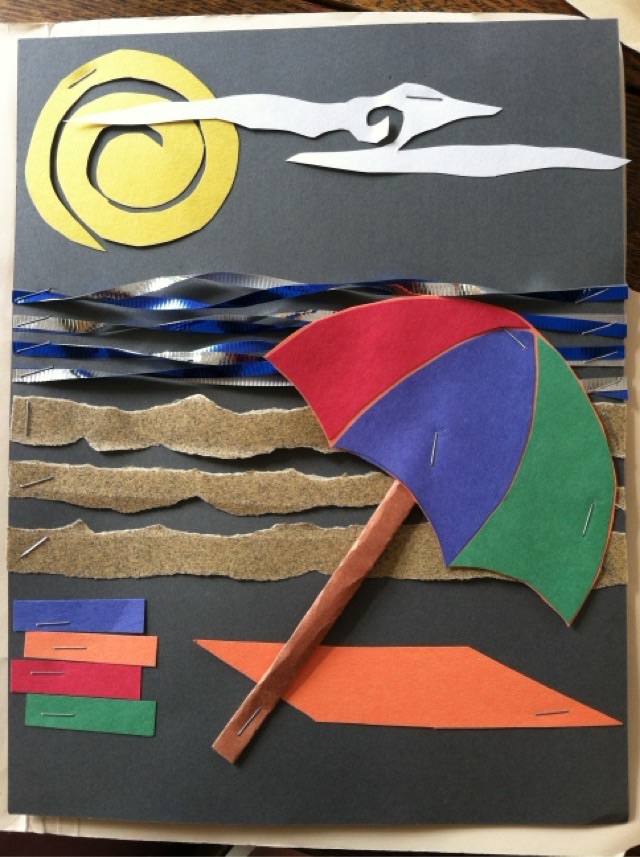
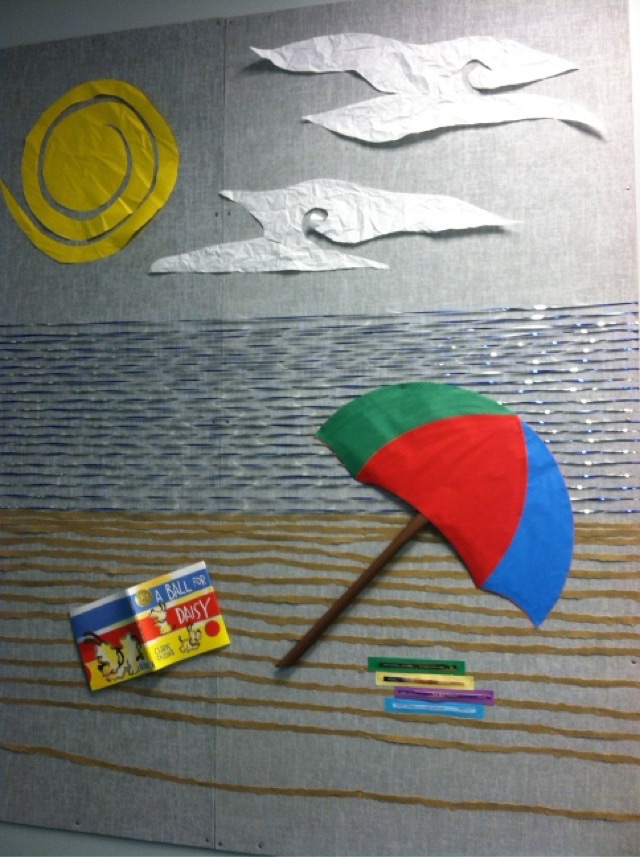
Today we look back at August 2013 and the library bulletin board to welcome kids back to school. I did a concept test on a regular sized sheet of paper, using strips of sand paper for sand, and ribbons for water. The kids love running their hands on the bulletin board, so I thought the sand paper would give them something nice and tactile.
Photo description: beach scene on black paper with paper umbrella, paper book stack, strips of sand paper, twisted ribbons, and paper sun and cloudsPhoto description: full sized bulletin board with a bonus book cover and I added a crumpled texture to the sun and clouds
The fun part of the full board is that there was a vent that blew air across the surface, making the ribbon move and giving motion to the ocean. I did not use backing paper; I was still fire shy after the previous year’s board was deemed a hazard by the fire marshal.
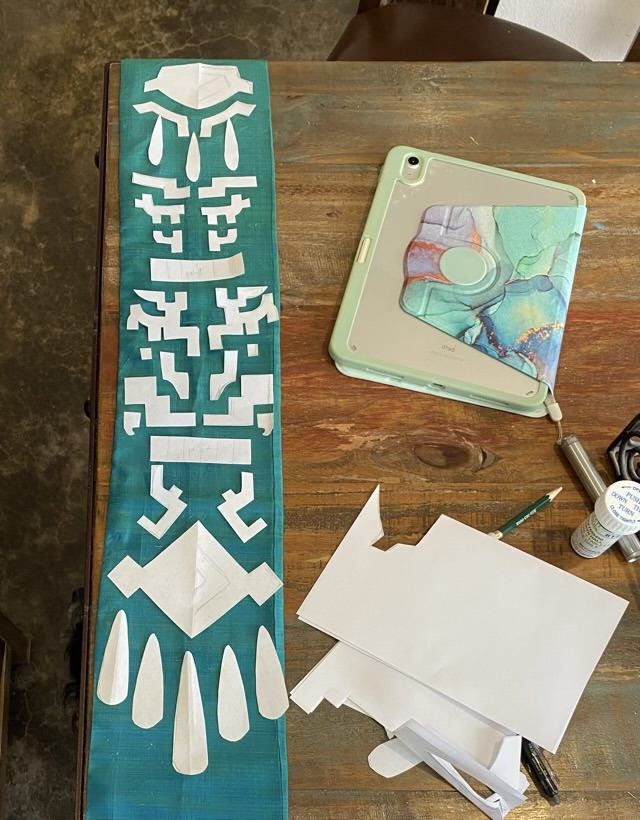
My eldest had a fantastic idea for a cosplay costume and I volunteered to help. (Ok, I may have begged, and “I’ll be in charge of this part” may have passed my lips. I’m definitely a Zelda fan, especially Tears of the Kingdom.) One of the parts I claimed was an elaborate panel that hangs on the front of Zelda’s Zonai dress. The panel has two layers, a silk banner and a copper beaded piece. To make the copper pieces light, I wanted to use EVA foam sheet and paint them. I cut shapes from paper first and laid them out on a banner of green/blue recycled silk.
Photo description: blue/green silk banner with white paper pieces laid out on top of a table with an iPad for reference and scraps of paper on the side
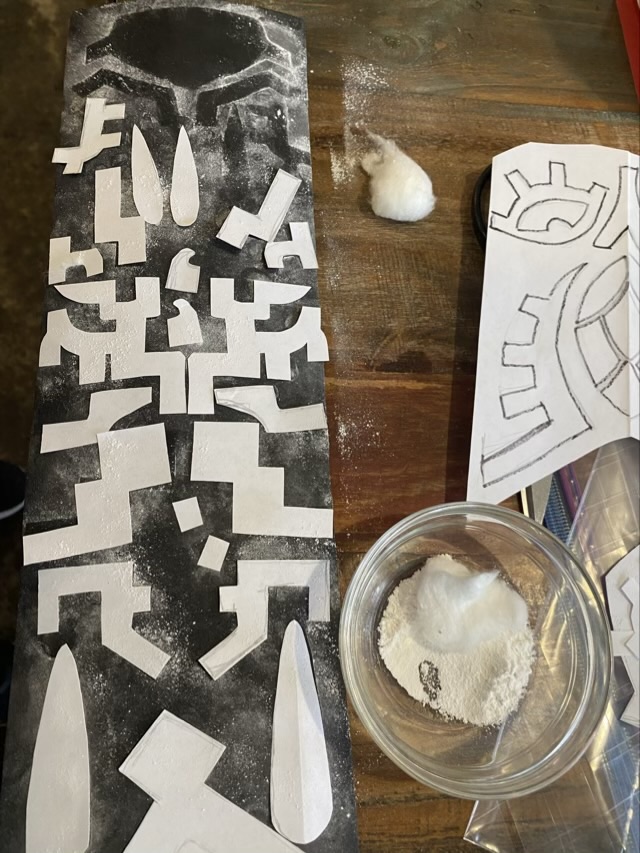
To transfer the paper pattern to the foam, my Mom suggested dusting the pieces. I laid them out on paper on the EVA foam, and used tapioca flour and a cotton ball to dust the surface.
Photo description: black EVA foam sheet with paper pieces covered in a thin layer of flour, bowl of tapioca flour and cotton ball to the side
The flour settled where the pieces weren’t, leaving a dark outline that was more precise than tracing. When I do this next I’ll use a foundation brush or something other than a cotton ball, because the cotton caught on the edges of the paper and did not lay down an even coat of flour.
Photo description: black EVA foam sheet without the paper
I was able to cut out most of the pieces using the flour shadows, and only on a few needed to use the original paper piece.
I’m going to break this project into several blog posts. My apologies to those who are not Zelda fans, I’ll be geeking out for a while. I hope there will be some techniques you will find interesting or useful.




 Critters and Craft