Expanding my fiber book

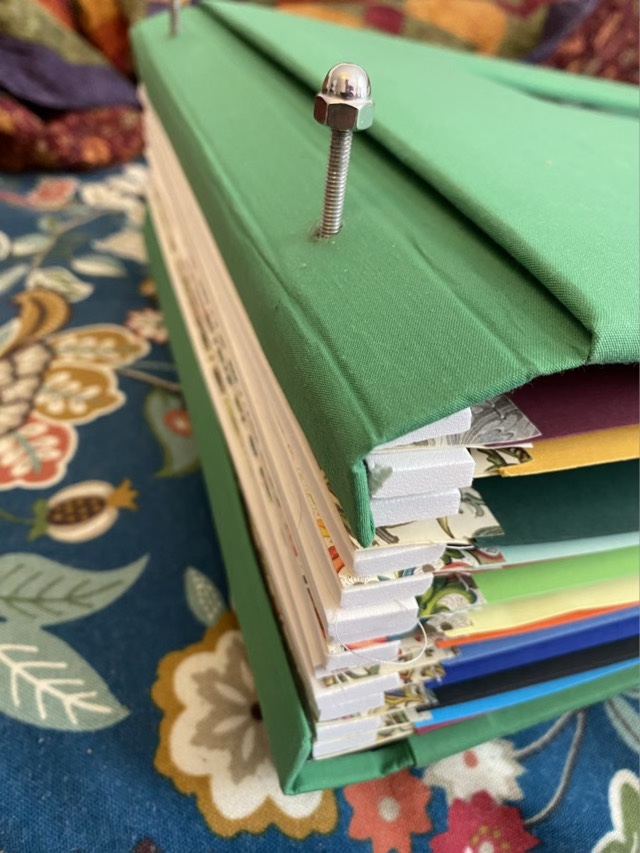
I’ve been quite frustrated with options for expanding my fiber book. The longest binding post screws I could find were not long enough, and the “extenders” had multiple reviews that that the threads didn’t fit, and I couldn’t find extenders that came with the caps. Bah. Time for a trip to the hardware store, specialty fasteners to the rescue. I found 5 inch threaded rods and some acorn nuts. They aren’t as fancy as a binding post, but they get the job done and I can probably fit another 10 pages in my book. I did have to adjust the cover to accommodate the acorn nuts, but it worked just fine to unfold the edge. A photo book this size would be very heavy and unwieldy, but my fiber pages are light and have thick spacers, so it works. I suppose I could separate up the pages into different books (shocking, right?), but right now I’d rather spend my money on fiber than book covers.

Photo description: Acorn nut on a threaded rod going through the edge of a photo book, sticking up about one inch over the cover, colored pages are spaced with white foam.

It is in my plan to eventually have an elegant external presentation, but I’m still cogitating on how I want that to look. This does the job for now.

Mohair fiber page

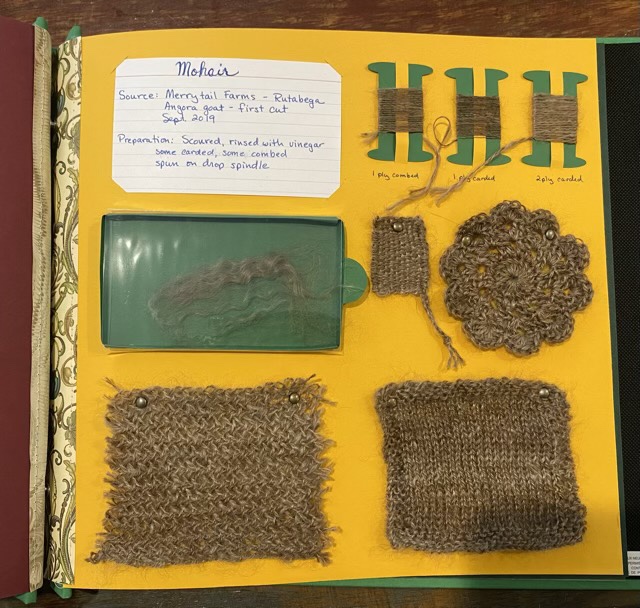
I finished my spun mohair fiber page. This mohair is from Rutabaga the Angora goat and is from her first shearing.

Mohair fiber page

I did a knitting swatch in stockinette stitch with a garter stitch border, crochet round, a minute weaver, and a nålbound swatch.

Information on each swatch written beneath the fabric

Nålbinding swatch

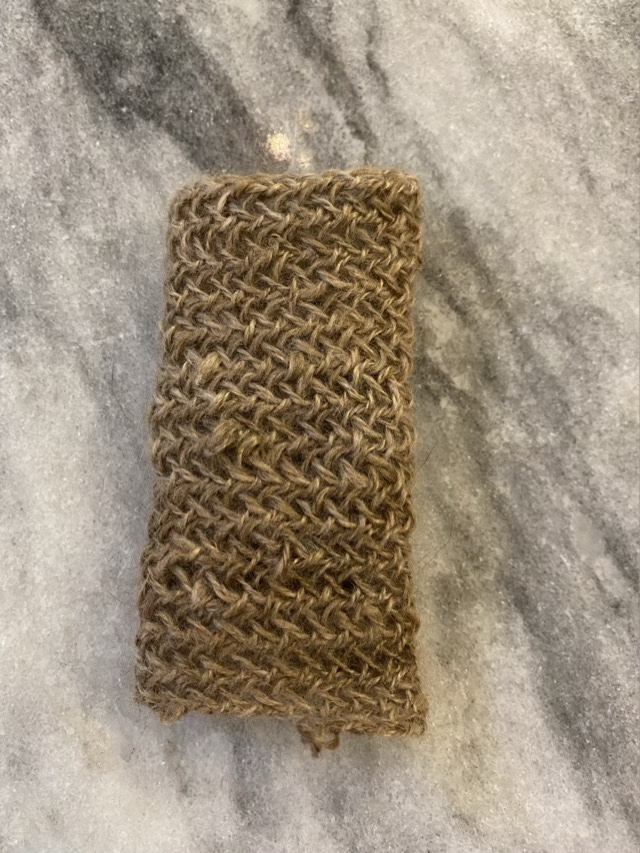
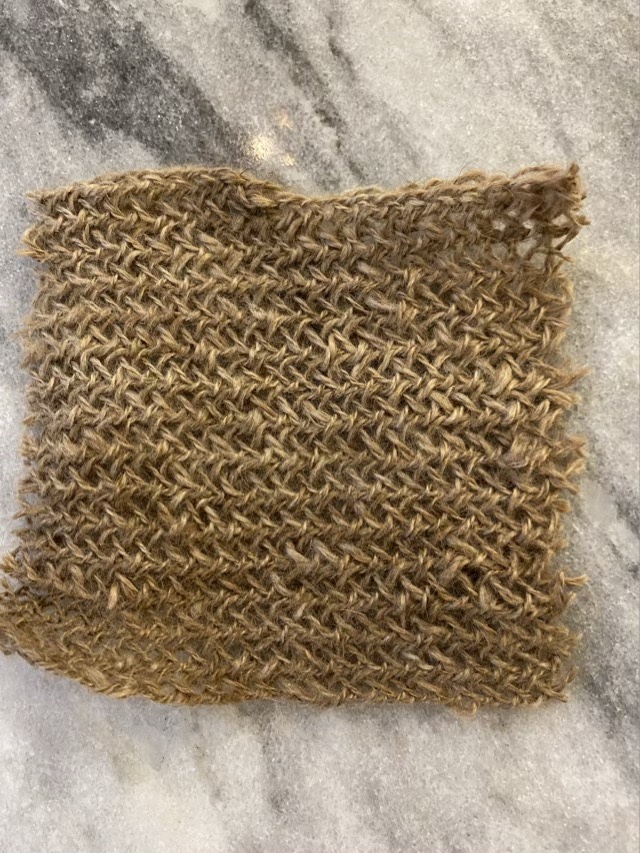
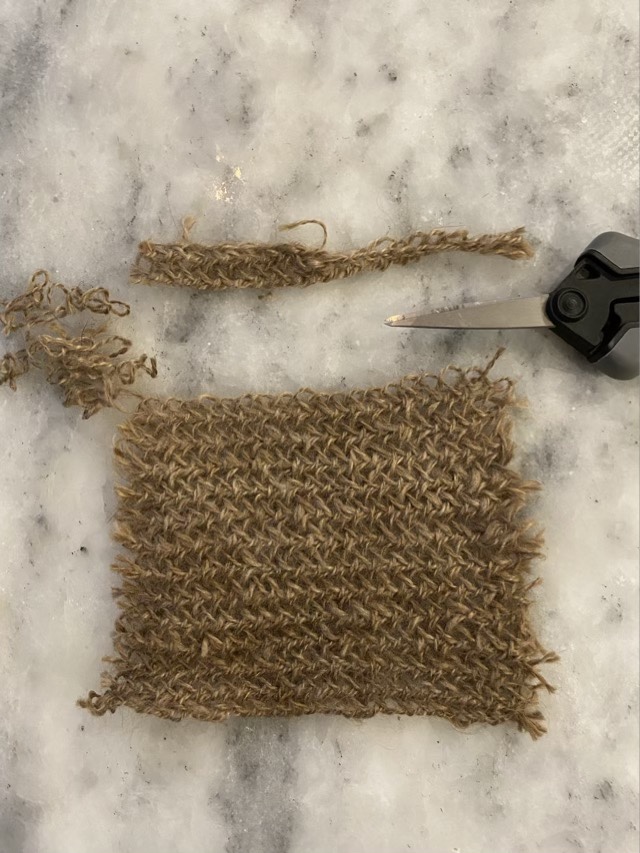
For my fiber book, I made a nålbinding swatch with hand spun mohair. The thing I love about nålbinding is the ability to cut it. Nålbinding is usually worked in the round, and each loop is connected to the next as well as to the row below. This makes it possible to cut the fabric vertically or horizontally and still have interlocked rows.

Nålbound tube in Dalarna stitch
Tube cut vertically to make a flat swatch
Swatch cut horizontally to remove uneven top

When nålbinding is cut, there are portions of loops that can be removed. I left the side edges raw, but removed the loose pieces along the top. This is going to be mounted on a page in a book, so won’t see too much wear and tear. It will still be interesting to see how it fares over the years.

Skeins and yarn cakes

Yarn cake (left) versus skein (right)

I bought some beautifully dyed yarn from a hand dyer. In the dying process, the yarn is left in skein form, which is basically a large circle secured in several places with twists of yarn. To store the skein it is twisted and one end tucked into the other. The skein form is beautiful, and shows off the dye, but is not friendly for direct use. It must first be wound into a ball or cake to be nice for crochet or knitting. You can have one person hold the skein open on their hands, and hand wind a ball, if you have someone with extra patience. Or a swift does the job of holding the skein open, and there are many types. I have an umbrella swift (named thus because it opens like an umbrella). I also have a ball winder (sometimes called a new wool winder), that has a rotating handle and makes center-pull yarn cakes. The sound of the Swift and ball winder turning makes a nice swoosh and clickty clack I find soothing.

Winding a center pull yarn ball

When I was learning to knit and crochet, I was taught to roll up extra yarn into a ball. Generally, you started with a small nest of yarn and wrapped more yarn around, changing directions every so often so it came out more or less round. Inevitably, I would drop the ball, it would roll across the floor, the cat might help its progress, and I would have to wind it up again. When I was older, I obtained a “new wool winder” which winds yarn from a hank into a cake-like structure, but was wonderful because the cake sat still and yarn could be pulled from the center. It did not work so well with small amounts of yarn, and I had to go and find the machine and a place to secure it to use it. Fast forward many years (better just skip, because there is quite a lot of time from then to now), and I was learning about spinning on a dealgan (a Scottish type of drop spindle), and the presenter in the video said the newly made yarn was wrapped around the spindle in the same way as for a nostepinne. What? The resulting cop of yarn could come directly off the spindle and the yarn could be pulled from the center. Hm. New rabbit hole. Nostepinne is a word for a fancy stick. I used a 1” dowel, which worked just fine the first time, but you really don’t even need a stick. A rolled up piece of paper will also work (especially if the cat is comfy on your lap and you can’t reach your stick, but there is a handy piece of paper).

Wrapped yarn ball (left) versus center pull ball (right)

Here is a video: https://youtu.be/Fk6PVyzV6BY

I’m sharing because I really found this way of winding to be life changing. And it is so simple.

On a separate note, Adobe Premier now will make captions from my audio automatically. So that saves me a bit of typing. It still needed editing because “nostepinne” is not in its transcription vocabulary. Shocking. The video isn’t fancy because I’m still learning the software.