I have finished a new fiber page for my spinning book! I mounted all my samples from hand spinning soybean top (top is the description of the fiber preparation, involves combing, and produces parallel fibers) on prepped black card stock. I would definitely use this fiber again, it is very strong, yet so soft.
Photo description: Soybean top fiber page. Clockwise from top left: original card from Hearthside Fibers reading “Soybean Top Developed in the USA in the 1930s by Henry Ford Used in Ford car upholstery pre-1940”, single spun, 2-ply, and 4 ply yarn samples, woven swatch, nålbinding swatch, crochet swatch, knit swatch, combed fiber.Photo description: same page with swatches flipped up to show the writing underneath: plain weave on Clover mini loom, nålbinding Dalarna O/U O:U O, crochet 1.75mm hook, Stiockinet size 2 needle knit.
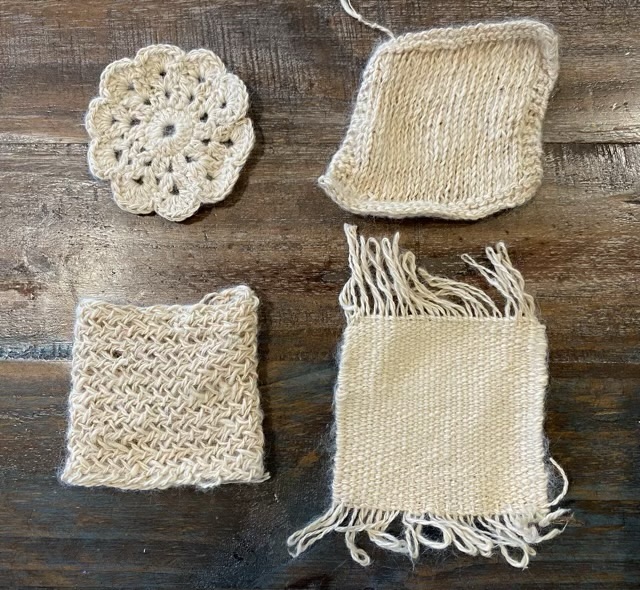
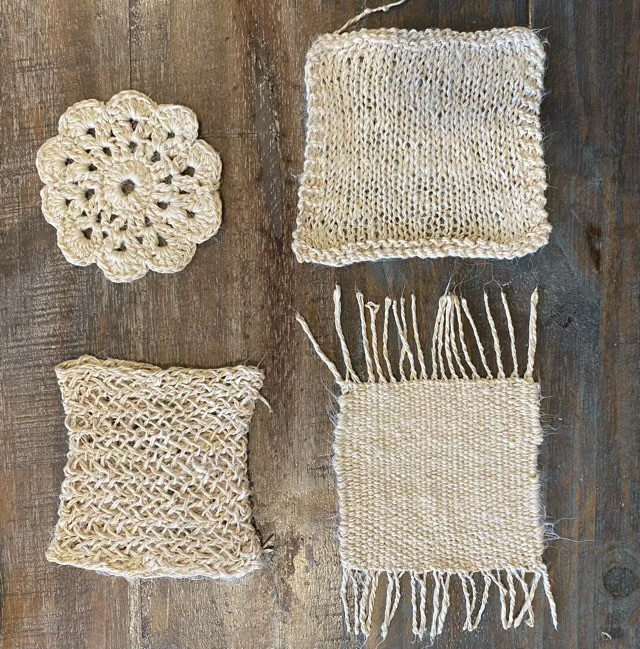
I made four example swatches from my spun soybean fiber: knitting, crochet, weaving, and nålbinding.
Photo description: swatches before blocking, clockwise from top right: stockinette knitting, plain weave, nålbinding Dalarna stitch, and crocheted lace round
The knitting swatch tells the most about the yarn, the obvious skew is because my singles have more twist than my ply. This bias does not have a significant impact on the other swatches. The nålbinding has several small knots because I could not get the fiber to felt together. I used a 1.75mm hook for the crocheted coaster, which was on the small side because the stitching is dense and stiff. The soy yarn is incredibly strong; I can’t break a single strand with my hands, but it is also incredibly soft even with the amount of twist I put in the single. There is good reason that it also carries the name vegetable cashmere. It also blocks well. It was very easy to shape when wet, and kept that shape when dry.
Photo description: same swatches after blocking
I was able to square up the knitting, and give the woven swatch some more twist in the fringe. The nålbinding swatch stitches opened up, but the crochet didn’t have much change, probably due to the density of the stitches.
The next step is to mount the swatches in my fiber book.
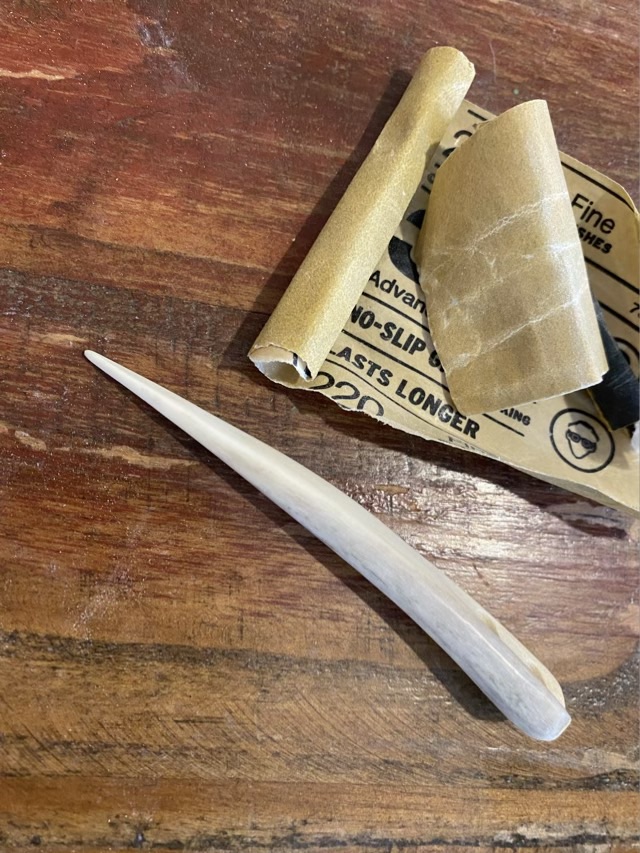
I have made my first nål for nålbinding out of antler bone! I have made several out of wood, and was hesitant about bone, but it turns out it is easy to work. I do wear a dust mask at all times because I don’t want that bone dust in my lungs. I like how well it buffs to a shine without applying a finish coat.
Photo description: thick bone needle with two holes on a table with scraps of sandpaper.Photo description: side view of the same nål, showing the natural curve from the antler tip.
This nål came out a little thicker than I care for, so I’m going to experiment with some other methods of construction. I just sanded this one down to shape; for the next one I’ll try cutting it lengthwise then sanding down, and I will try a different curve.
Thor the technical kitten (since he is still under a year old), likes to carry around his toys. One of his favorites is a wrist warmer that I nålbound from home spun bison down. Materials alone make it a pricey toy, but if time invested is considered, it vaults into precious territory. Apparently he took it on a field trip to the catio, then back inside, because I found it on the rug covered in dried grass.
Photo description: Brown wrist warmer made from American Bison fiber, covered with bits of dried grass. There is some felting, and a couple pulled loops in the fabric.
Allowing the wrist warmer to become a toy was a calculated event. The one donated to the cat was a tight fit and I wasn’t wearing the pair. Now it becomes a test of how durable I made the spinning and nålbinding. I’m actually quite amazed that it is holding up to kitten attentions as well as it is.
I actually spun this bison fiber before I started my fiber book. I used a tahkli spindle and spun fast and fine, then made a two ply yarn. I experimented with singles spun in both the S and Z directions, then nålbound wrist warmers (blog post here). The second, tighter wrist warmer continued to get tighter as the fibers felted together, until it was uncomfortable to wear. Then the kitten found it and had a hay day. So I dedicated the first piece to the book. I had some leftover yarn so did up a knit swatch and a crocheted lace round. I didn’t save any single spun yarn, so had to deconstruct some plied yarn for the page.
Photo description: Clockwise from top left: “Bison Spinning Fibers” card; single ply yarn; two ply yarn on a paper bobbin; one nålbound wrist warmer; crocheted lace round; knit square; loose bison fiber
Bison down fiber really is a luxury fiber. It feels like spinning clouds and the yarn is so soft and so very, very warm. It is definitely one of my favorite fibers. (And yes, this is an absolutely shameless plug for my neighbors, The Buffalo Wool Company. Fantastic people, even more fabulous dedication to the preservation of the American Bison.)