I finished another fiber page (really I did three together, but I’m going to spread it out in this blog). This page is about hemp. The hemp top, combed hemp fibers, came in a collection of plant fibers as a gift from my sister. I spun the singles on a drop spindle, then made a two-ply yarn using a different drop spindle. The fiber was nice to spin, but the resulting yarn was stiff and scratchy, even after setting the twist by boiling. Hemp is usually used to make rope and strong fabrics, certainly not anything you would want next to your skin. I made a knitted swatch with size 4 needles, a crocheted round with size C hook, and a woven sample with four salvages using a Clover mini-loom and doubling the warp threads. Even though I wouldn’t make clothing with this yarn, I think it is the neatest page I’ve done so far.
Photo description: Clockwise from top left, card from Hearthside fibers, three bobbins with single, 2-ply, and set 2-ply yarn, crocheted lace round, woven not-quite rectangle (still working on my weaving tension), knitted rectangle, and a card stock drawer with hemp fiber.
I finally finished my flax page. This is internet-sourced combed top flax, which is an unusual preparation. It is the short fibers left over from processing the long fibers, combed together. This particular sample was also dyed, probably with nettle dye. There was very little information from the seller (buyer beware). I did manage to spin it in on a drop spindle, using a sponge to wet my fingers. Linen yarn needs to be boiled to set the twist and soften the fibers. When I boiled mine, I used tap water, which has traces of iron. The soft green color turned to a soft orange. The picture below shows the color change especially across the paper bobbins.
Photo description: 12×12 page with floral paper binding; the original fiber label top left; paper bobbins holding the yarn as a single, a two ply unset (green), and two ply set (orange) top right; unspun fiber in a paper drawer middle left; plain weave sample middle right; knitted sample bottom left; weft-faced weave bottom right.
I did a knit swatch on size 4 needles. It isn’t precise, probably due to the variations in yarn thickness, and has a bias, probably due to over twist of either the single or the ply. Still, it isn’t as rough as I thought it would be and has some nice drape.
I obtained a Clover brand mini-loom to make the woven samples. The first weaving (bottom right) I followed directions on warping the loom and ended up with a weft-faced weave. Interesting, but not what I wanted. The second time (middle right) I wrapped the warp completely around the loom and doubled the number of warp threads. This brought the epi (ends per inch) up and let me do a plain weave that showed both the warp and the weft.
I swear I did a crochet swatch too, but I must have stashed it somewhere safe. I do still want to spin traditionally prepared flax, but I’m not likely to buy combed top flax again.
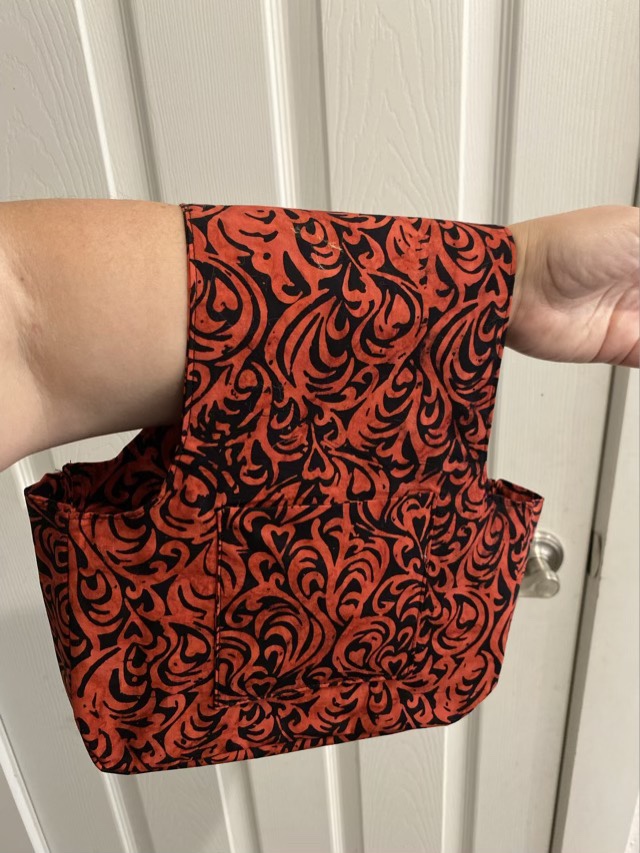
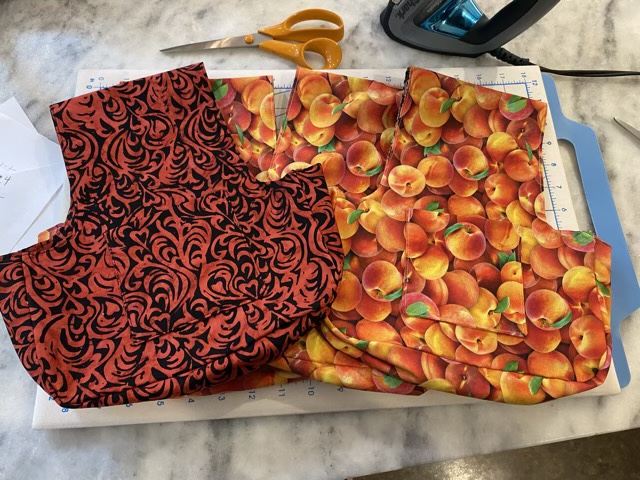
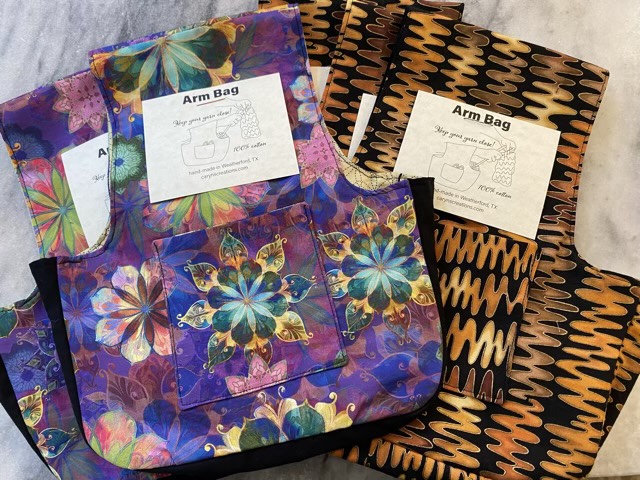
I made up a few arm bags to sell at our local craft store. I love these bags. I love having my yarn up close, and not having to draw it from a container on a table or the floor. They make it possible to stand or walk and craft as well. The wide handle lays comfortably on my forearm, there is enough room to reach into the bag while it is on my arm, and there are two pockets! Pockets are important. I make them with 100% cotton quilting quality fabric.
Arm bag on my armSome more fabric patternsA few more fabric colors
I commissioned my eldest for the drawing on the tags, as I was busy sewing. I think it came out well. These are currently sold exclusively at NerdCraft in Weatherford, TX.
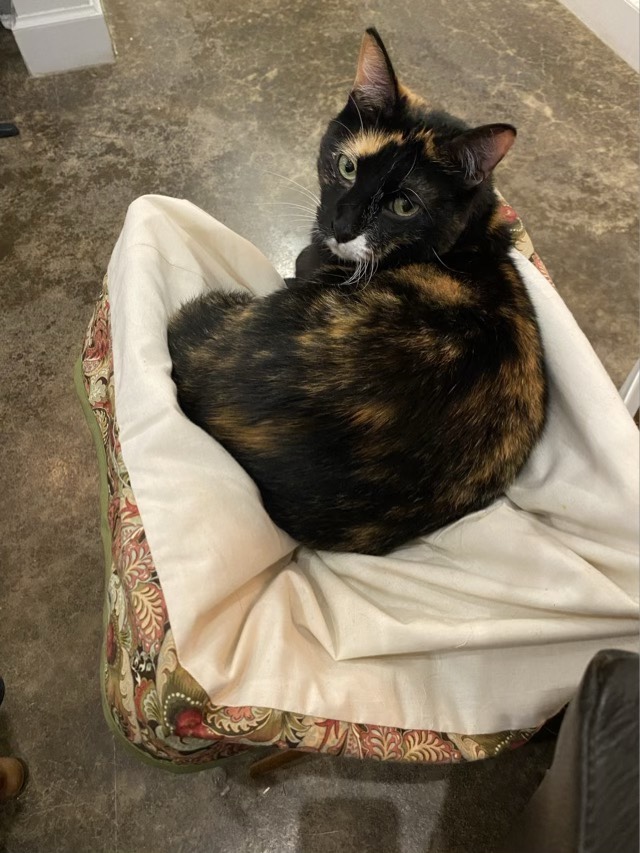
My knitting bag next to my chair was my grandmother’s. It has a fold out wooden frame and inside pockets (pockets are important). With a kitten in the house, I need to keep it covered and keep him out of my yarn. I’ve tried several things, then rediscovered a basket lining I made years ago. Inside out, it makes a great cover. I would like to put some elastic in, to give it a snug fit, but even without it does the job of protecting my yarn. The kitten likes it, so my older cat, Izzy, thought she would give it a go.
I’ve been slowly progressing on my brioche rainbow scarf project. I’ve made it down to where the colored yarns need to be rewound because as I pulled from the center, the yarn was getting tangled. Since this is a waiting-in-the-car project, I rolled up a park map to use as a nostepinne to rewind each color then pop it back in the split pool noodle (which really works well to hold all the colors). I still have many hours of work left, but the end is nearing. It is funny how I used to consider scarves quick and easy projects.