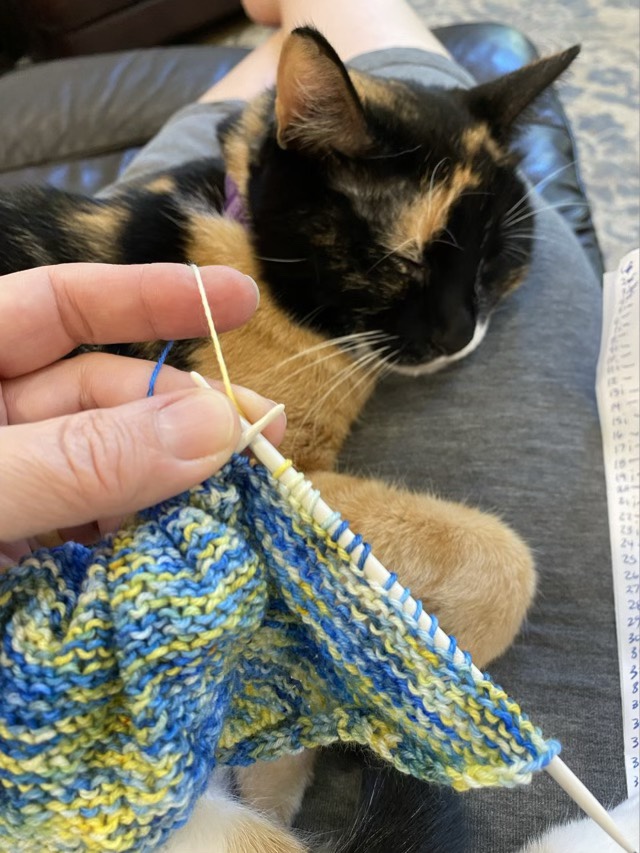
I have two knitting works in progress. One needs a section ripped out, so is resting until I have the courage to tackle it, and the other I cast on several months ago, and am now circling back around to work on it. This is a fingering weight sweater (right? Crazy.) that I bought the yarn to support a cause, and determined I wanted to make my youngest an actual garment. The knitting isn’t hard, but it does take a long time. Izzy the cat appreciates it when I knit; I provide a long-term nap space.
Photo description: Yellow and Blue fingering weight yarn on Prym circular needles in the foreground; in the background a sleeping calico cat laying on my lap.
I am acknowledging that this will be an on-again off-again project as other shiny things distract me.
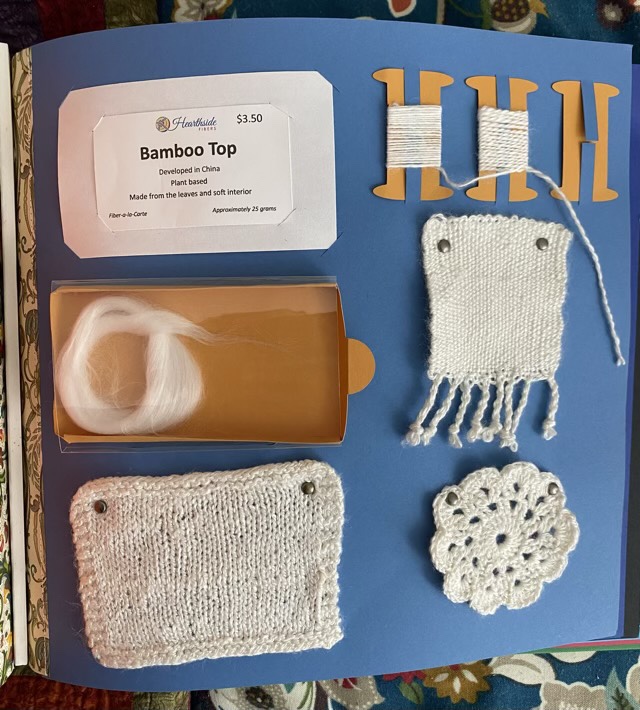
Photo description: Clockwise from top left: “Bamboo Top” card which reads “Developed in China, plant based, made from the leaves and interior”, single spun yarn on a paper bobbin, 2-ply yarn, swatch woven on a Clover mini loom with 3 selvages, crocheted lace round, knitted rectangle, unspun fiber in a paper box.
Spinning my bamboo sample was very enjoyable. The fiber is soft, and the staple is a nice length. I did have some static issues, but those that were resolved with a spritz of water. I spun the singles on a drop spindle, and I kept the fiber and spindle in my purse to spin during waiting times. I made the two ply yarn from a center-pull ball using the same spindle. The fiber has a beautiful luster.
Photo description: A hand holding a single spun bamboo yarn wrapped nostepinne style on a 3D printed spindle.
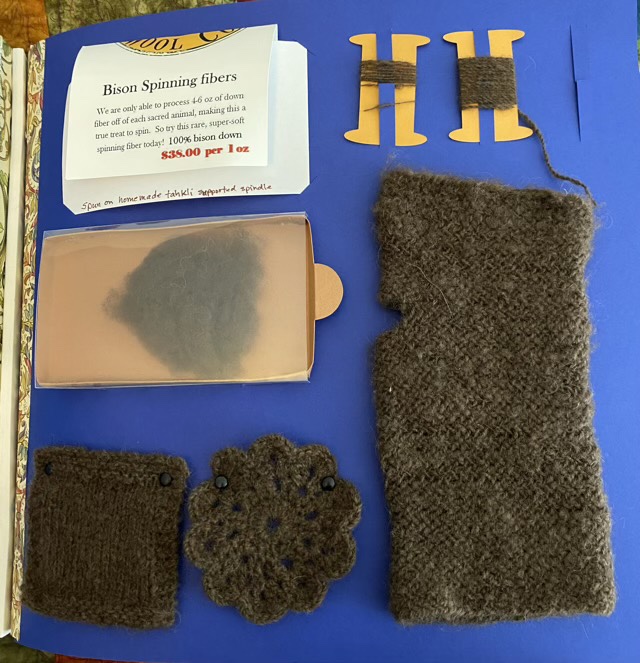
I actually spun this bison fiber before I started my fiber book. I used a tahkli spindle and spun fast and fine, then made a two ply yarn. I experimented with singles spun in both the S and Z directions, then nålbound wrist warmers (blog post here). The second, tighter wrist warmer continued to get tighter as the fibers felted together, until it was uncomfortable to wear. Then the kitten found it and had a hay day. So I dedicated the first piece to the book. I had some leftover yarn so did up a knit swatch and a crocheted lace round. I didn’t save any single spun yarn, so had to deconstruct some plied yarn for the page.
Photo description: Clockwise from top left: “Bison Spinning Fibers” card; single ply yarn; two ply yarn on a paper bobbin; one nålbound wrist warmer; crocheted lace round; knit square; loose bison fiber
Bison down fiber really is a luxury fiber. It feels like spinning clouds and the yarn is so soft and so very, very warm. It is definitely one of my favorite fibers. (And yes, this is an absolutely shameless plug for my neighbors, The Buffalo Wool Company. Fantastic people, even more fabulous dedication to the preservation of the American Bison.)
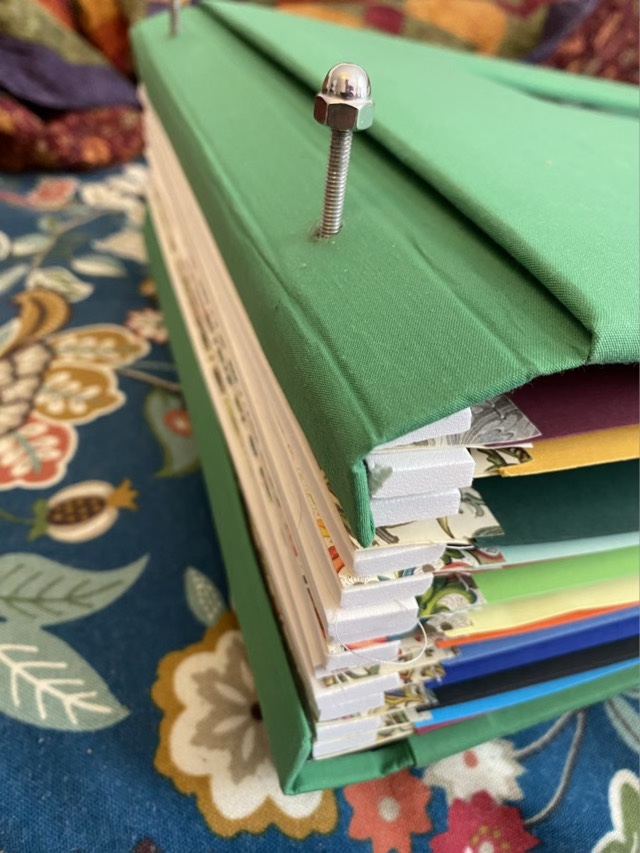
I’ve been quite frustrated with options for expanding my fiber book. The longest binding post screws I could find were not long enough, and the “extenders” had multiple reviews that that the threads didn’t fit, and I couldn’t find extenders that came with the caps. Bah. Time for a trip to the hardware store, specialty fasteners to the rescue. I found 5 inch threaded rods and some acorn nuts. They aren’t as fancy as a binding post, but they get the job done and I can probably fit another 10 pages in my book. I did have to adjust the cover to accommodate the acorn nuts, but it worked just fine to unfold the edge. A photo book this size would be very heavy and unwieldy, but my fiber pages are light and have thick spacers, so it works. I suppose I could separate up the pages into different books (shocking, right?), but right now I’d rather spend my money on fiber than book covers.
Photo description: Acorn nut on a threaded rod going through the edge of a photo book, sticking up about one inch over the cover, colored pages are spaced with white foam.
It is in my plan to eventually have an elegant external presentation, but I’m still cogitating on how I want that to look. This does the job for now.
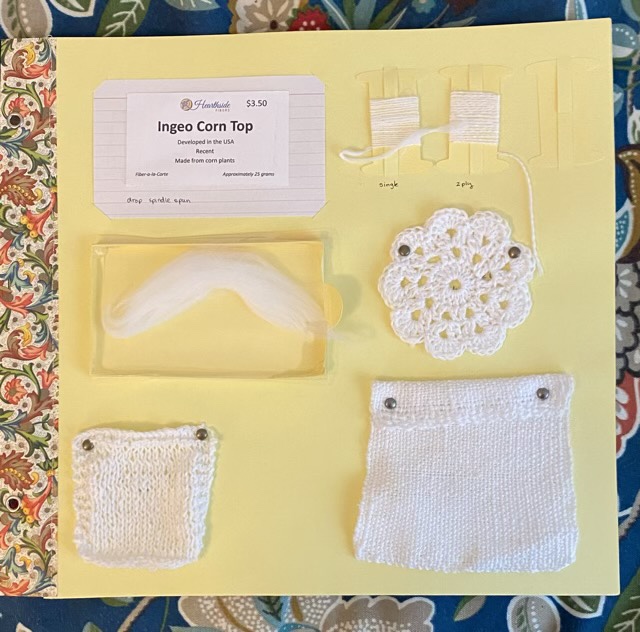
The Ingeo corn top was an interesting addition in my plant fiber sample bundle. It feels like cotton, but has a much longer staple length (the length of the individual fibers). I spun it up on a drop spindle and made a two-ply yarn.
Photo description: clockwise from the top left: Hearthside Fibers description card; paper bobbin holding the single; paper bobbin holding 2-ply; crocheted round (size C hook); four selvage woven sample(Clover mini loom); knit sample (size 4 needles); un-spun fiber in a paper drawer
I perused an internet search on the fiber, and liked the semi-science description (although it is still marketing speak) from Paradise Fibers:
“Extract dextrose from plant fibers, ferment, distill, and extract lactic acid into a polymer, creating silky, lightweight roving. Ideal for garments, biodegradable, breathable, high wickability, and flame resistance. Crimp and resilience make knitting easy. Low odor, good moisture management, fast drying, and soil release. Dye just like a protein fiber and marvel at the results! Renewable, natural, and simply divine.”
Some other sites also say that it is a good fiber for people with sensitive skin. I would certainly wear it. The samples I made up felt wonderfully soft. This is definitely a fiber I would buy in larger quantities to make full-sized project.