I finished knitting my Helix scarf! It has lovely ripples when laid out, but is a bit short. I used all my hand spun blended wool and silk yarn, so if I need to add on, it would have to be a different color. Hm. I think I will block it (get it wet and lay it out) before making rash decisions.
Photo description: Helix scarf made with hand spun fingering weight 2-ply yarn, showing opposing ripples along a central spine.Photo description: same scarf, but folded in half and laid out in a circle.
I really love this pattern, and the way they do the short rows. It really is a wonderful way to show off hand spun yarn, and I like the subtle variation in color that the blended fiber produced.
I saw the idea of using a numbered chain to count knitting rows. A simple sequence of 1-10, with a melody clip to mark the tens, will allow counting up to 110. I did not want to buy plastic beads, but I did have copper circles and chain in my stash.
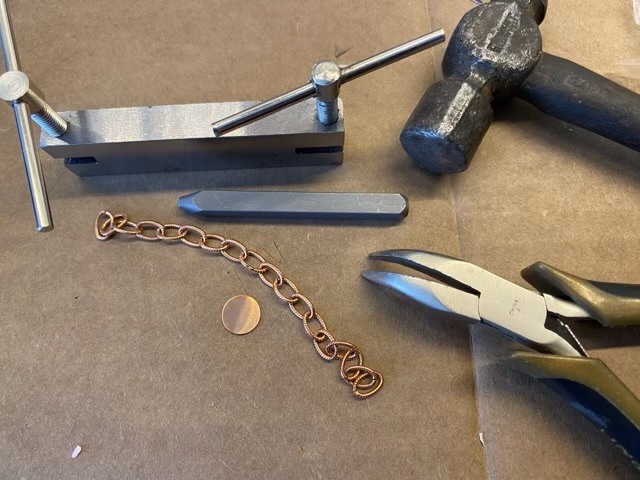
Photo description: clockwise – metal hole punch, antique ball peen hammer, bent nose pliers, copper circle, copper chain, metal number stamp
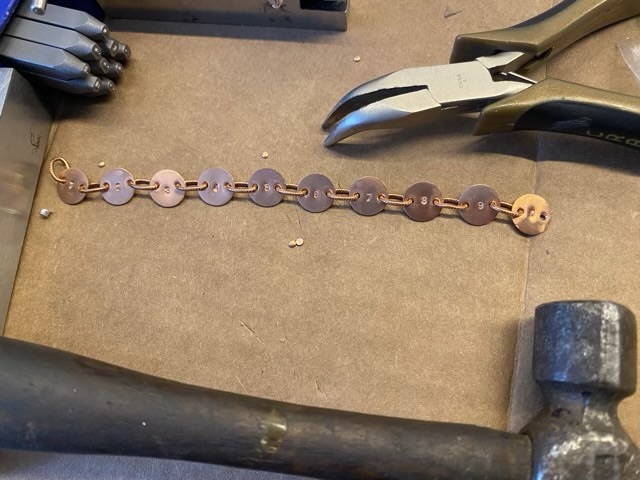
I started by punching two holes in the sides of the copper circles, then I stamped a number between the circles and planished the back flat. I connected the number links with links of chain.
Photo description: copper circles linked with oval copper chain surrounded by the tools mentioned above. My “10” link is a 0 because there wasn’t room for a 1.
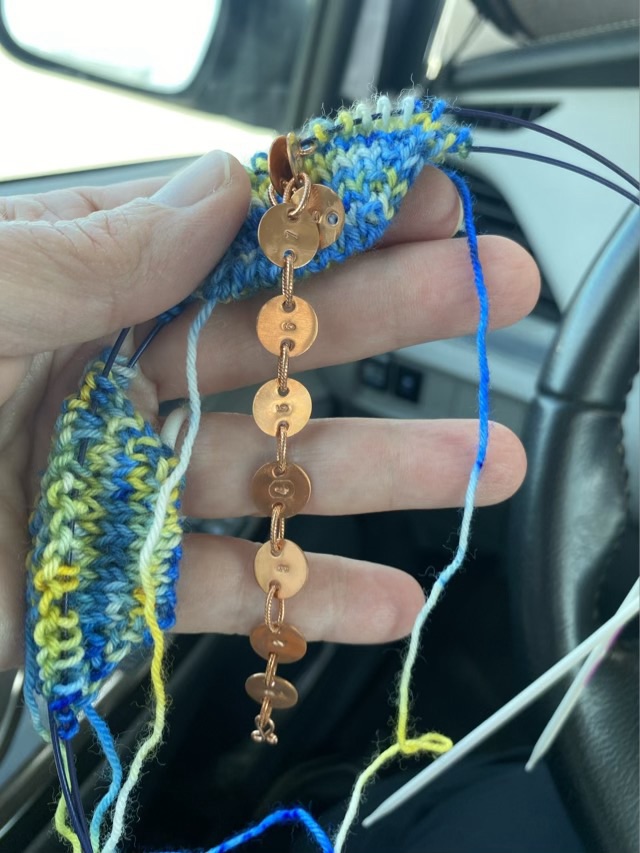
I made a small melody clip out of 20 gauge copper wire. The size of the copper links means this will only work on knitting needles that are size 2 or smaller, which is perfect for sock making.
Photo description: toes of two socks with the row counter on the needle between stitches. The melody clip is on the first link, and the needle is through the eighth link.
To use the row counter, every time you knit to it, you move it one link. For the start of the sock toes, I’m really just using it to keep track of odds or evens, an increase row or no increase row. This is because I had to rip out these socks already because I forgot the no increase rows. I do like the row counter!
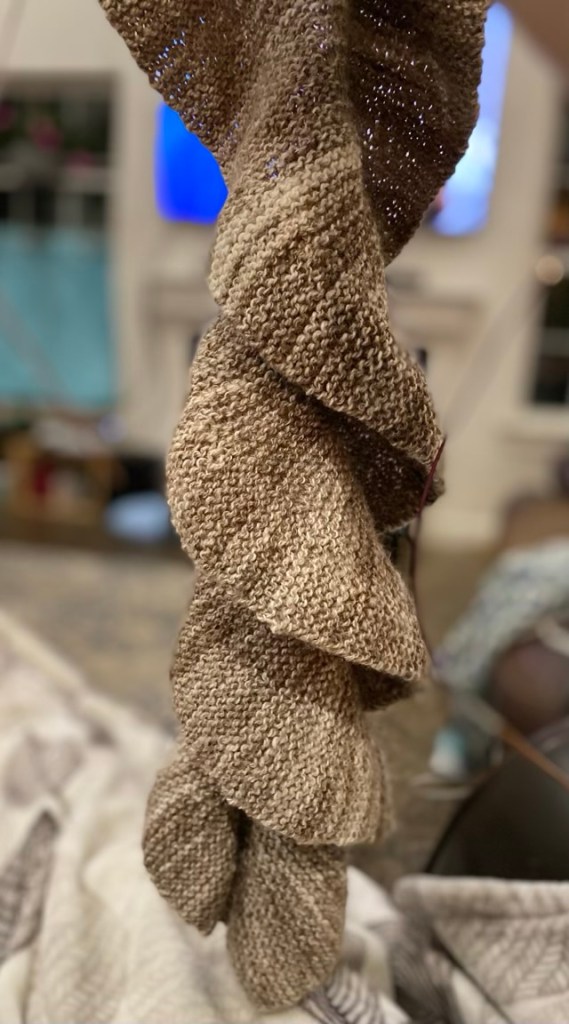
Photo description: garter knit scarf held up vertically showing a helix twist.
The pictures that accompanied the scarf pattern showed a lovely wide double-sided ruffle, but the title was helix scarf, which caused me to wonder, until I had knit awhile. So cool that the short rows on each side make this twisted effect. I really like short rows, and I like this pattern because it is a three-row repeat, which is easy to remember.
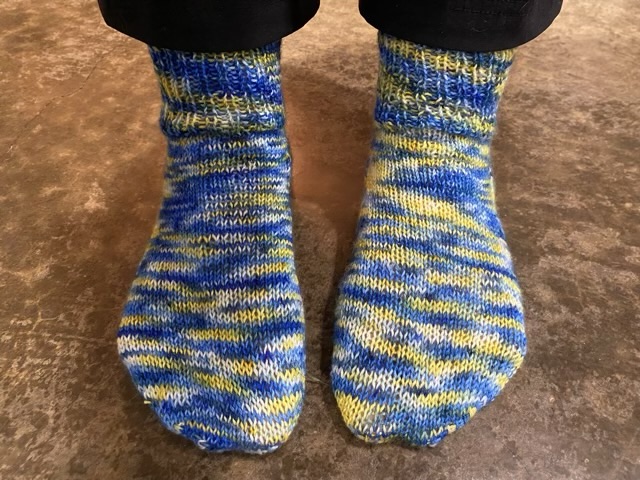
Photo description: blue, yellow, and white variegated socks with ribbed cuffs on my feet.
I finished a garment! Ok, yes, it was a pair of socks, but they fit! In addition I learned many things, such as I don’t like knitting socks top down, and I’m not a fan of a heel flap construction. I should probably use smaller needles, too.
What I did like about this project is knitting both socks at once with two circular knitting needle sets. When I was done knitting one sock, I was also done with both socks. No trying to make a second match! Two needle sets were quite fiddly with this pattern and method, but I have hopes for the next pattern that uses a toe up method!
I know other people really like the top down method, and enjoy double pointed needles. I’m glad we are all different and that there are people out there sharing their preferred methods.
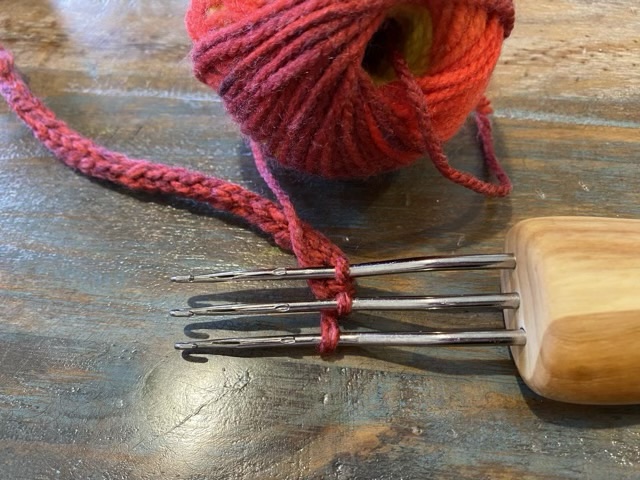
It works! The three hook i-cord maker that I made (yesterday’s post) works quite well to make a cord that is usually made by sliding stitches off a needle to make a round.
Photo description: three hook cord maker with a red i-cord in process.
Casting on three stitches on a regular knitting needle around size 11 makes the cleanest start, but if a needle isn’t available, making a chain with one hook, then placing the loops on the other two hooks, works just fine. To make the rest of the i-cord, you pull the loops on the hook down below the latches, lay the yarn loosely (really, I mean it), over the hooks just below the curve, and pull the loops up and over the hooks. The latches should close as the loops are pulled up, trapping the new section of yarn, and allowing the loops to pass over. A good strong tug brings the new yarn to make three loops, which you then pull back down below the latches. When I picked up the knack, it really went quite quickly.
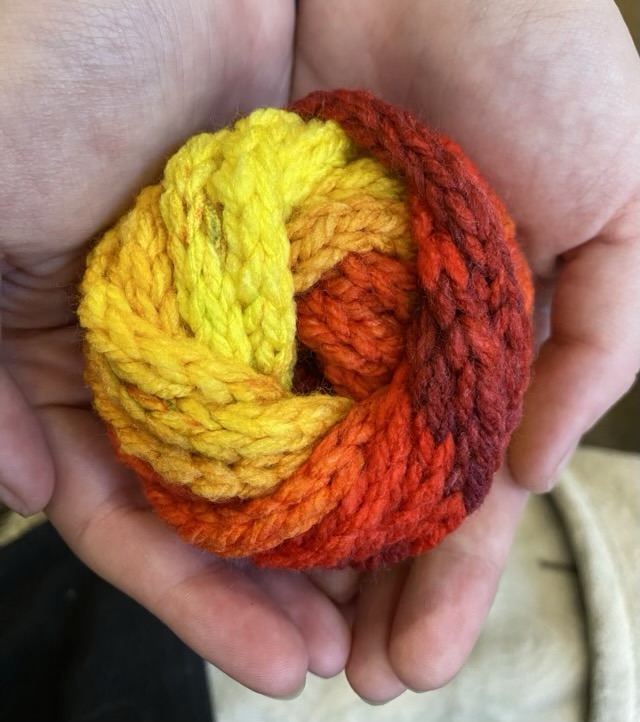
Photo description: wound ball of i-cord made of bulky red, orange, and yellow variegated acrylic yarn.