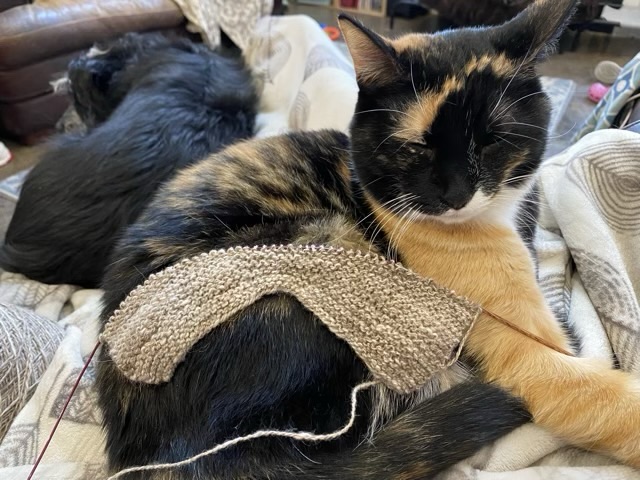
Photo description: beginning of a knitted scarf with short rows lying on a calico cat with a small black dog in the background.
I have cast on the Helix scarf from Spin Off magazine! I did make a modification, casting on thirty seemed very narrow, so I ripped out (only a couple rows) and cast on 50 instead. I adjusted the short rows to alternating 20 and 10. It turns out that I really like short rows, and the wrap and turn method. Izzy the cat doesn’t mind being on my lap as I knit, but Thor the cat thinks the yarn smells really good and keeps trying to take off with it, or chew on my circular needle.
Yes, I finished ripping out the sweater and the next day cast on a pair of socks. I am using two circular needles to knit two socks at a time. I have knit socks before, but it has been awhile, so I pulled out a book I found in a stash of craft books. These socks knit top down.
Photo description: two blue and yellow sock cuffs on circular needles in front of my steering wheel. I’m knitting while waiting for school pickup.
I made the mistake of working each sock from the same yarn cake, one strand from the inside, one from the outside. The yarn twists as I turn the work and I’m constantly untwisting as well as untangling from around the circular needles. I have done double pointed needle knitting, but all the ends capable of dropping stitches terrifies me.
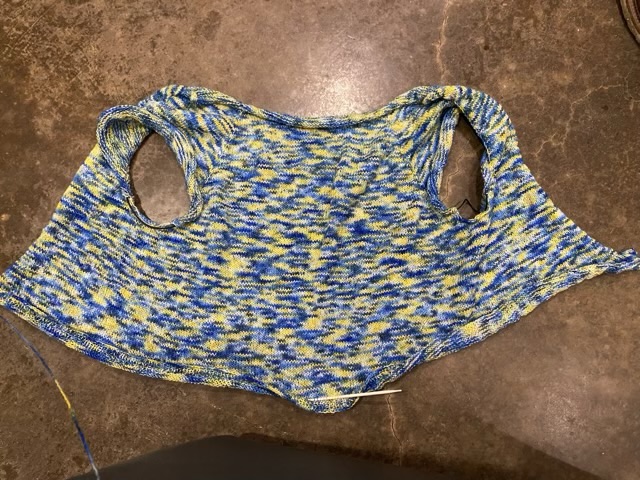
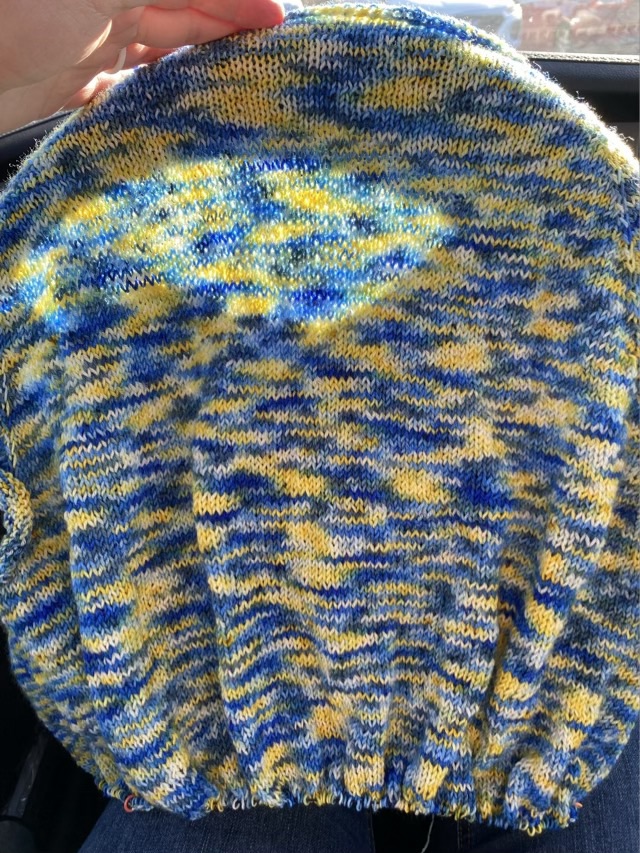
So usually I am not a proponent of ripping out yarn work. If an item passes the 10 second rule (someone who is not an expert can’t find the mistake in under 10 seconds) it’s fine. I’ve put dozens of hours into knitting a fingering weight cardigan, finally getting it to the point it could be tried on. The intended target doesn’t like it. Honestly, I don’t either. The colors look fabulous in the skein, but I really dislike color pooling in knitting, and this one is particularly jarring.
Photo description: partially knit cardigan with arm holes, back, and sides in a variegated yellow and blue yarn with a small repeat, very visually busy.
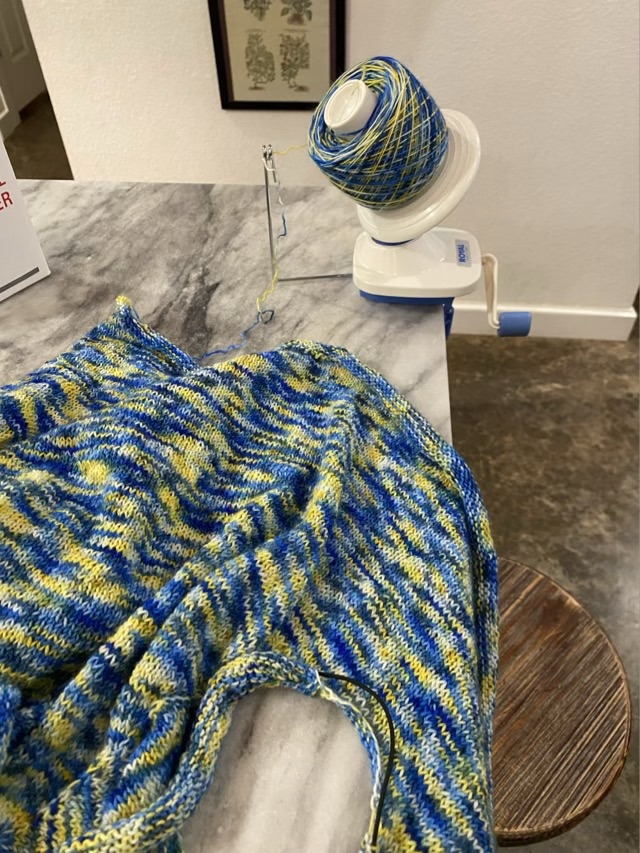
So I had a choice: put a couple more dozen hours into an ugly item no one will ever wear, or rip it out and make socks that everyone will wear. Frog it time. (Rip it, rip it, rip it.)
Photo description: partial cardigan laying on the counter with the yarn attached to a wool winder.
I say “frog it” flippantly, but it is a heavy duty to destroy your own work, even when the intension is to make anew. To cushion the heartache, I shot some video of the deconstruction and posted YouTube shorts. It did provide some catharsis.
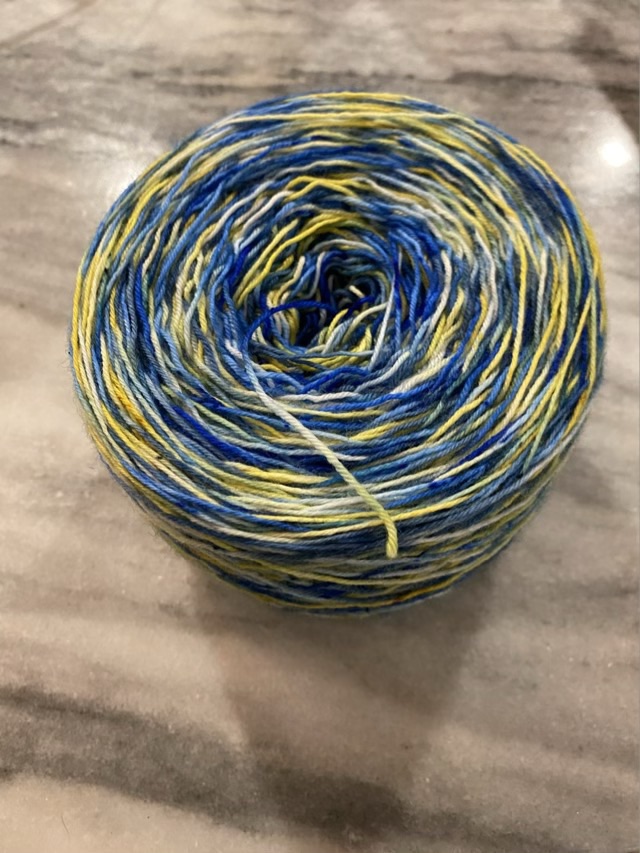
Photo description: yarn cake of fingering weight yellow, white, and blue superwash merino and nylon yarn.
Winding it back into a cake will help the kinks from knitting straighten out too.
I decided to move my cardigan knitting project to be a car waiting project. When school is going, I regularly carve out an hour of my day to yarn works while waiting for pick up. It is a time that I am uninterrupted by tasks that cause me to get up and move away from the knitting, such as letting animals outside, or getting distracted by another craft. I enjoy listening to an audio book and work away. That is all this cardigan needs, is some regular focused time. I might get it done before spring.
Photo description: Cardigan draped over the steering wheel showing the back panel with variegated yarn pooling in small areas of yellow and blue. Reminds me of looking at the sky in spring through tree branches.
There are many ways of doing most things. Finding what works best for you is usually a series of trials and errors. I have been knitting with fingering weight yarn the same way I knit with thicker yarn, but have been having trouble keeping even tension because the thinner yarn slips through my fingers more. I tried wrapping it three times around my pinkie, but it had more tendency to bind. I recently tried a new finger wrapping method, going clockwise around my pinkie, the counterclockwise around my ring finger. Bingo. I have more control of the yarn without binding or excessive yarn drop.
Photo description: In process knitting photo showing the working yarn wrapped around the fingers of my left hand.Photo description: view of yarn wrapping from the top of my hand.
This little change helped increase my knitting speed as well as reduced frustration with what seemed to be uncooperative yarn.