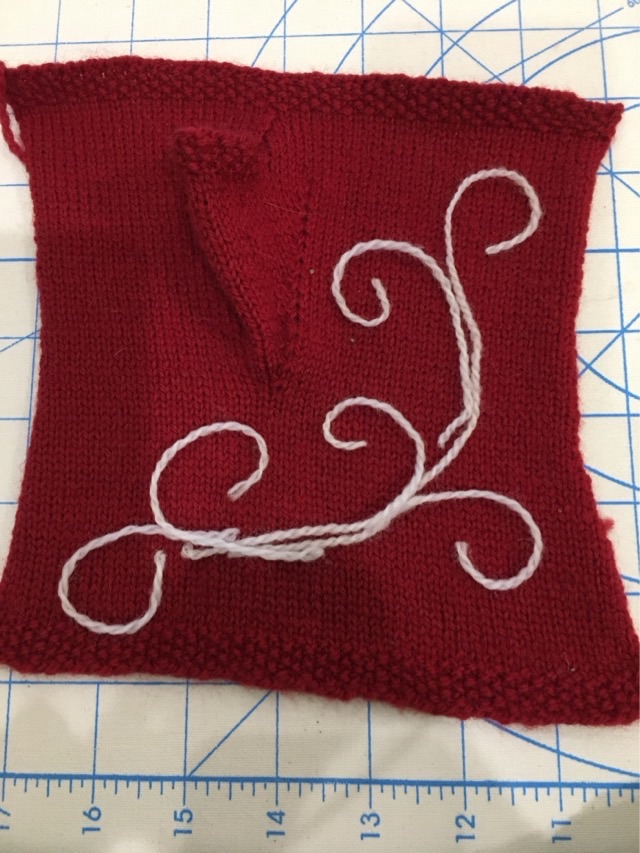
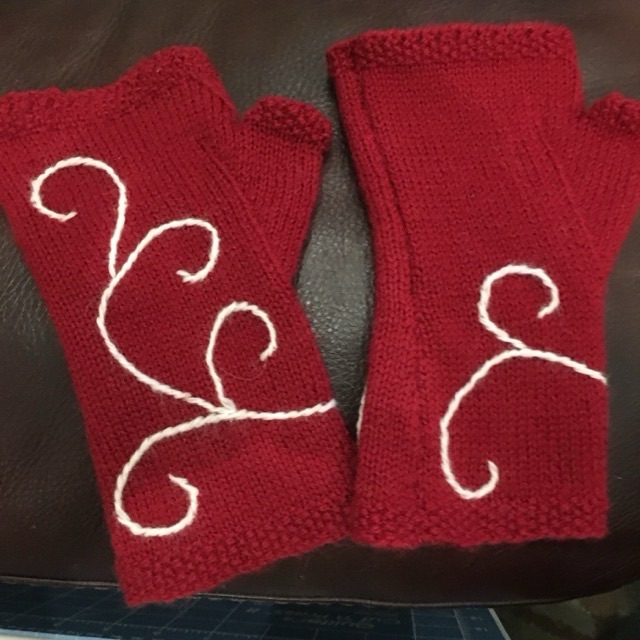
I’m a little surprised these gloves didn’t make the post list back in January of 2019. Hm. I knit them with merino wool fingering weight yarn and embroidered with white wool. I planned the embroidered swoops by laying down yarn scraps on the unsewn glove and taking a picture.
Photo description: red knit fingerless glove laid flat before sewing, with white scraps of yarn laid out in swoops and swirlsPhoto description: finished gloves with swoop embroidery, showing two sides
Winter is looking over the horizon, and I’m hoping I didn’t give away all these gloves. I’ll look in the cedar lined hope chest soon where I stash my winter gear.
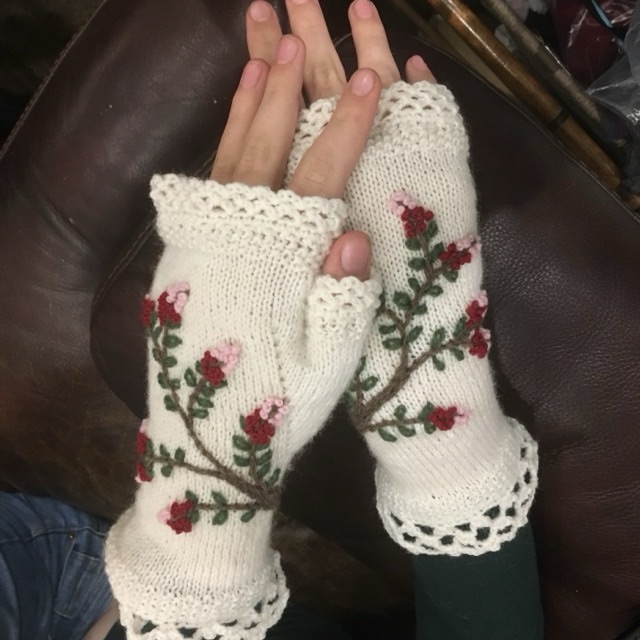
I made a second pair of fingerless gloves in November 2018, with the body of the gloves knit, the edges crocheted, and embroidered flowers added to the backs of the gloves.
Photo description: knit, crocheted, embroidered fingerless gloves made from wool fingering yarn
I’m not sure of the practicality of white wool gloves, but the embroidery sure looks nice against the light background.
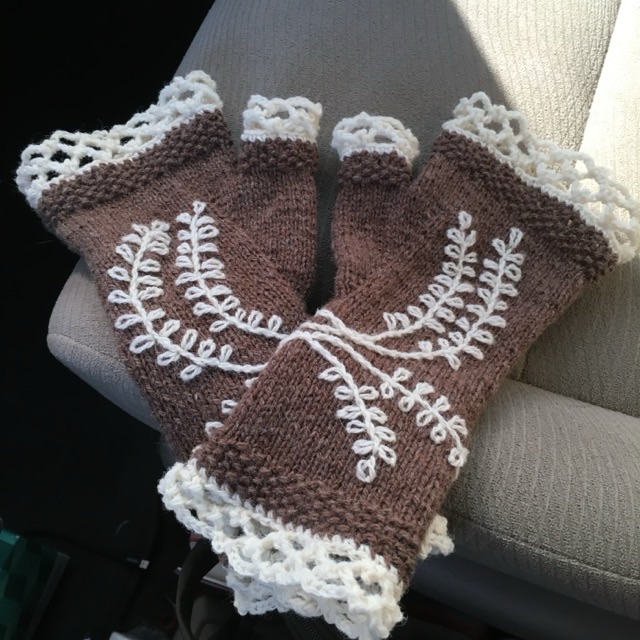
In October 2018 I finished a pair of fingerless gloves. I’m quite pleased with these, I knit a brown glove with wool yarn with stockinette stitch for the base and moss stitch for the edges, then used white wool to crochet a simple picot lace to the wrist and fingers. Using the same white wool I embroidered a mirrored leaf design on each glove. To plan the leaf design I digitally drew on a picture of the gloves then used my drawing as a guide for the stitches.
Photo description: brown and white fingerless gloves made from fingering weight wool yarn using knit, crochet, and embroidery techniques
I really enjoy making things using multiple methods in a single item. One day I’ll figure out how to make something spun, woven, knit, crocheted, nålbound, and embroidered.
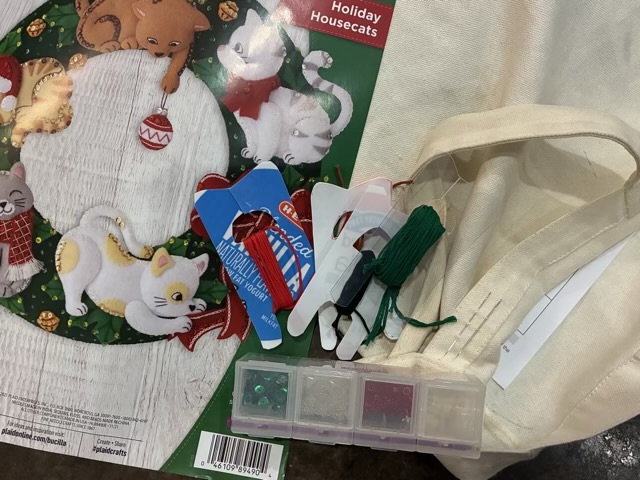
I bought a felt sewing kit two years ago, and just found it again while I was looking for something else. Since I have a dozen works in progress, what is one more? I really did try to put in back in the storage space, but it called to me. The first step was reading through the instructions (yes, I’m one of those), then prepping the materials and finding a project bag. I used bobbins cut from waste plastic to sort and hold the embroidery thread, and a small pill holder for the sequins and beads. The instructions suggest a plate, but I know myself and at the first distracted moment I would bump the plate and send seed beads all over the room. So I keep them on lock down. Yes, it takes a little longer to open the case, get out a bauble, then close the case, but it is better than picking them up off the floor and separating out the cat hair.
Photo description: “Holiday Housecats” felt kit with embroidery thread on bobbins, sequins and beads in a pill box, and a project bag with the needles threaded into the hem
Now to see how long it holds my attention and how long it takes to finish.
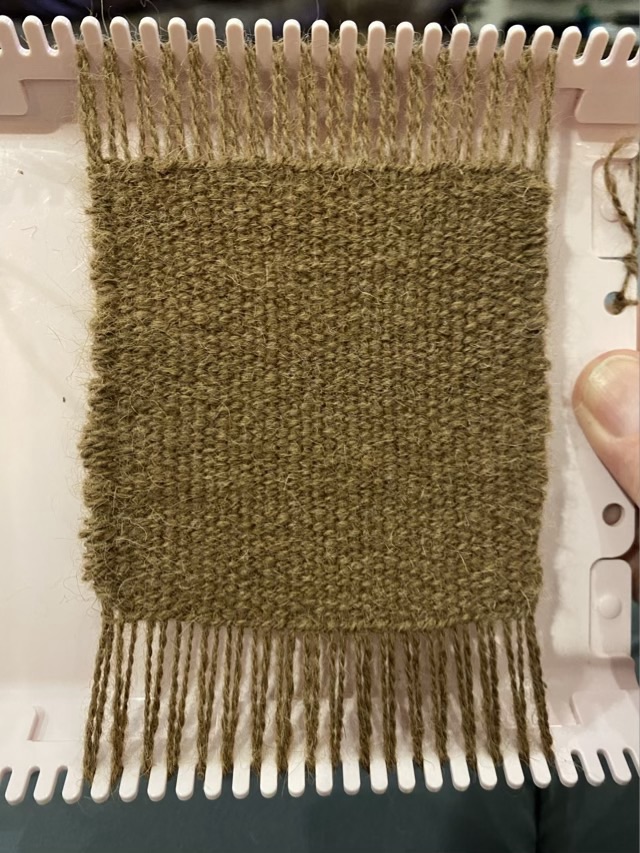
I used my Clover mini loom to weave a swatch of my two ply hand spun camel yarn. I like to double the warp and I chose a plain weave this time. I start and end my weaving with a twined row to help keep the ends in place.
Photo description: 2 ply camel yarn warped onto a Clover mini loom
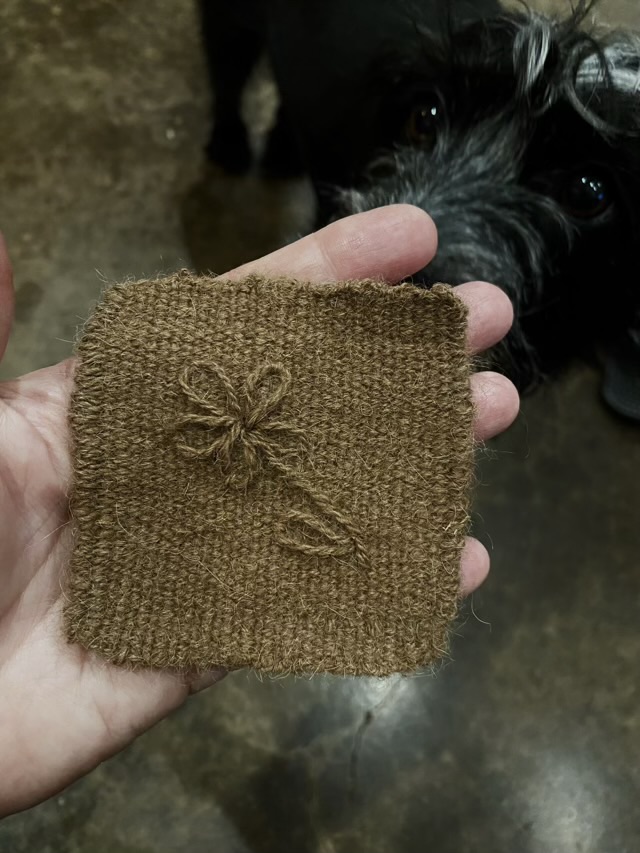
To finish, I used an embroidery needle to run the looped warp ends back through the weft on the back. I rather like the ribbed edge created by doing so. I added an embroidered daisy with a stem and leaf because the front looked rather plain. The daisy and leaf are done with a lazy daisy stitch, and the stem is a stem stitch, which amuses me.
Photo description: back of the small woven swatch showing the woven in loops and the back of the embroidery Photo description: front of the small weaving swatch done in hand spun camel yarn with five petal daisy, stem, and leaf, Missy the dog looking on in the background
It is interesting that the color of the yarn looks different in each picture. In real life, the color is a soft brown quite like milk chocolate. I did try to color adjust the final picture. I suspect the radical difference in backgrounds is the primary suspect for the color shift.