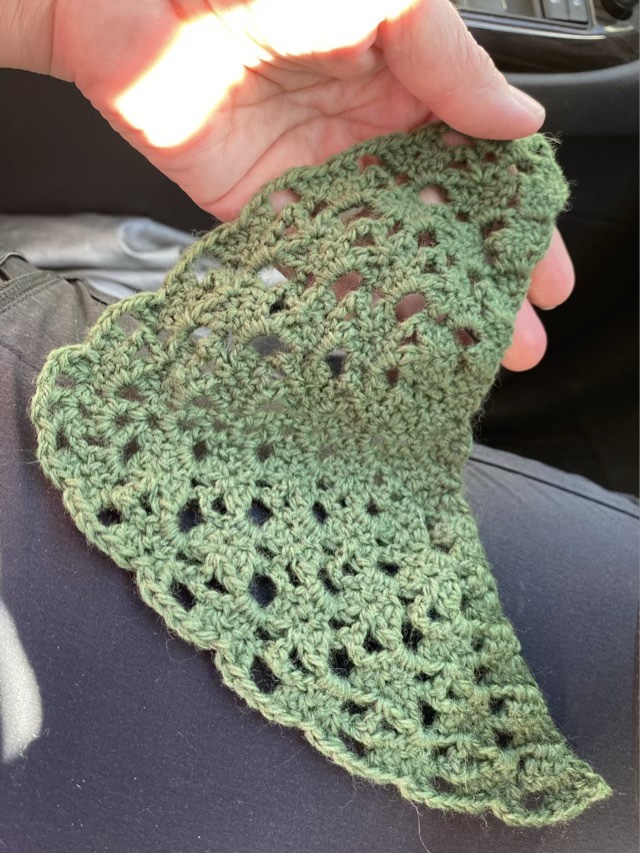
It isn’t often that I finish my prototype after I finish a larger project. Usually the idea is to wrap up the smaller project first so I’m better prepared. Ah well. This doll’s scarf was my purse project, and I used it to figure out a pattern I purchased. When I finished the larger scarf (see yesterday’s post), I still had waiting time, so pulled this project out of my purse and bound it off.
Finished doll scarf
Since I added a button to the larger scarf, I gave this one a button too. I found in my stash a hand made polymer clay and metal button I created years ago. It coordinated with the yarn beautifully!
Blocked and buttoned triangular doll scarf
The pattern for this scarf is from Dessert Blossom Crafts and is called “Amore Shawl”. It is a nice pattern once you get the repeats down.
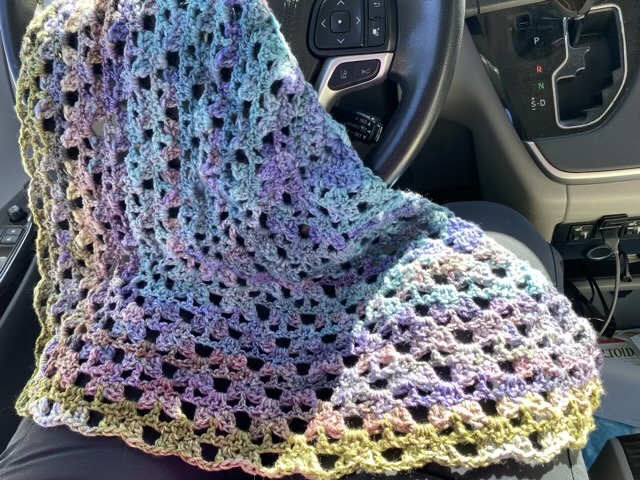
My second waiting shawl is more like a brief pause shawl. It took less than a week to finish, and probably only three or four hours of active work. Crochet lace goes fast, especially with thicker yarn.
Finished shawl/scarf, hand spun roving from Supernova dye works, crocheted with a pattern from Desert Blossom Crafts
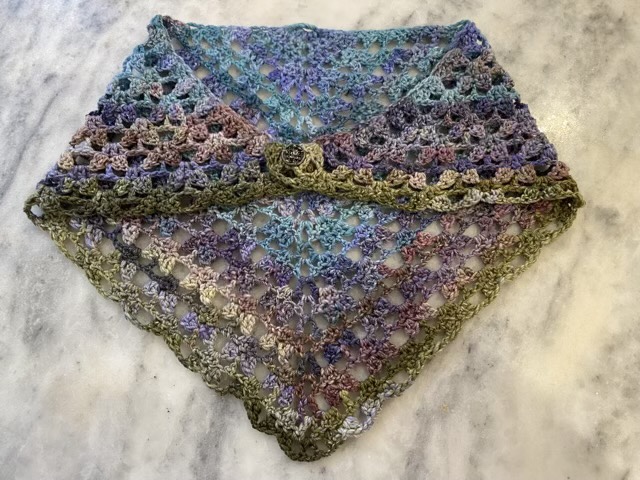
It is more the size of a scarf than a shawl, and to help it stay on, I put a button on one corner, and use the natural holes in the lace as button holes.
Shawl after blocking with sewn on button
I like how the color variation came out. When I spun it on my vintage wheel, I separated out the colors in the roving, sorted them, then spun. I used a chain ply to preserve the gradient. The gradient came out beautifully when it was crocheted!
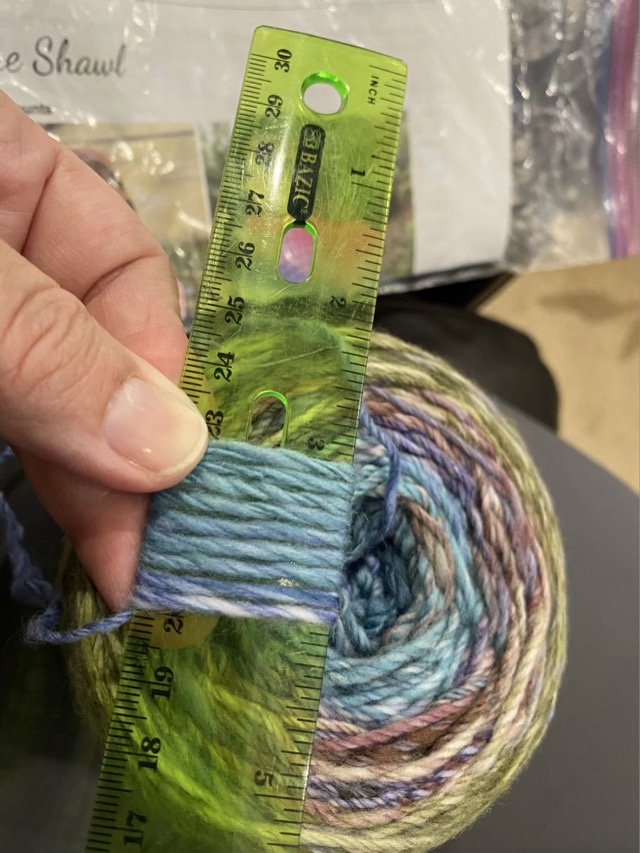
I’ve started a crochet project using the first yarn I spun on my spinning wheel. The consistency varies wildly, so I took my wraps per inch (wpi) measurements from one of the thicker sections.
Measuring wraps per inch on hand-spun yarn
I consulted a wraps per inch chart to select a crochet hook size based on my measurement of 9 wpi. By selecting a hook for the thicker parts of the yarn, the thinner areas will be more lacey, but that is OK because my pattern is for a lace shawl. If I sized the hook for the thinner sections of yarn, the shawl would become stiff for the thicker sections.
Start of a new shawl project
I’ve put the whole project in a bag in the car so it is ready for the waiting times.
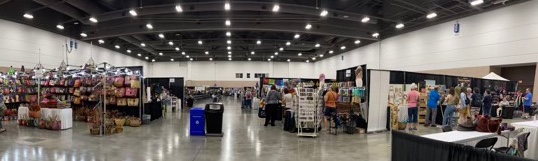
“What?” you say, “you have never been to a fiber festival? How is that possible?” Well, you might not say it, but the woman in the elevator did. I must say that she said it after cheering that it was my first visit. Yes, I have been working with yarn for around 40 years, but I only took up spinning just before the pandemic, and during the pandemic all the festivals were shut down. I have been searching out fibers to spin locally and online. Walking into a convention center with a huge room full of fiber was mind blowing.
Panoramic photo of the convention area, which really does not give justice to the amount of fiber that was really there
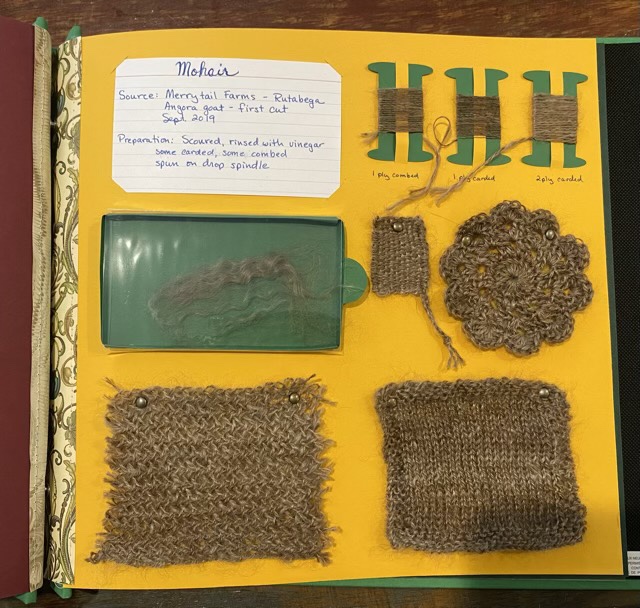
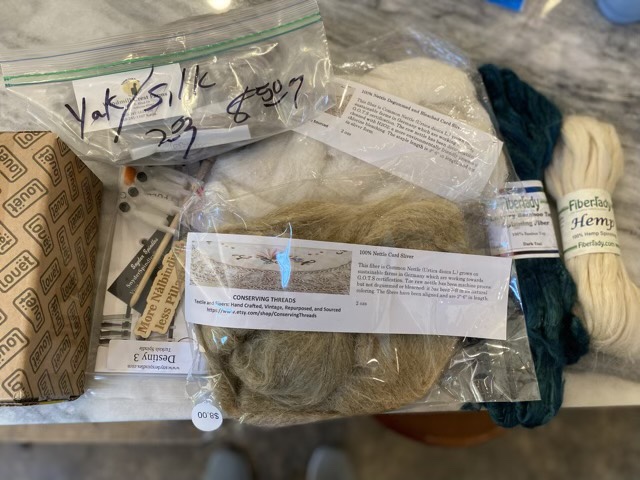
Probably 90% of the fibers at the festival were already spun and dyed, ready for the eager knitters that lined the aisles. But there were pockets of un-spun fiber in various preparations. I found bamboo, hemp, nettle, and yak (!) spinning fibers, all of which I have not yet attempted to spin. There were a few raw fleeces as well: mohair and Rambouillet. I caved on some white mohair (it was the first time the seller was offering raw fleece and it looked like she did a nice job skirting and labeling). Rambouillet is now on my wish list; I couldn’t quite face a whole fleece right now, but the processed yarn and blankets were divine.
Fiber Festival haul
I did find myself some wool combs, which appeared to be the last pair in the room. I also found an intriguing Turkish spindle 3D printed from flexible filament (more on those another day). The booths did cater mostly to the knitter, but there was representation for weavers, crocheters, felters, spinners, and there were even some nålbinding needles! After about an hour and a half, my brain shut down. It appears that I will have to work up my festival stamina!
The convention center was yarn bombed, which is fabulous