I found a skein of acrylic yarn with a long color repeat in a recent stash clearing. I love making worry worms from these kinds of yarn because I get one or two or three color worms in all different combinations.
Photo description: crocheted worms of varied colors on the left and the label for the yarn on the right: Bernat Super Value Stripes
The color repeats were more exact than I expected, and I started getting the exact same colored worms, so I pulled out the other end of the skein and mixed and matched different colors together.
Photo description: red and blue crocheted worm in progress that used yarn from both ends of the skein, calico cat as backdrop
I like that these little bobbles bring people genuine amusement.
In December of 2014 I was crocheting up a storm. Sometimes when I look back at old photos I find things I forgot I made and find a technique that I would like to explore more.
Today’s throwback is for a lace cowl I crocheted using partial circular lace motifs.
Photo description: red crocheted lace cowl on the back of a leather couch
I like the finished look of this freeform lace. I’m wondering if I didn’t do more because of the brain ache, or if I just became distracted by something else. Either possibility is probable.
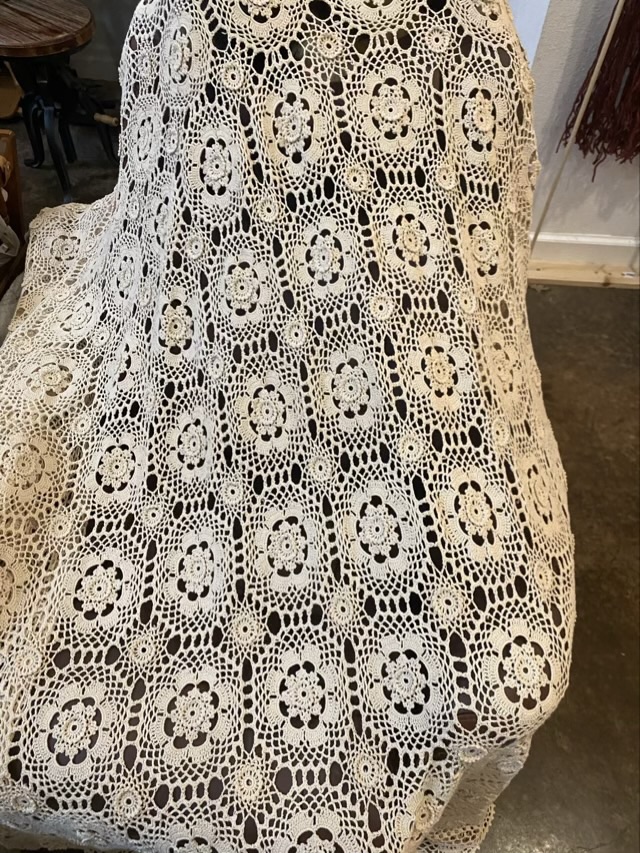
I have a side hobby of spotting fake crafts. Either AI generated photos or machine made items pretending to be hand crocheted. Hand knit is harder to tell apart from machine made, since knitted fabric can be produced rapidly by a series of hooks and knitting machines have been around for a long time. I have heard of crochet machines that do make single loops with a single thread, but they are used to edge blankets and not make intricate lace. I was surprised then, when I was crawling a garage sale, to find a large crocheted throw.
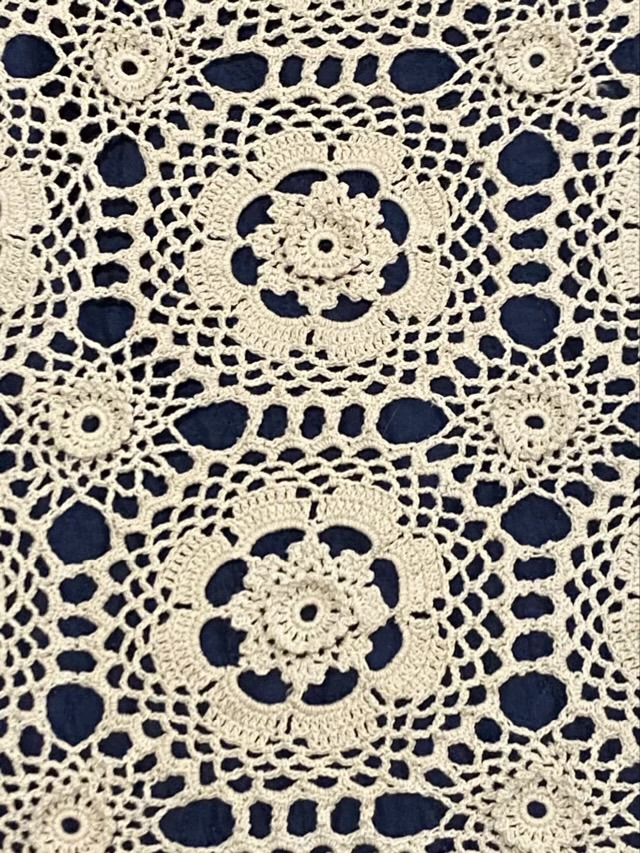
Photo description: king-sized cotton crocheted lace coverletPhoto description; closeup of two motifs of the cotton coverlet, showing the stitches, all of which I can identify and recreate.
I asked the sellers for historical detail, but it was a multi-person sale and the person who owned it wasn’t there. I bought it for $8. It smelled like moth balls and time in a closet.
When I got it home, I found a tag: made in China. Oh. So this was not an heirloom blanket sold at a garage sale. This was an item bought commercially and not used. I suspect the “flat dry” was the problem. Not many people have room to flat dry a king-sized blanket.
Photo description: tag found on the blanket that reads: 100% cotton, machine wash, cold water, gentle cycle, no bleach, flat dry, made in China RN 59757
The only way to produce this large and intricate work cheaply is by using many poorly paid people. I know the original owner didn’t pay $8, but to sell it for that tells me that they didn’t pay much.
That it is in pristine condition tells me that it was barely used, if used at all. There are no stains and no tears. But it is definitely hand crocheted. I can identify each stitch and see the progression of the work. Each motif was worked with a crochet hook then connected and I can see the connection stitches. I can tell how the border was worked and what stitches were used. I washed it and dried it both by machine on the delicate and gentle cycles, and it came out fine.
That the skill to make the coverlet is so casually discarded and undervalued is a sad state.
Photo description: rose top card from Hearthside Fibers top left, single spun, two ply, and cable ply yarns top right, unspun fiber middle left, twined swatch middle right, crochet cables swatch bottom left, knitted cables swatch bottom right
The Rose Top fiber sample was nice to spin, and working up the swatch projects was satisfying. Even though this fiber is produced in a similar way to Tencel, only using rose stems and leaves rather than wood pulp, I found this easier to handle.