Found crochet

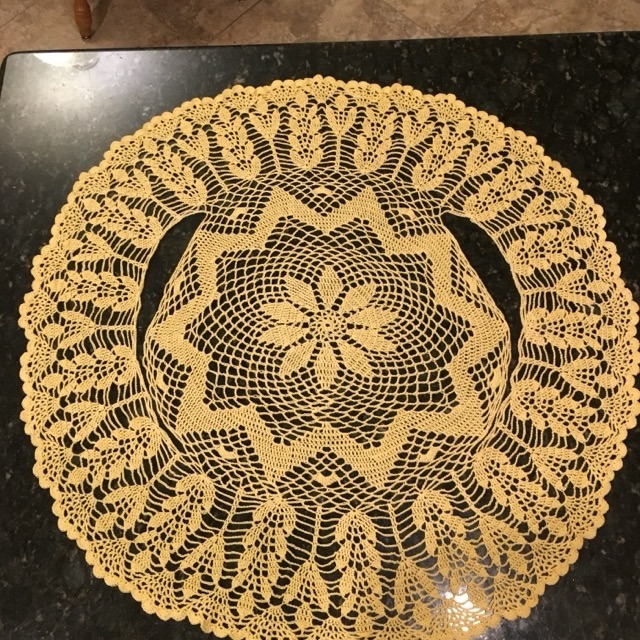
I have a side hobby of spotting fake crafts. Either AI generated photos or machine made items pretending to be hand crocheted. Hand knit is harder to tell apart from machine made, since knitted fabric can be produced rapidly by a series of hooks and knitting machines have been around for a long time. I have heard of crochet machines that do make single loops with a single thread, but they are used to edge blankets and not make intricate lace. I was surprised then, when I was crawling a garage sale, to find a large crocheted throw.

Photo description: king-sized cotton crocheted lace coverlet
Photo description; closeup of two motifs of the cotton coverlet, showing the stitches, all of which I can identify and recreate.

I asked the sellers for historical detail, but it was a multi-person sale and the person who owned it wasn’t there. I bought it for $8. It smelled like moth balls and time in a closet.

When I got it home, I found a tag: made in China. Oh. So this was not an heirloom blanket sold at a garage sale. This was an item bought commercially and not used. I suspect the “flat dry” was the problem. Not many people have room to flat dry a king-sized blanket.

Photo description: tag found on the blanket that reads: 100% cotton, machine wash, cold water, gentle cycle, no bleach, flat dry, made in China RN 59757

The only way to produce this large and intricate work cheaply is by using many poorly paid people. I know the original owner didn’t pay $8, but to sell it for that tells me that they didn’t pay much.

That it is in pristine condition tells me that it was barely used, if used at all. There are no stains and no tears. But it is definitely hand crocheted. I can identify each stitch and see the progression of the work. Each motif was worked with a crochet hook then connected and I can see the connection stitches. I can tell how the border was worked and what stitches were used. I washed it and dried it both by machine on the delicate and gentle cycles, and it came out fine.

That the skill to make the coverlet is so casually discarded and undervalued is a sad state.

Unexpected resistance

I went to rinse and block my small twined cotton bag and was a little shocked when it held water. It wasn’t completely water tight, there was a slow drip, but it didn’t absorb water like I expect cotton to do. My hypothesis is that because I hadn’t washed it at all to this point, there may be some natural water resistance on cotton bolls. Not enough to keep the harvest safe from rain (as this cotton farmer describes), but some. Or the twining is tight enough and thick enough to resist the water for a short time.

Photo description: small twined cotton bag holding water over a sink

I’ll file this under “things that make me go hm.“

Small twined bag

For my North Carolina grown cotton fiber page I had enough hand spun crepe yarn to twine a small pouch. I used a square of sanded eighth inch plywood as my form and twined until I was about square. To finish the bottom, I ran the warp threads up the opposite side of the bag.

Photo description: half the warp threads woven back through about seven rows of twined weaving with the bag wrong side out
Photo description: all the warp threads woven in and the needle used shown
Photo description: pouch right side out after trimming the warp threads

After I wove in all the warp threads, I realized a probably should have knotted them, then wove them in. Since this bag will only be on display in a book, it won’t see heavy use, but it is something I need to remember for next time I twine a bag. The picture of the pouch looks skewed because there is a bias twist in the fabric. I noticed when I started twining that I was actually untwisting the ply, so I switched my twine direction, which reinforced the ply, but gave it extra twist energy. It should even out after blocking.

Fat quarter travel pillow

I don’t like the U shaped travel pillows. I’ve tried several, and the bulk pressing against the back of my neck (really anything around my neck) drives me nuts. So I made a different kind of pillow. It is ideal for reclining chairs because it has two side pillows so my neck doesn’t twist too far, and no stuffing behind my head. The best part is that I made it with one fat quarter, some thread, and poly fil stuffing.

Photo description: fat quarter (18”x21”) of quilting fabric with a pineapple motif

To make the pillow, fold a fat quarter in half lengthwise, right sides together (9” x 21”, doubled). Sew along the edges, leaving two 4” gaps on the outside thirds of the long edge (for stuffing later).

Photo description: fat quarter folded in half and sewn with two gaps on the far edge, on a model 66 treadle sewing machine

Clip the corners and turn the pillow right side out. Fold the case in thirds, mark the line, then sew seams along the lines. This divides the pillow into three parts.

Photo description: pillow case divided into thirds and being sewn using the fold as a guide

Fill the outside sections with stuffing, then sew the gaps closed. I usually do this by hand, but the foot on my model 66 has such a nice tiny toe, I thought I would try on the treadle sewing machine. It worked well.

Photo description: sewing the pillow gap closed using a treadle machine fitted with a standard foot
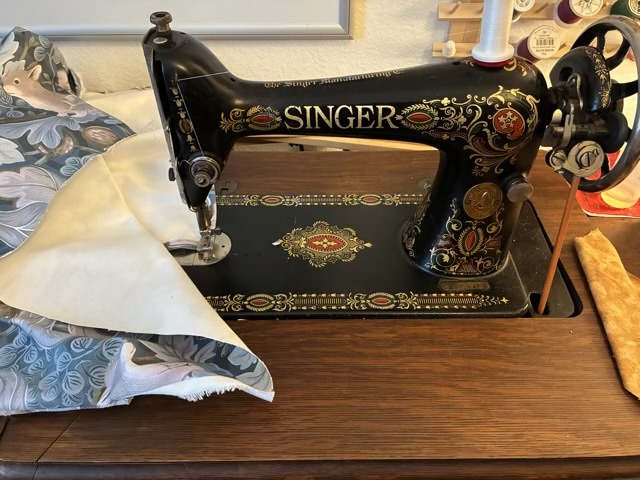
Photo description: finished travel pillow laying on the work surface of a 1916 Singer treadle sewing machine

It amuses me that the fabric coordinates with the “red eye” decals on the sewing machine. I can report that the pillow works great, especially for naps.

Throwback Thursday: chair organizer

In May of 2013 I made this arm chair organizer that has pockets on the side for magazines and notebooks. I’m not sure why I didn’t sew on something to hold it down on the seat cushion, instead relying on butt power, but I am pleased how nicely I trimmed out the pockets using bias tape.

Photo description: floral fabric with a black background sewn with three overlapping pockets trimmed in green and filled with books
Photo description: other side of the organizer with different sized pockets to hold different books, electronics, and magazines
Photo description: over exposed photo of the chair from the front and the organizer stretched across the arms of the chair, no butt anchor

If I were to remake this project, I would add fabric to tuck down on the sides of the cushion, or maybe even go all the way around or under the cushion. Hm. Maybe I didn’t have enough fabric so had to rely on butt power. It would have made more sense to run the center section under the cushion.