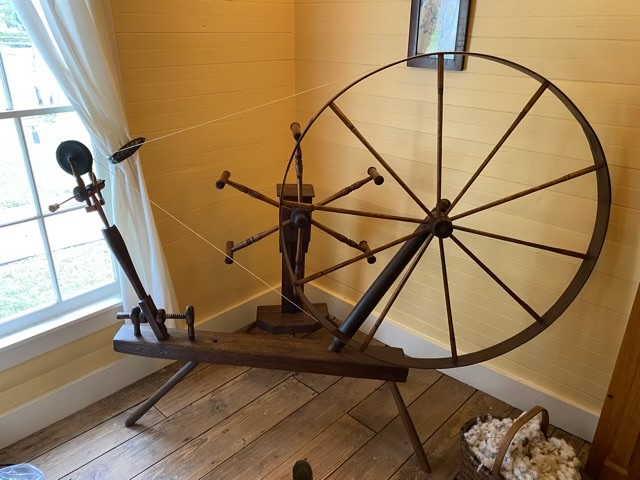
Photo description: 1800s Great Wheel at Man House in Mansfield, TX, yarn weasel in back corner, basket of raw cotton (bottom right)
Y’all, I get to demonstrate spinning on a great wheel, also known as a walking wheel, in October. I recently took a drive out to meet the wheel and see if I could spin with her. We are compatible. I took some Teeswater wool roving to give her a spin, and she has been kept in good working order. There is a little slip in her drive band, but I have permission from the museum to use beeswax if necessary. She has an accelerator head, so was probably used mostly to spin cotton, especially since they were growing cotton in that area in the 1800s. I will take two kinds of local grown cotton sliver to spin in the demonstration. I’m so excited.
Photo description: close up of the spindle head showing the cotton drive bands, accelerator head, and spindle with 15 minutes worth of spun Teeswater wool, and a cork on the spindle tip for safety
The wheel is potentially 200 years old, or at least approaching her 200th birthday. It is a humbling experience and an honor to spin with her.
In January of 2015 I was examining the construction techniques of Irish crochet, a type of free form lace that has a rich texture.
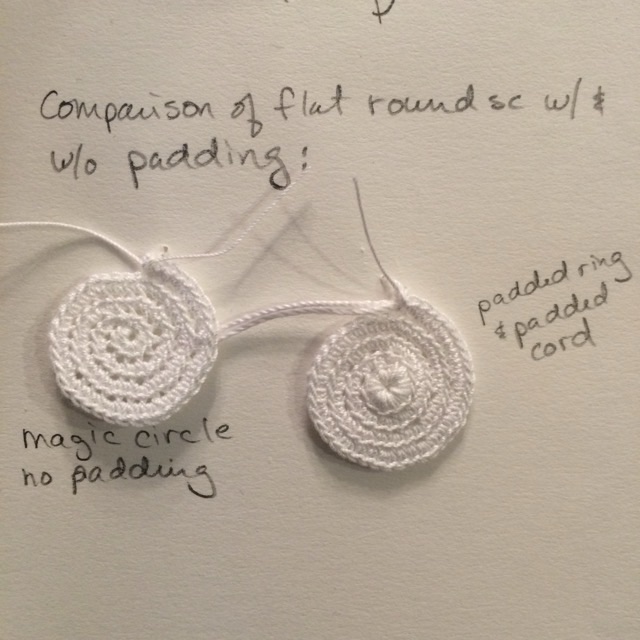
Photo description: two crocheted circles, one without padding (left), one with padding (right)
Padding in crochet is carrying a thicker cord, or multiple cords, along inside the crocheted stitches. The padding cord also gives more control of the shape of the crochet because it can be pulled tighter and lock in curves.
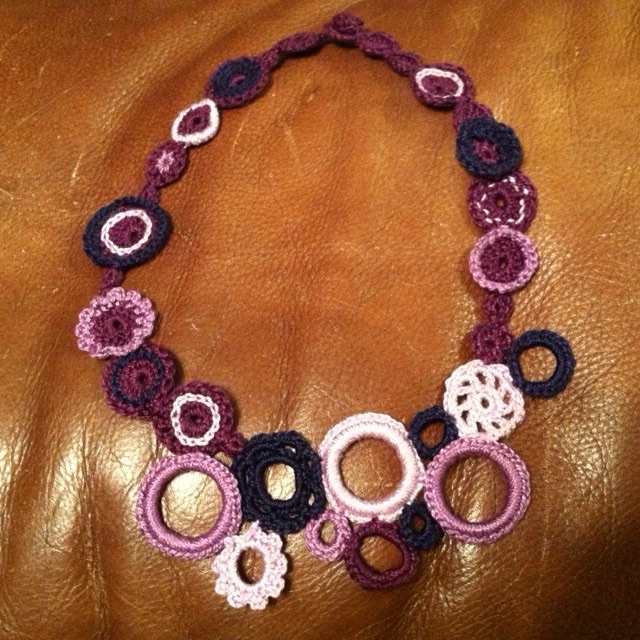
Back in December of 2014 I decided to combine crochet and jewelry making to create a light weight but bold necklace with pearlized cotton in shades of purple.
Photo description: crocheted circle necklace with hand made button clasp using four shades of purple pearlized cotton on a leather couch cushion
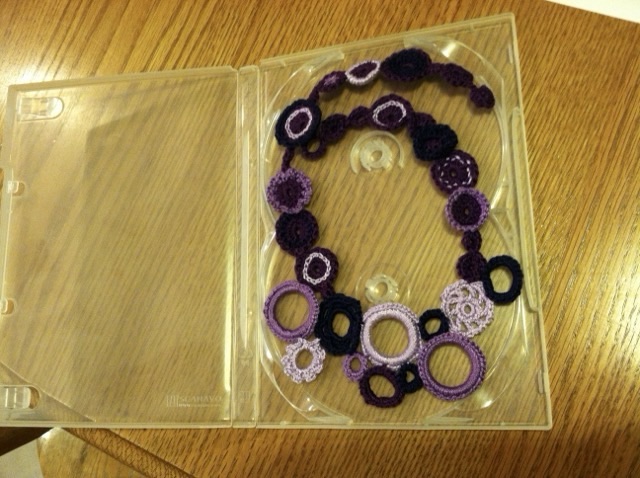
In 2014 I really had started to embrace taking pictures of my creations. I even took a picture of the CD case I repurposed into a guess-thwarting jewelry box.
Photo description: same purple crocheted necklace in a clear double CD case to keep it flat and give the recipient a moment of “hm?” before opening
I’m pretty sure since this is purple it went to my Mom. I’ve done more crocheted jewelry since. It is much lighter than traditional bold jewelry pieces, but does have to be laundered, starched, and laid flat to dry on occasion. I can personally tolerate a crocheted necklace for a little longer, if it isn’t too tight.
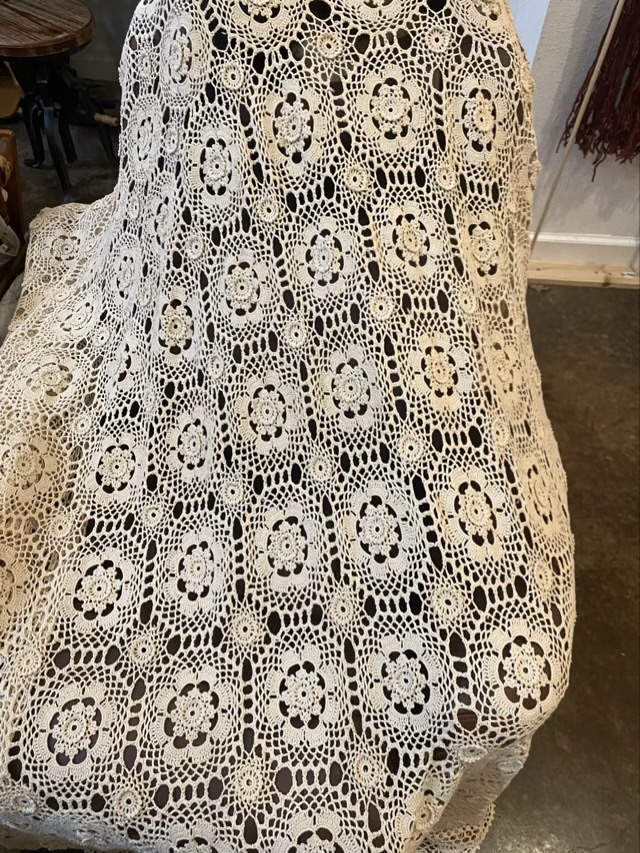
I have a side hobby of spotting fake crafts. Either AI generated photos or machine made items pretending to be hand crocheted. Hand knit is harder to tell apart from machine made, since knitted fabric can be produced rapidly by a series of hooks and knitting machines have been around for a long time. I have heard of crochet machines that do make single loops with a single thread, but they are used to edge blankets and not make intricate lace. I was surprised then, when I was crawling a garage sale, to find a large crocheted throw.
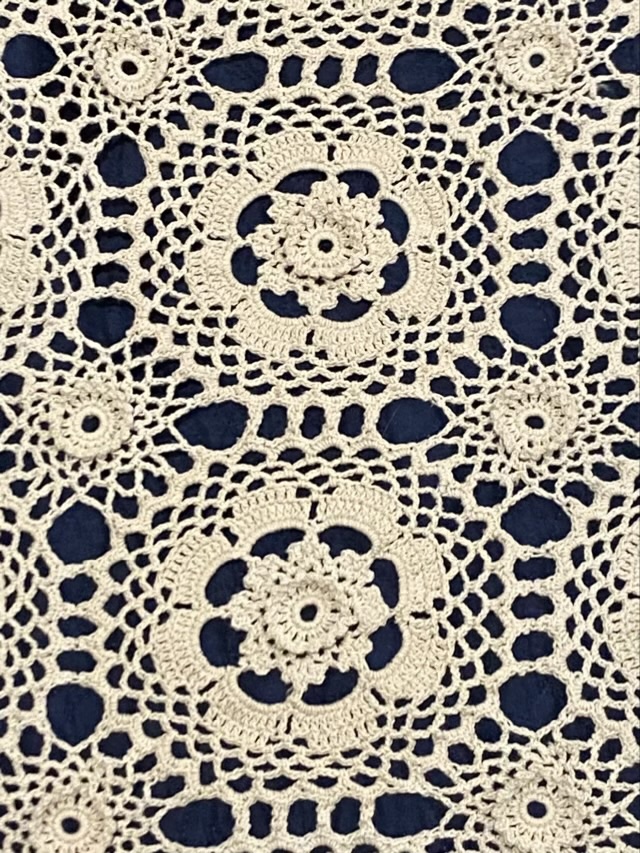
Photo description: king-sized cotton crocheted lace coverletPhoto description; closeup of two motifs of the cotton coverlet, showing the stitches, all of which I can identify and recreate.
I asked the sellers for historical detail, but it was a multi-person sale and the person who owned it wasn’t there. I bought it for $8. It smelled like moth balls and time in a closet.
When I got it home, I found a tag: made in China. Oh. So this was not an heirloom blanket sold at a garage sale. This was an item bought commercially and not used. I suspect the “flat dry” was the problem. Not many people have room to flat dry a king-sized blanket.
Photo description: tag found on the blanket that reads: 100% cotton, machine wash, cold water, gentle cycle, no bleach, flat dry, made in China RN 59757
The only way to produce this large and intricate work cheaply is by using many poorly paid people. I know the original owner didn’t pay $8, but to sell it for that tells me that they didn’t pay much.
That it is in pristine condition tells me that it was barely used, if used at all. There are no stains and no tears. But it is definitely hand crocheted. I can identify each stitch and see the progression of the work. Each motif was worked with a crochet hook then connected and I can see the connection stitches. I can tell how the border was worked and what stitches were used. I washed it and dried it both by machine on the delicate and gentle cycles, and it came out fine.
That the skill to make the coverlet is so casually discarded and undervalued is a sad state.
I went to rinse and block my small twined cotton bag and was a little shocked when it held water. It wasn’t completely water tight, there was a slow drip, but it didn’t absorb water like I expect cotton to do. My hypothesis is that because I hadn’t washed it at all to this point, there may be some natural water resistance on cotton bolls. Not enough to keep the harvest safe from rain (as this cotton farmer describes), but some. Or the twining is tight enough and thick enough to resist the water for a short time.
Photo description: small twined cotton bag holding water over a sink




 Critters and Craft