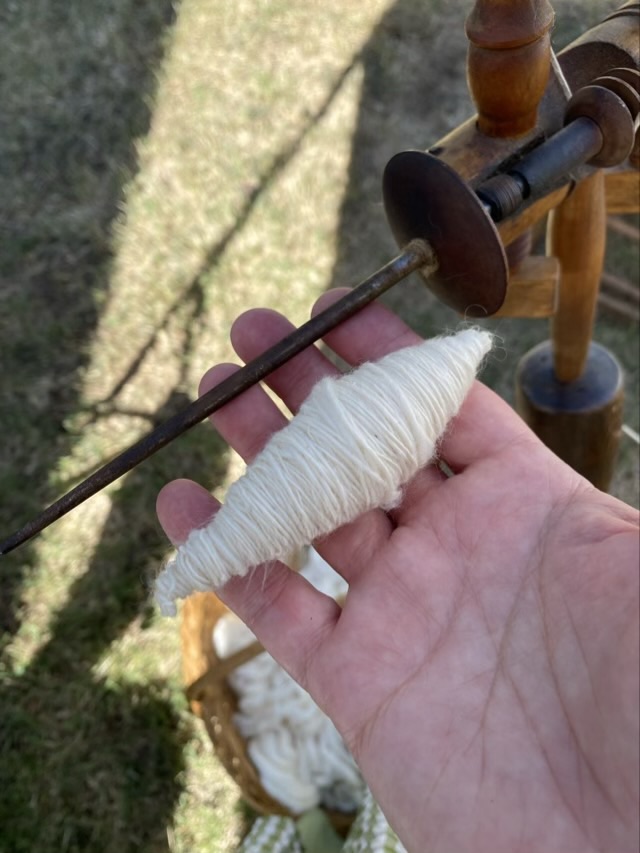
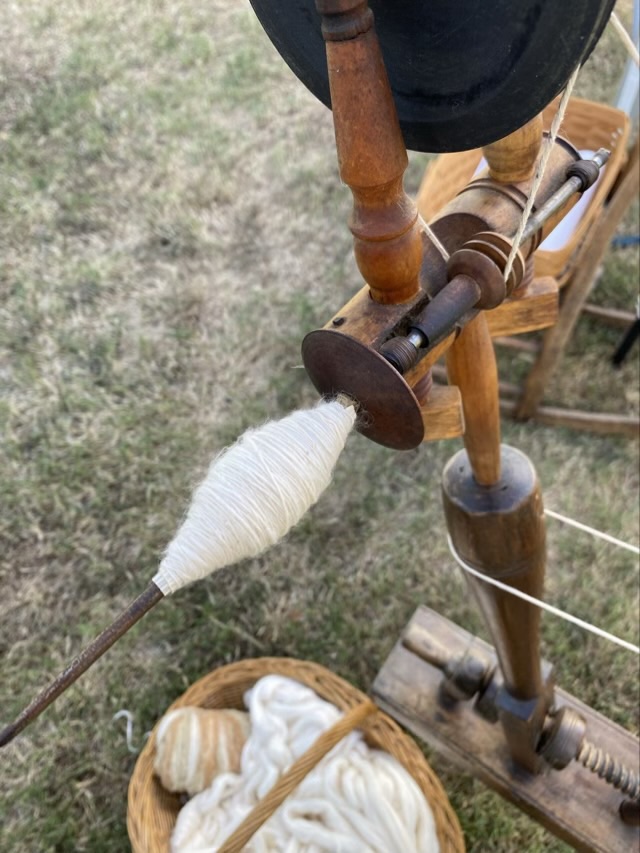
Another Great Wheel

I had the opportunity to make friends with another walking wheel! I went to the Doss Heritage and Culture Center in Weatherford, Texas and met with the lovely people working there with the collections and events. They let me go down to the basement where there were two antique walking wheels, one with all the parts, albeit with some field-expedient repairs, and another missing the spindle and accelerator wheel.
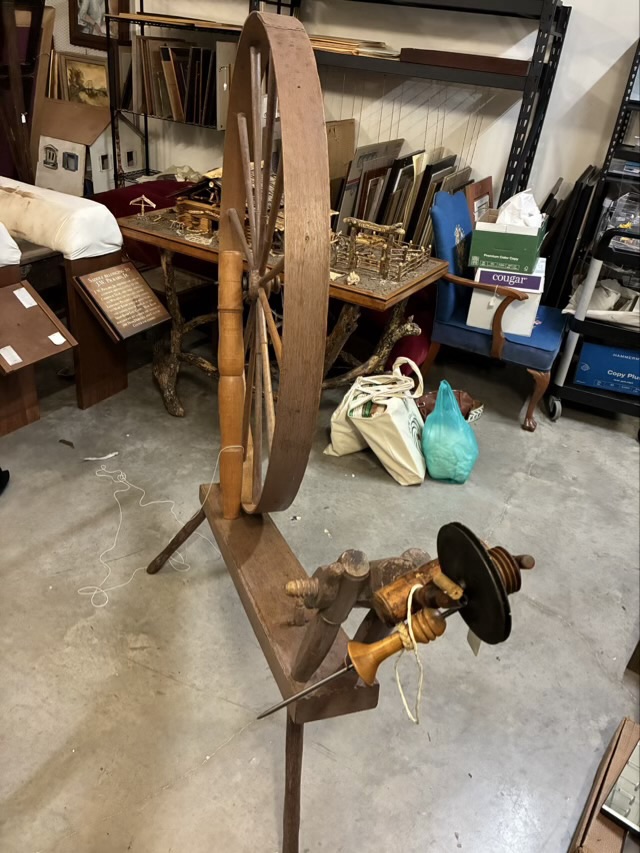
Photo description: great wheel before I started
Photo description: mother-of-all with spindle and accelerator head

I took off the mother-of-all, which holds the maidens, accelerator head, and spindle, to get a good look at the condition. I’m fairly certain that this mother-of-all is not the original one that went with the wheel, or the wheel was painted at some point, but the colors don’t match. The top of one of the maidens has also been lost to time, replaced with a dowel and metal spike, which certainly does the job.
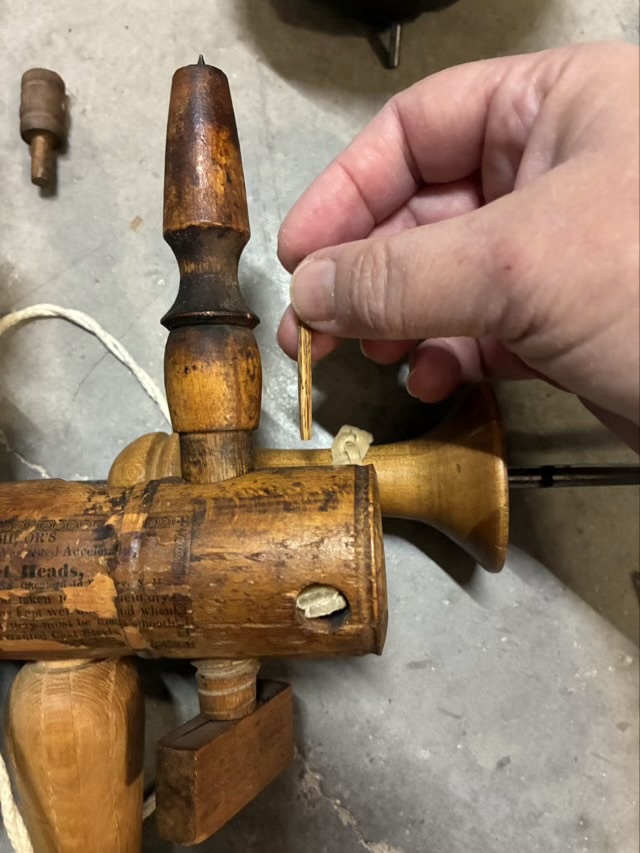
Photo description: small wood stake that goes into the mother-of-all to hold the braided rawhide straps in place

Where the last great wheel I worked with had waxed linen that held the spindle, this wheel had rawhide magic braids that were nearly as hard as the surrounding wood. I was surprised that the pegs holding the rawhide in place could still be pulled out.

After looking over the mother-of-all, I put it back on the wheel, upside down. Oops. It took me about an hour of tinkering and fussing before I figured it out. In that time, though, I gave her a new cotton drive band waxed with beeswax, waxed the accelerator band, aligned the wheel with the base, and adjusted the wheel spacing against the post. The wheel rubs against the post, so I wrapped the post with waxed cotton cord to protect it from abrasion.
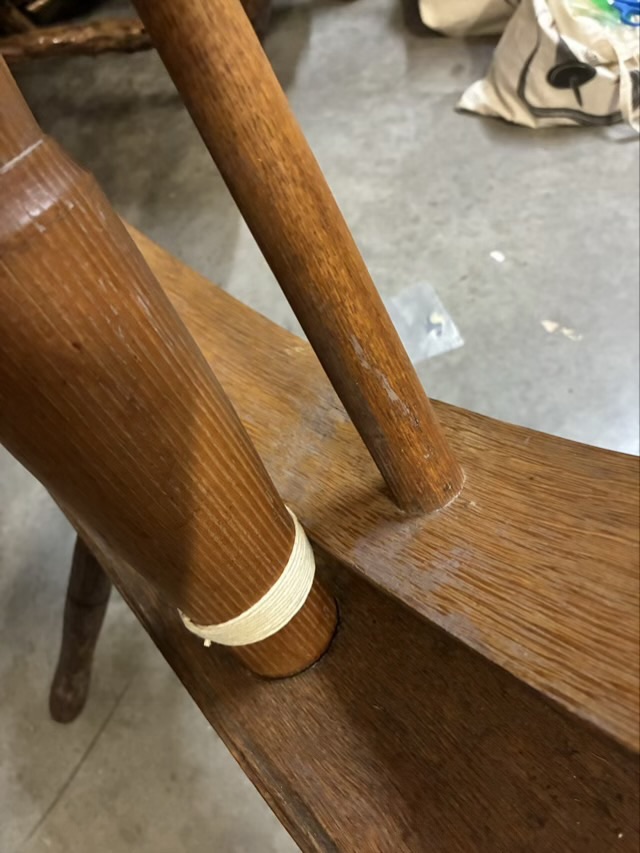
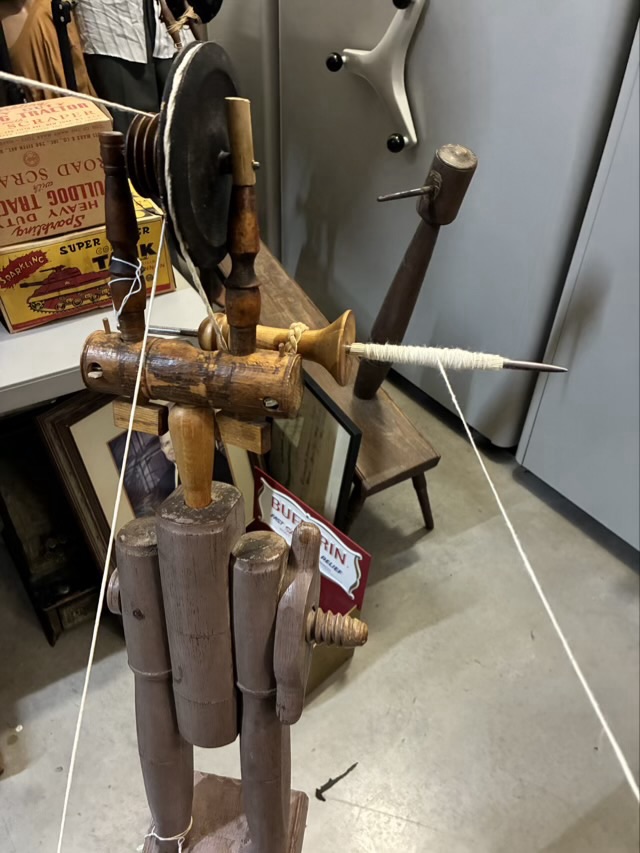
Photo description: waxed cotton cord lashed around the base of the post where the wheel rubs against it
Photo description: great wheel mother-of-all and tension system set up and spinning, there is another great wheel base in the background, which has a wheel, but the hub hole has worn away and it needs refitting

I love the tensioning system on this wheel. The wood nut on the right in the picture loosens to allow the center post to rotate forward and backward, decreasing or increasing tension. I think I actually like this set up better than the double nut Great Wheel, although both are more reliable over time than a greenwood tension system that relies on the bend-ability of fresh wood.

I did put a corn husk quill over the spindle to make it easier to remove the cop of yarn. For a leader I pulled three strands from my cotton twine, and did a larks-head knot over the corn husk quill. I spun Texas grown cotton sliver for a while before time called me away.
Mandolin

I’ve been holding back some of my holiday gift money and keeping an eye on the marketplace. I like small instruments and have been eyeballing mandolins. Then one came up that was for sale in the next town over, and looked to be in good condition, so I bought it.

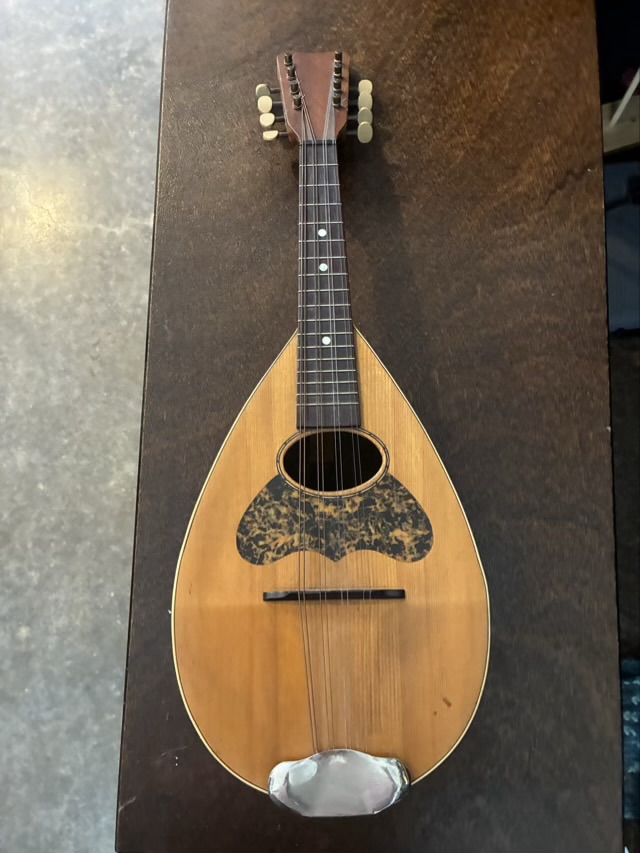
Photo description: face of a American Conservatory bowl back 8 string mandolin
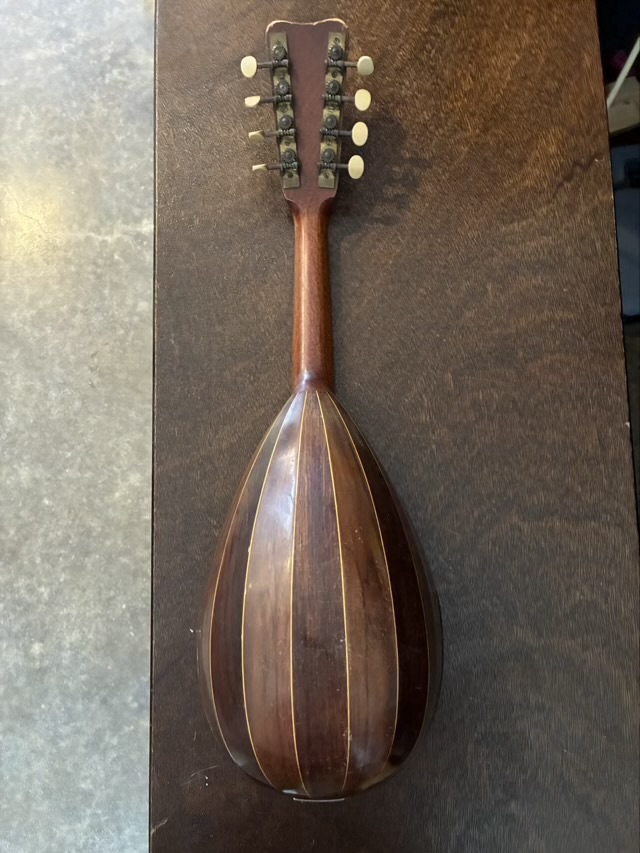
Photo description: bowl back of the American Conservatory mandolin

The seller put me in touch with the previous owner, who had purchased the mandolin from a man who was clearing out his Dad’s house. The instrument had been his grandfather’s and had been sitting in the top of a closet for years. It was made by Lyon & Healey, back when they made more than harps, somewhere around 1890.

I tuned the mandolin, and it keeps pitch well. There are no cracks, and the tuning pegs hold. Absolutely amazing for an instrument that is over 100 years old.

Great Wheel Alignment

As I was demonstrating spinning on 165-year-old Great Wheel, I spent an equal amount of time spinning, talking about the wheel, and adjusting the wheel alignment.

This Double Nut New England wheel has a flat wheel surface made by bending two long thin wood boards into a circle, tapering the ends, and securing with iron rivets. The flat surface does not hold onto the cotton drive band like a concave surface would, and alignment with the spindle post is key in keeping the band on the wheel.

Photo description: view of the Great Wheel from the back, one cotton band on the wheel is the drive band, the other was an attempt to keep the drive band from slipping off. It didn’t work, the drive band merrily skipped right over it.

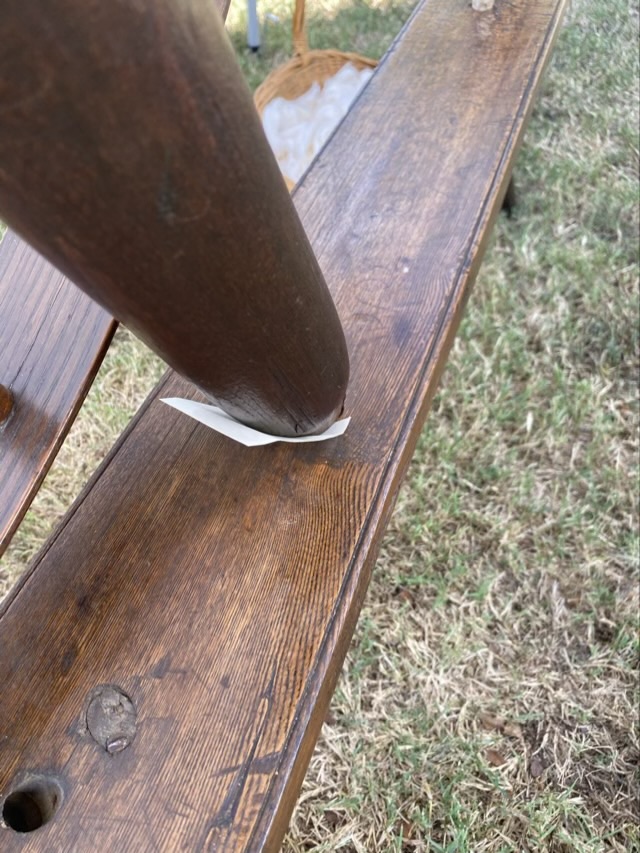
I found that the wheel post was not glued or nailed into the table, and had some play forward and backward as well as side to side. I attempted to wedge the wheel post in using a business card, with limited success.

Photo description: base of the wheel post with a scrap of card board wedged in

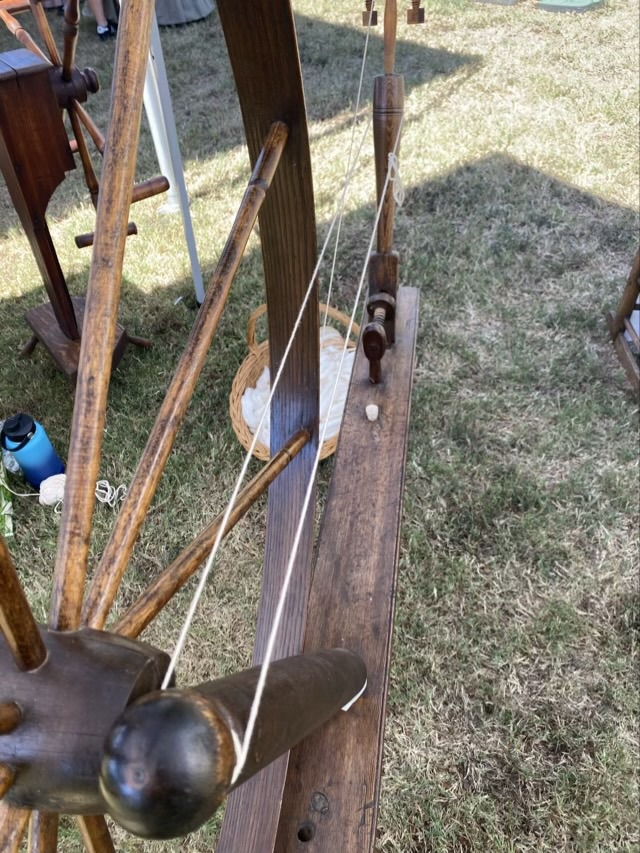
I did have some luck when I ran some cotton string from the wheel post to the spindle post. Mainly the line of cotton rubbed up against the drive band, keeping it on the wheel. Not an ideal situation, but a decent stop-gap measure.

Photo description: cotton string going around the wheel post and spindle post

I also tightened the drive band by cutting it and redoing the knot. I used a double sliding knot that is near impossible to undo once it is slid together. Once the ends are trimmed the knot also has a low profile, making it easier to pass through the grooves on the accelerator whorl. I ran some pure beeswax along the drive band as well, to give it some grip.

Photo description: tying the cotton drive band together with a sliding knot

The biggest factor in keeping the drive band on was to make sure the wheel was aligned with the accelerator whorl. The whorl has several grooves so the drive band can go in the one that aligns best to the center of the wheel. There was play in both the spindle post and wheel post, so keeping them in alignment was a game of concentration. When the area was quiet, I could get quite a long spin going, but when I started talking, my concentration would drift and the drive band would pop off.

I think I will add some tissue to my kit. Wrapping the base of a post with paper tissue can often increase the security of the connection, without causing permanent damage. I’ll talk about my spinning wheel field kit in another post!

This post is part of a series about my experience demonstrating spinning on a 1860s Great Wheel in Mansfield Texas.

Great Wheel Spindle

“She’ll prick her finger on a spinning wheel’s spindle and die.” -Maleficent

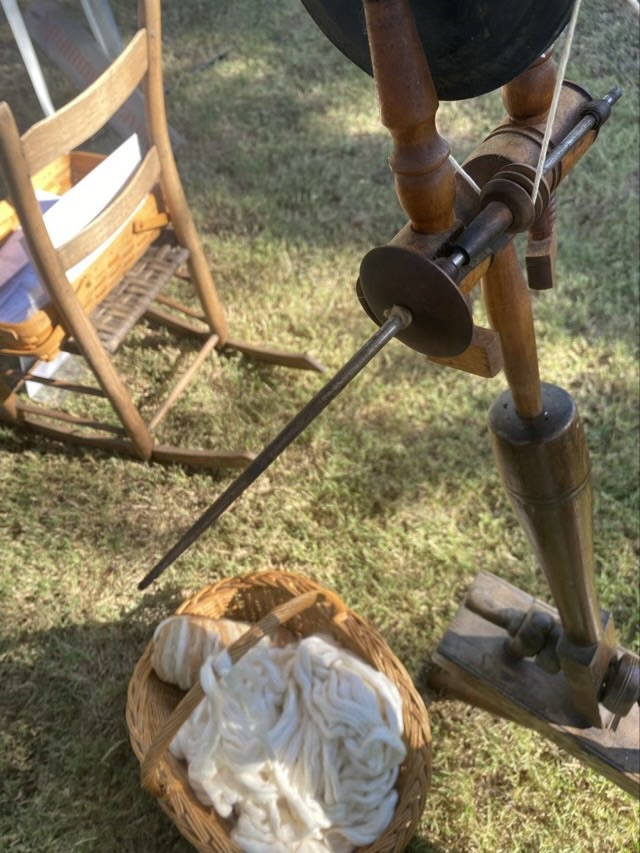
A Great Wheel, or Walking Wheel, does not have a flyer assembly like treadle spinning wheels. The wheel has a drive band that turns a spindle, often made of iron, that is long and thin.

Photo description: iron spindle on a 1860s double nut New England Great Wheel, basket of prepared cotton fiber on the grass below

This iron spike, I’ve read, could be quite sharp, although the one on this wheel was not. Out of caution, the museum keeps a cork on the tip of the spindle to avoid the pricking of fingers or impaling of body parts.

The spindle is held to the Mother-of-all assembly with spindle bearings. On this particular wheel the bearings appear to be either carved wood or wrapped thread so old and hardened as to be a solid unit. I have seen pictures of other Great Wheels where the spindle bearings are made from fresh braided fiber and tightened through holes in the Mother-of-all.

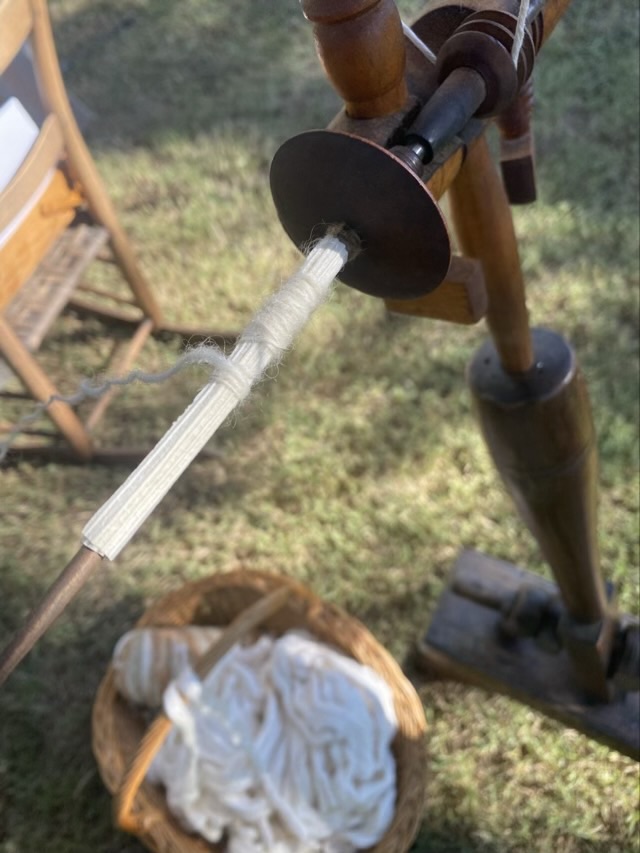
I read that spinners would often use a “quill” with this type of spindle, wrapped around the spindle so that the cop of yarn could be easily removed. Historically the quill was a section of corn husk, so I bought dried corn husks from the produce section of my grocery store, and cut rectangles. To keep the husks pliable, I stored a few in a plastic bag with a damp paper towel overnight. Before I started spinning, I wrapped the husk around the spindle with the smooth side in. Corn husks have prominent ribbing on one side, and when the ribs are on the outside of the quill, they help hold the spun yarn in place.

Photo description: corn husk quill wrapped around the spindle and secured with wool yarn

I used a wool yarn leader to start my spinning, because that is what I made when I did my test spin a month before. It was an easy transition to go from the wool to cotton. I built up the cop of cotton yarn by spiraling the yarn back and forth across the quill as I rolled it up. This keeps the yarn from bunching and sliding as the pressure of the wound yarn builds up.

Photo description: building the cop of yarn onto the quill

This particular spindle does have a disc and I could have run the yarn right up to the disc without risking tangling the yarn in the spindle bearings, but since I wanted to be able to quickly remove the yarn, the quill worked well.

Photo description: cop of single spun cotton yarn onto a corn husks quill removed from the Great Wheel spindle

My first cop of yarn went too close to the ends of the quill. For the second I was able to control the yarn better and keep it centered on the quill.

Photo description: another cop of yarn with the corn husks quill showing at each end

I left a cop of yarn on the spindle when I was done for the day so it could be part of the display when they put the Great Wheel back in the Man House at the museum.

This post is part of a series about my experience demonstrating spinning on a 1860s Great Wheel in Mansfield Texas.

Great Wheel hub

The main wheel of a Great Wheel is truly great in size and the hub spins on a metal rod on the wheel post. The wheel stays on the post with a small nail or cotter pin inserted into the end of the rod.

Photo description: closeup photo of the wheel hub from the wheel post side of a Double Nut New England Great Wheel

The nail for the Great Wheel I was demonstrating with had fallen out… somewhere. This meant that the wheel kept migrating to the end of the rod, changing the alignment of the drive band and causing the drive band to slip off. My field-expedient fix was to use a wood toothpick. The toothpick alone, however, did not keep the hub snug against the wheel post, so I cut a leather washer and put it between the wood pin and the hub.

Photo description: opposite side of the wheel hub, with a scrap of leather acting as a spacer and a toothpick as the pin to hold the wheel on the rod and keep it close to the wheel post

I kept the smooth part of the leather toward the hub to reduce friction, and added a drop of light weight oil to the metal rod. It turned well and stayed in place the rest of the day.

This post is part of a series about my experience demonstrating spinning on a 1860s Great Wheel in Mansfield Texas.