It came back

The hearty hibiscus was not doing well in the shadowed front garden bed, so in winter I moved it out to the meadow next to the coop. I wasn’t sure it was alive, but it put out leaves and buds this summer!

Photo description: hearty hibiscus with buds ready to bloom, coop and chicken in the background

I planted it near the rain runoff path, so usually I don’t need to worry about watering it. The cross vine planted there no longer needs watering, except when we get a week of 98 degrees. Then everything looks rather sad.

PVC overtone flute

Watching YouTube shorts sent me down another overtone rabbit hole. There was a person with a flute with no finger holes playing a lilting beautiful tune. Wha?! Some quick internet research revealed the Koncovka, a Slavic shepard’s instrument made from a long wood tube. The flute has two overtone series possibilities, one with the bottom hole open and the other with it covered, giving this simple whistle an astonishing number of notes for something with no finger holes. My next question was how to make one, and I found this short YouTube tutorial to make a PVC version.

I have some thin walled PVC tubes from an old Ladder ball game. These pipes have become materials for other projects more than they were ever assembled for the game.

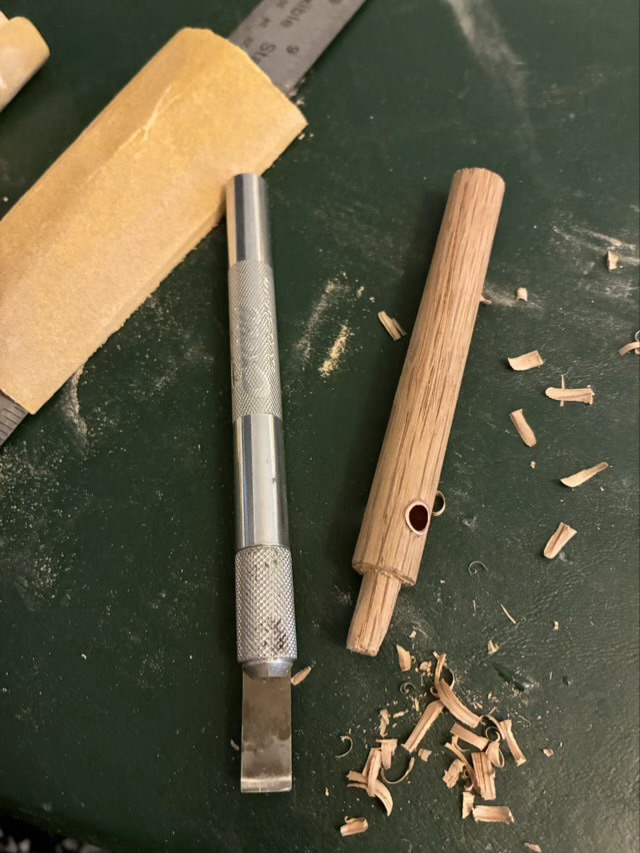
Photo description: PVC pipe with a slot cut and sanded smooth, a section of dowel sanded to fit snuggly inside the tube, and a short section of red PVC pipe the same length as the wood and split lengthwise
Photo description: wood plug finished with butcher block wax and fit into the top of the tube
Photo description: red sleeve placed over the white PVC to create a narrow hole
Photo description: rubber band around the red sleeve to keep it tight and reduce air leaking
Photo description: finished PVC overtone flute

The tone of the flute is quite pleasing and very fun to experiment with. Below is an audio file of me playing the PVC overtone flute I talk about in this blog post.

I love it when my crafting and music rabbit holes merge and open a new room.

Jewel orchid

My jewel orchid under glass is getting ready to bloom! It has sent up the spike and there are buds at the top.

Photo description: jewel orchid spike under an acrylic cylinder

It isn’t a great photo. When the blooms open, I’ll have to see if I can set up a photo shoot for it. I’ve heard the blooms aren’t very showy. Jewel orchids are mostly prized for the leaf decoration, which you can see in the photo above is showy.

Singer treadle base

After removing the rotting wood top and wire brushing the rust and wasp nests from the Singer Treadle machine base, it was time to refinish the cast iron.

Photo description: Singer Treadle machine base from 1907 before polish

I chose to treat the cast iron with black stove polish to keep the rust away and keep it close to the original color.

Photo description: using a soft bristle brush to apply the black stove polish into the intricate cast emblem on the side of the treadle
Photo description: completed application of black stove polish

I used squares of cotton and a small brush to get the polish in the cracks and crevices. It was satisfying to see the paste melt into the iron.

The wheels all rolled well, so I cleaned them with a brass wire brush on my rotary tool and treated them with sewing machine oil.

Photo description: steel wheel before picture
Photo description: steel wheel after picture with the dust and dirt removed

The plan is to put on a table top, but keep the treadle functional by putting holes in the top so the drive band can come up through and run a device on the surface. I may experiment with some scrap wood first.

Waste to warmth

Making blocks is a great thing to do with the odds and ends of left over yarn you have in your stash. Warm Up America is a non-profit organization that gives warmth to those in need. One of their many ongoing projects takes 7”x 9” blocks either crocheted or knitted. Volunteers join the blocks together to make blankets. They have many free patterns, which is another way to increase your skill level with a smaller time investment, and make something truly meaningful. There is more than warmth in handmade items, there is connection and the knowledge that another person put time and effort into helping a fellow human. It is a philanthropic activity that is both physically and psychologically beneficial to both the maker and the receiver.

I made blocks with the diagonal squares pattern from Mary Maxim, which I love so much. I found worsted weight acrylic yarn crocheted with a size K hook with 8 squares by 10 squares makes a 7” x 9” block.

Photo description: 7” x9” crocheted blocks made with left-over yarn

The block on top in the picture above was made with alternating rows of color, which was an interesting experiment, but resulted in many, many, many ends that had to be woven in. Please weave in your ends!