Plying ball

I finished spinning a single of my Ramie fiber sample. The long staple bast fiber was easy to spin fine, and was enjoyable to work with.

Photo description: Drop spindle with single spun Ramie fiber on a scale registering 48g

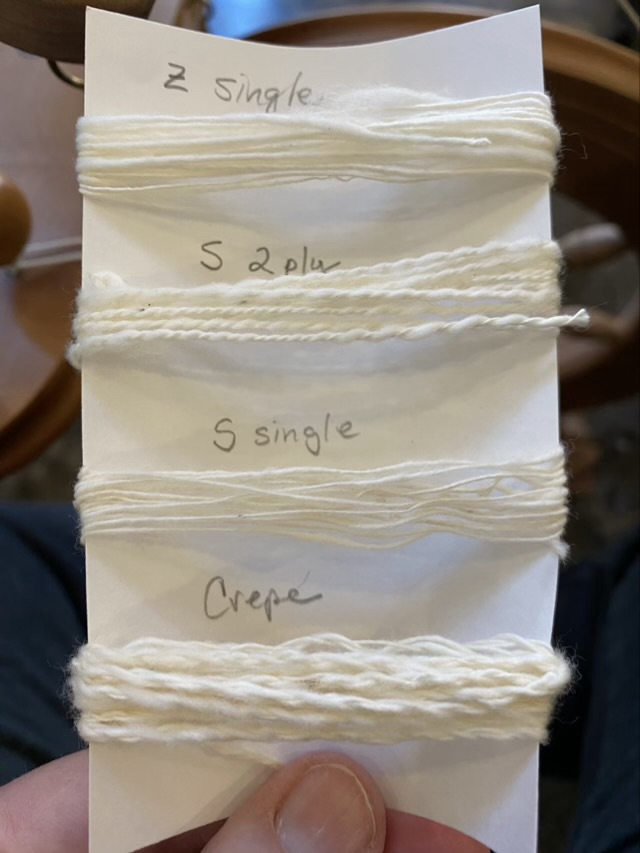
It is so fine that I decided to divide the yarn and make multi ply yarn. I weighed my full spindle, and since I had the spindle weight marked on the whorl (22g), I knew I had 26g of yarn. I wrapped a center pull ball of yarn that weighed 12g and set it aside to try chain plying, which results in a three ply yarn. I then wrapped two 4g balls and a 10 gram ball. Oops. No worries, I decided to do a four ply by using both small balls, and taking from the inside and the outside of the larger ball. It was tricky to handle, so I made a plying ball, which means I wrapped the four strands of yarn together, without twist, into a center pull ball. There were still some tangles, but they were manageable. I could then add twist as I pulled the four strands from the middle of the ball.

Photo description: bottom: spindle with plied four strand yarn, middle: plying ball with four strands, top: bit of tangle at the ends, which I was able to sort out once the rest of the yarn was plied
Photo description: four ply Ramie yarn on a drop spindle

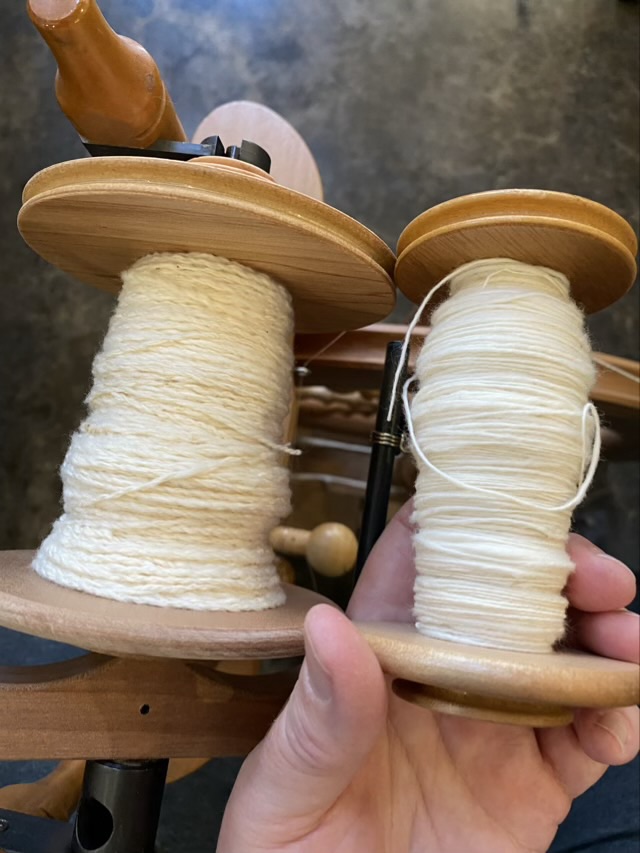
The rather rough single spun yarn felt much softer once it was plied into a multi-strand yarn.

Photo description: two balls of Ramie yarn, left one is single spun, right one is four ply.

Throwback Thursday: Mixed Media

Here is something from July 2008 that reflects most of the crafts I was involved with at the time: crochet, wire work, and glass fusing.

Photo description: copper and glass necklace from 2008

The rope was crocheted with copper lined seed beads (I think, I may have crocheted copper wire with clear seed beads, but the rope looks too even with a nice drape, which tells me I probably used silk cord, rather than wire, and the the copper color may come from a lined seed bead). I finished the rope with hand made wire cones and a purchased copper toggle clasp. The pendant is fused glass with a hand made chased copper inclusion in the shape of a four loop Celtic knot. I was experimenting with fused glass using a small kiln because I could set it up, let it run its program overnight, and check on it in the morning in my own time, very important when dealing with a young child and another on the way.

I attached the glass pendant using copper wire, and added five independent coils of copper around the rope. I must have done this for flexibility reasons, it would have looked better with a single longer coil, but that would have changed the drape.

These seed bead crocheted ropes do make me nostalgic for the times I could wear necklaces. They have a comforting feel in the hand.

All in

I checked my cameras in the chicken coop and was shocked to see all five hens in the coop! The new Black Star chickens have both finally accepted the roost. They took the prime corner spot, which sent Seashell off to the nest box, but she isn’t broody, so I’m not concerned.

Photo description: inside of my coop at night, two Black Star hens on the roost at the left, two Faverolle hens on the roost at the right, and the tail feathers of the third Faverolle hen in the top right of the nest boxes at the far right, mouths open because the high was over 100 degrees Fahrenheit that day

Molting has begun, and egg laying has stopped. They are all older hens as well, so we may have seen the last of the eggs until Spring (maybe).

Knotted into a corner

I’ve been carrying around tatting supplies in my purse and using them when I have a few minutes of waiting. Rather than bother with the bulk and hassle of a pattern, I’ve been exploring how the forms of tatting go together. Such experimentation is very useful to develop my skills and also results in some learning opportunities. In tatting, motifs are connected using picots, or loops in the work. This requires preplanning or an abundance of loops on a useable side of the work. I was attempting a triangular piece, and merrily made a line of knots with no loops. Oops.

Photo description: experimental bit of tatting, with the bottom edge solid without picots

Although the line of the piece shows promise, I can’t add onto the smooth edge with my current level of knowledge (there may be a technique out there that gets around this conundrum).

As an added learning bonus, it seems tatting also has some play with tension. How tight you pull the center thread determines the motif radius, so even when following a pattern, if the arcs and loops differ from the author’s, the piece might not lay flat. Irish crochet had a similar artistic feel.

Major Chord recipe

I have a new favorite alcoholic beverage. It came from experimentation with some cupboard favorites, and we couldn’t find an existing name for it, so my husband came up with a great name: Major Chord. The recipe has three ingredients and they go together very well.

Photo description: soft yellow liquid in a tall glass with ice sitting on a tatted coaster

Major chord:

  • 2 ounces Deep Eddy Peach Vodka
  • 1 ounce lemon juice
  • 1/2 can Goslings Diet Ginger beer
  • Ice

I stir the mixture with a bar spoon.

I could even take the analogy further and compare it to a barbershop quartet where the ginger beer is the bass, giving a depth of flavor; the peach vodka is the lead, giving the bright melody; the lemon juice is the baritone, giving it zing; and the ice is the tenor, floating on top and adding sparkle.

But only after I’ve had a couple.