Tattered

Molting is not a pretty time for chickens. My Faverolles (hatchery quality) usually have a very slow molt so while there are feathers everywhere, they usually just look a little disheveled. Except for one hen that in the last couple molts has lost all her neck feathers at once. It is very disconcerting to walk into the coop and it looks like the chicken has been strangled. She is fine, though, and now the feathers are coming back in.

Photo description: Faverolle hen mid molt looking quite tattered

Spinning Tencel

I started on a new fiber sample from my stash: Tencel. Tencel is derived from wood pulp, and the manufacture is reported as an “environmentally friendly closed loop process”. To save you some googling, I looked up what closed loop manufacturing means, and it is essentially that an item can be recycled over and over again. The Tencel sample I have from Hearthside Fibers has a long staple length and a high luster.

Photo description: unspun Tencel fiber held fanned out in my hand in the sun showing a high shine

The fibers are almost slippery, and I’m having trouble spinning consistently. I’m dropping the spindle even more than usual.

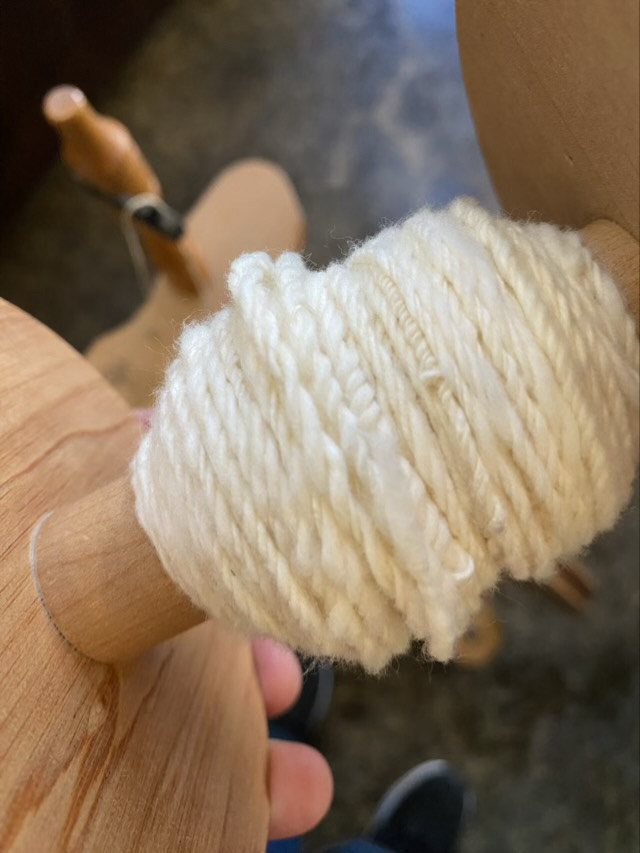
Photo description: the beginning of a cop of Tencel single spun yarn on a drop spindle held in the sun to show off the sheen

This sample is going to take me awhile to spin. Not only is it tricky, it is horribly hot outside still, with highs over 100 all week and lows over 80. Yuck.

Oh and yeah, the hook came off my spindle again. Next step is to epoxy the thing in.

Broken

My daylily bracelet finally broke after four weeks of wear. I felt it pop, but didn’t find the break until later where I joined a new leaf into the twine. It was probably the soak in the chlorinated pool that hastened its demise.

Photo description: daylily leaf bracelet with a broken strand on my wrist, calico cat in the background

Adding obstacles

The squirrels really appreciate that I put out dried ears of corn, but they go through one ear in a day. I added an obstacle, so they have to work harder for the corn by tying knots in a 1/2” hemp rope and adding a screw eye. The corn is twisted onto the screw and hangs in the middle of the rope.

Photo description: Rope tied from the bird feeder stand to to railing with an ear of dried corn hanging from the middle

The squirrels have figured out how to get one kernel at a time off, but prefer the birdseed. We have a four squirrel family, so maybe one will figure this out while the others are gorging on seed.

Chain plying Ramie

I like chain plying single spun yarn because I don’t need three bobbins and a Lazy Kate to get a three ply yarn. I use a center pull ball and make a crochet chain with really long loops. I was unsure about chain plying my Ramie fiber because I’ve read that it isn’t a good technique for bast fibers like flax because flax doesn’t like the sharp bends which happen at the ends of the loops. Flax is not as flexible as wool. Ramie is also a bast fiber, taken from the stem of the plant, but it chained plied quite well; the chain loop ends disappeared into the ply twist without little stubborn loops.

Photo description: three ply yarn (chain plied) on the left, four ply yarn (not chain plied) on the right

For chain plying with a drop spindle, I prefer to sit and park my spindle by my leg, then pull a loop as long as my arm. I keep the end of the loop open with a finger and the yarn ball in the same hand, then I can suspend the spindle and give it a spin in the opposite direction of the single.