Swirled beret attempt

I can spiral two and three colors, how about four? Well, this might take some development. The angles of the spiral arms change even more than in the three spiral version, and I quickly slid into beret territory, but then didn’t make the increases evenly somehow and ended up a little wonky.
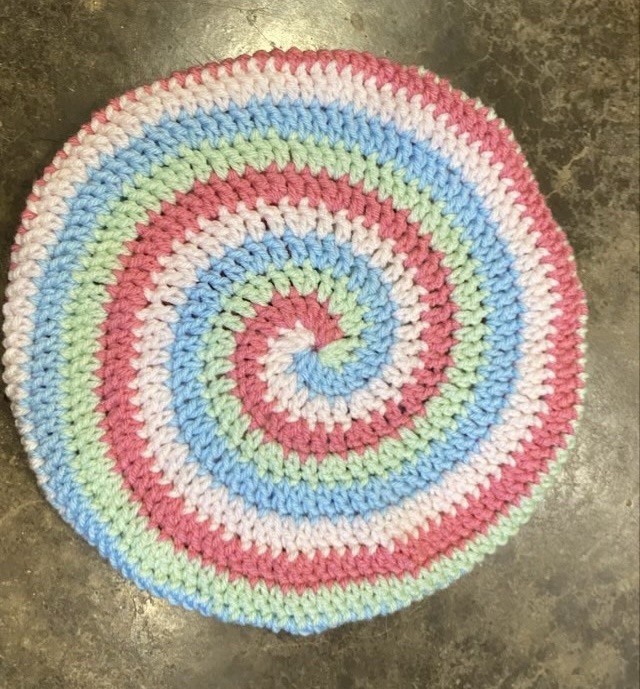
Photo description: four color spiral beret which is an imperfect circle

Making the beret band was a fun experiment. I tapered the final stitches on the last round and the single crochet ribbed band went on nicely.

Photo description: same beret, other side showing the four color band, which is frankly the best part of the hat

I don’t think I’ve talked about the subtle difference between beanies and berets. After a beanie’s circle is made the sides are straight with no increases or decreases, the circle should be the circumference of the head size to get a nice fitting beanie. A beret circle goes far beyond the head circumference, then the sides use decrease rows to come back to the right circle size before adding on a band.

Three color spiral beanie

There are several ways to crochet a striped hat, but my favorite is with spirals. Can I spiral three colors together? Yes!

Photo description: close up of the top of a crocheted three-color spiral hat in green, light pink, and dark pink

To start the spiral, each color has a single crochet, half double crochet, and two double crochets into a magic circle. This gives a slight taper to the start of each color. The increases for the crown are worked in each color and there are no ends to the rows, the stitches are worked continuously around in double crochet alternating colors. To end, I reversed the taper with a half double crochet, single crochet, then a slip stitch before weaving in the ends.

Photo description: side of the same hat showing stripes on the side and the decrease at the brim for the dark pink color.
Photo description: same hat folded to show the spiraled crown

Tree moss

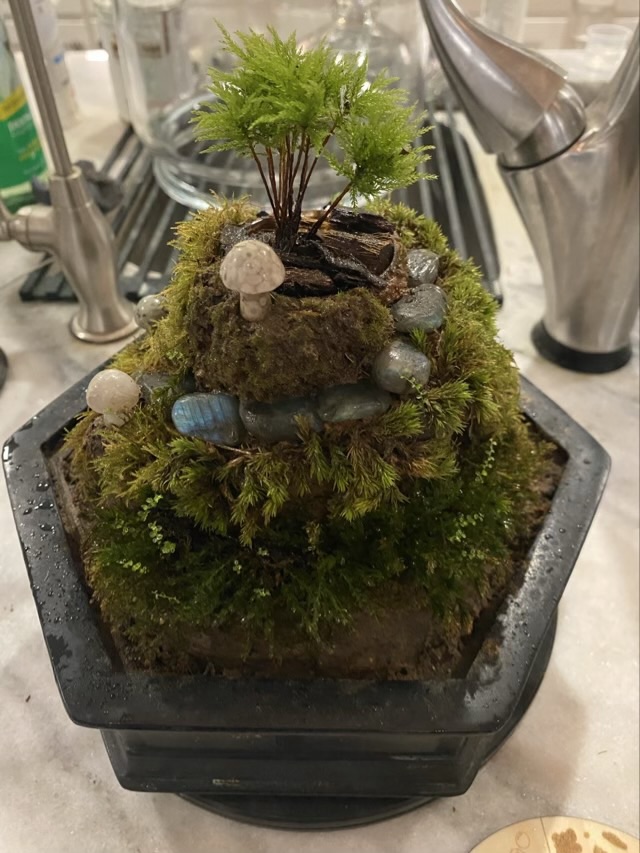
My little jewel orchid was not thriving in the terrarium; I don’t think it had enough light. The moss I purchased was thriving though, so I went looking for something relatively tall (1-2 inches) to crown my miniature hill. I found Climacium Tree Moss (Dendroides / Americanum). This moss grows a kind of trunk and looks like a miniature copse of trees. Adorable and perfect.

Photo description: mossarium without the glass cover showing the new tree moss on top and new growth on the moss near the base, stone “steps” of polished labradorite, and carved stone mushrooms

The jewel orchid lost its roots (probably too wet in the terrarium), so I put it in a jar with some living moss near a north facing window (no direct sunlight, but plenty of indirect). I’ll post an update on it as it recovers. I’ve read that an orchid can regrow roots from healthy stem and leaf, so I’m hoping.

Twisted brim

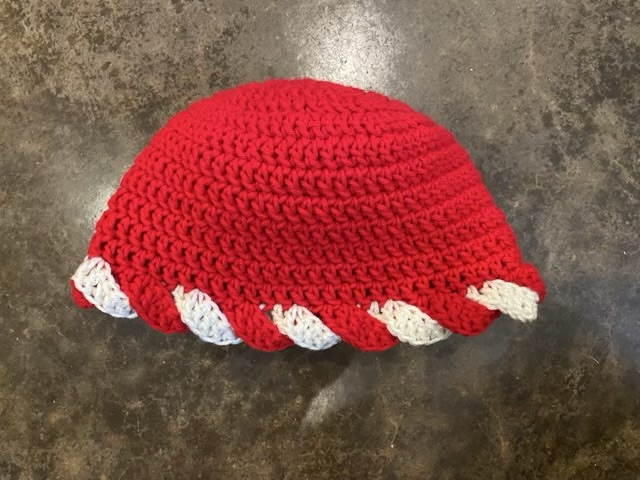
I’ve seen a twisted brim made of two twined sections of needle work in nålbinding, and wanted to try it in crochet (because I still have acrylic yarn that I’m trying to get through).

Photo description: finished crocheted hat with twisted brim made with red and white yarn

Pattern (American notation)

  • Row 1: in Magic Circle double crochet (dc) 12. Slip stitch (sl st) to first dc.
  • Row 2: CDCS, dc in same stitch, increase (inc) by making two dc in each row 1 dc. Slip stitch (sl st) to CDCS. (24 stitches)
  • Row 3: CDCS, dc in same stitch, *dc next stitch, inc next stitch*, repeat * around. Slip stitch (sl st) to CDCS. (36 stitches)
  • Row 4: CDCS, dc in same stitch, *dc next 2 stitches, inc next stitch*, repeat * around. Slip stitch (sl st) to CDCS. (48 stitches)
  • Row 5: CDCS, dc in same stitch, *dc next 3 stitches, inc next stitch*, repeat * around. Slip stitch (sl st) to CDCS. (60 stitches)
  • Rows 6–12: CDCS, dc in each stitch around. Slip stitch (sl st) to CDCS. (60 stitches)
  • Twisted brim
    • CDCS in red, dc in next two stitches. Make bridge: yarn over (yo), insert hook in same stitch, yo pull through, chain (ch) 1, yo pull through two loops twice. Yo, insert hook into both loops of ch st, ch 1, yo pull through two loops twice. Make four more, for a total of six bridge stitches in red.
    • CDCS in white in next stitch of hat, dc in next two stitches. Make bridge: yarn over (yo), insert hook in same stitch, yo pull through, chain (ch) 1, yo pull through two loops twice. Yo, insert hook into both loops of ch st, ch 1, yo pull through two loops twice. Make four more, for a total of six bridge stitches in white.
    • In red, yo, go behind the white bridge, insert hook in ch st then into next hat st, yo pull through hat and ch st, yo pull through two loops twice. Dc in next two stitches. Make six bridge stitches.
    • In white, yo, go behind the red bridge, insert hook in ch st then into next hat st, yo pull through hat and ch st, yo pull through two loops twice. Dc in next two stitches. Make six bridge stitches.
    • Continue the last two steps to make twined loops of red and white around the brim of the hat. For the last round only make five bridge stitches and join the beginning of the color. Weave in ends.
Photo description: start of the twisted brim with two bridges made, one in white, one in red

Here is a video showing the sequence for the bridge in white.

Molt

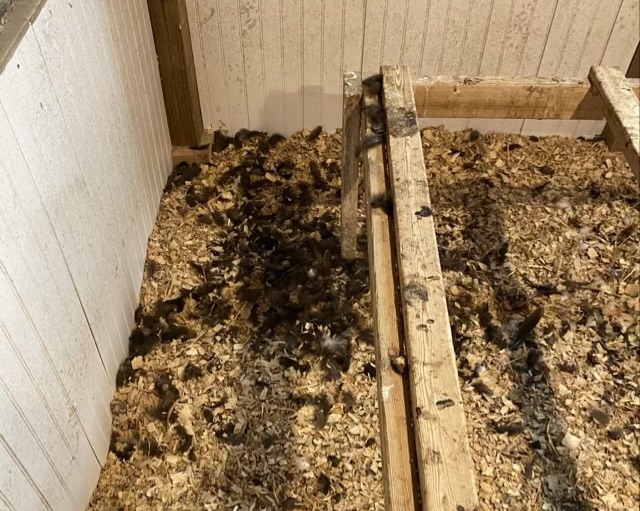
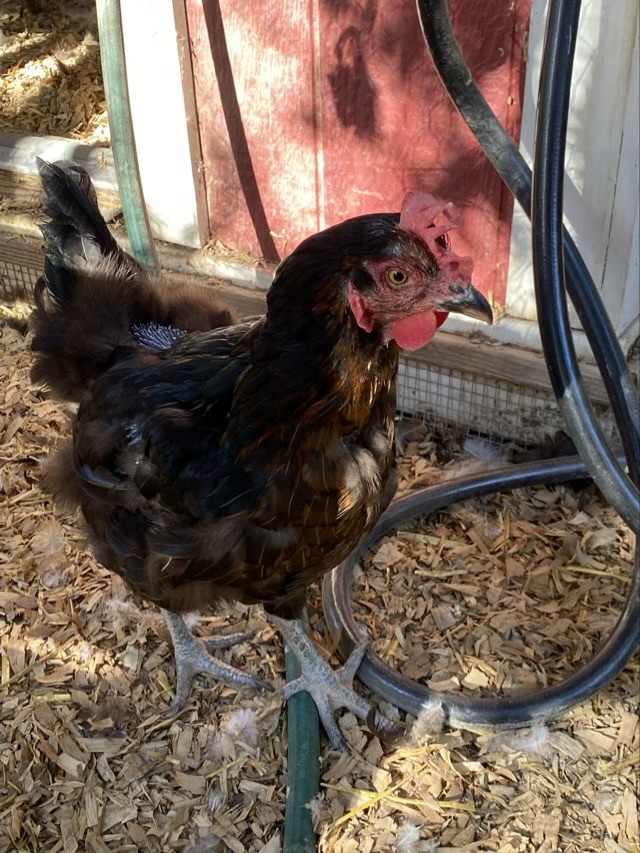
Wing Ding the Black Star hen doesn’t mess around with her molt. When I took a peek at the coop through the web cam, I thought a predator had broken into the coop and taken out a chicken. I went out and all four hens were fine, Wing Ding was just molting.

Photo description: pile of black feathers on flakes of pine shavings in the back corner of the roost
Photo description: Black Star hen in molt, looking quite bedraggled and spots with no feathers, with the new pin feathers coming in

This is one of the characteristics of a good layer. They molt quickly and get back to laying. My Faverolles are not good layers and take months to molt. They are all over five years old, though, so we might have seen the last of their eggs.