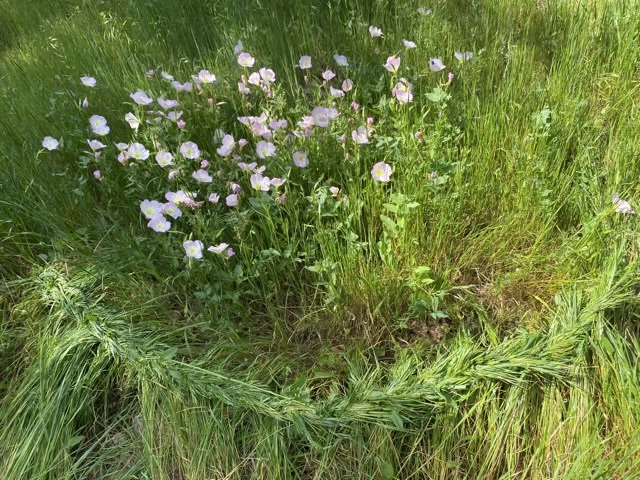
I’ve seen where people have french braided long grasses, so when I wandered through our meadow and saw the waving Spring grass I thought I would give it a try. (Yes, I was completely in the middle of another project for this side quest.)
Photo description: patch of evening primrose with a half circle of braided grass in front
I did more of a Dutch braid, where the braid lays on top of the joined strands, but it didn’t have as much definition as I hoped. I was also struggling to have enough grass to join in the braid and still get the curve I wanted. So in a few weeks, when the grass is higher, and I need a break from a task that takes me through the meadow again, I’ll give it another go.
I recently had the great fortune to learn from my neighbor who is an accomplished Cherokee weaver. She started me on a Cherokee style Peace Symbol/Door Hanger and told me that these would hang in the council house and be decorated with feathers. If the feathers were white, they were at peace, if red, they were at war, and if black, the village was in mourning. There are thirteen spokes representing the thirteen cycles of the moon during the year. I thoroughly enjoyed weaving this. I love the style and the way the light plays through the thin round reed.
Photo description: Wall hanging made of number 2 round reed with a woven center with thirteen interwoven loops
I am not Cherokee, neither in lineage or registration, so I’m being very clear that what I made is “in the style of” or “like” a Cherokee weaving.
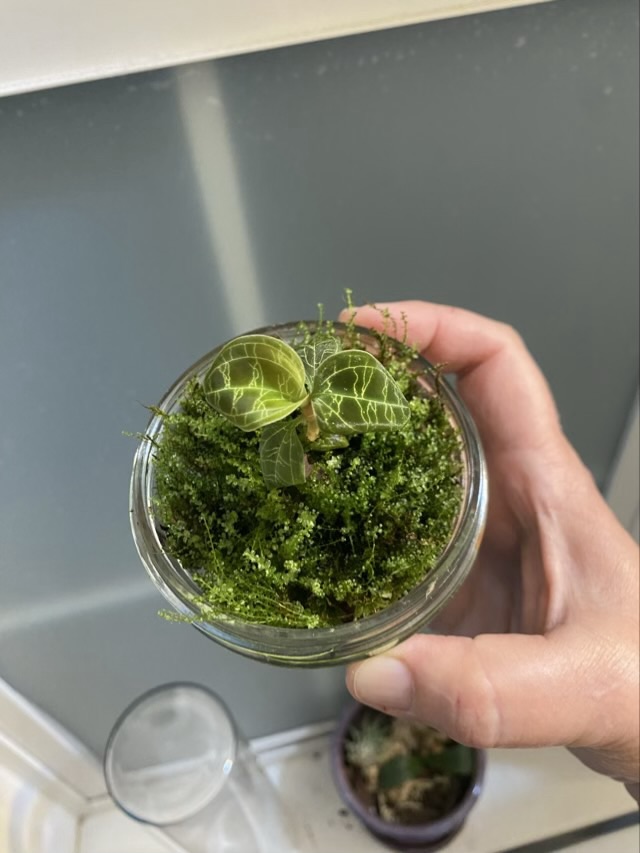
When my jewel orchid failed to thrive in my mossarium, I transferred it to an old fancy Ball jar filled with moss in a south west facing window covered in a translucent frost window covering. It was happy there, so happy that it started on a new leaf.
Photo description: fancy Ball glass canning jar filled with moss and one jewel orchidPhoto description: top view down into the jar, new curled leaf visible on the orchid
There are two problems with the canning jar container: one, I can only see the jewel orchid when I open the jar; two, if the orchid gets happy enough to bloom there is no room for the flower spike. So I purchased a tall clear acrylic vase, transferred the orchid and his moss to a different canning jar, and used the vase as a lid.
Photo description: same window, different home for the jewel orchid, a smaller canning jar, but a taller clear cover
I can now see the orchid, and if it sends out a flower spike, it has somewhere to go. He remains happy in his new home, as his leaf opened fully with no curling or discoloration.
Photo description: 10 days after the last picture showing the jewel orchid with two fully formed leaves in a live moss bed in a small canning jar held up to the light
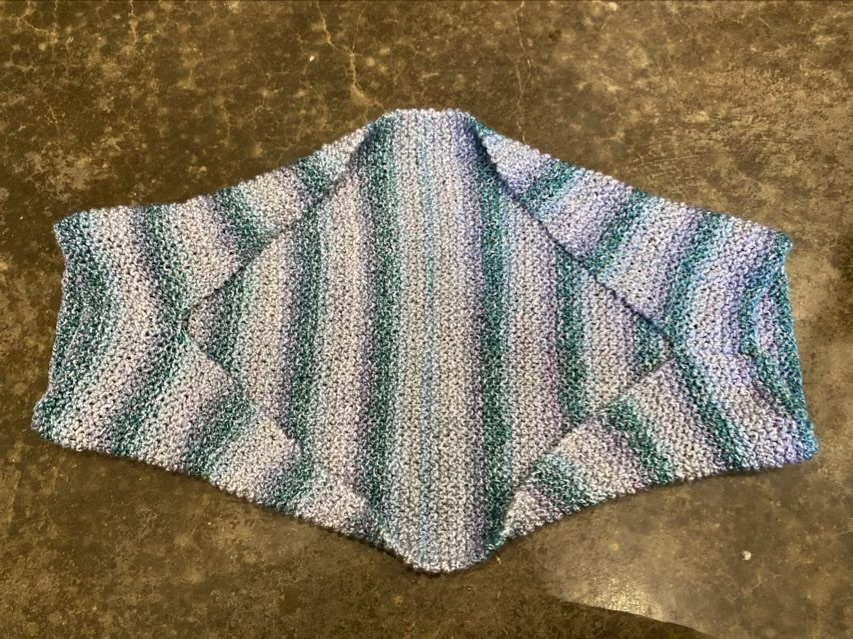
My youngest gifted me two skeins of yarn last December. I cast on with size 11 knitting needles at the end of February, thinking that a nice wide scarf would be cozy. Hm. Two skeins does not make a very long, wide scarf.
Photo description: knitted rectangle with purple and teal stripes (yarn was self-striping)
So the scarf became a shrug. Sewing the ends together for a few inches formed short sleeves, which help keep the shrug in place.
Photo description: knitted shrug with now vertical stripes
It works! It is now a garment that gives a little extra warmth, and as a bonus, doesn’t wrap around the neck. This isn’t the first time, and won’t be the last, where I have had to pivot the purpose of a project. This one definitely came out better than the original idea.
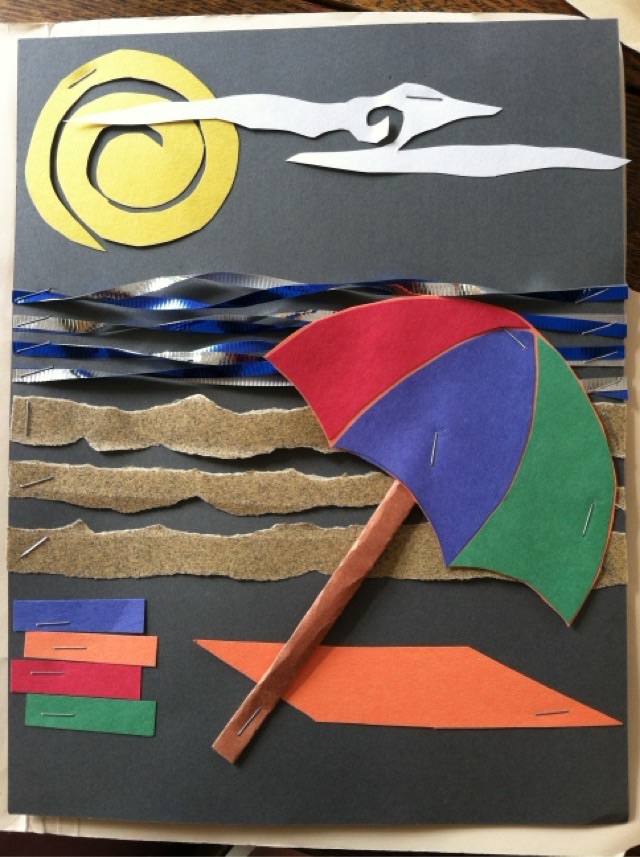
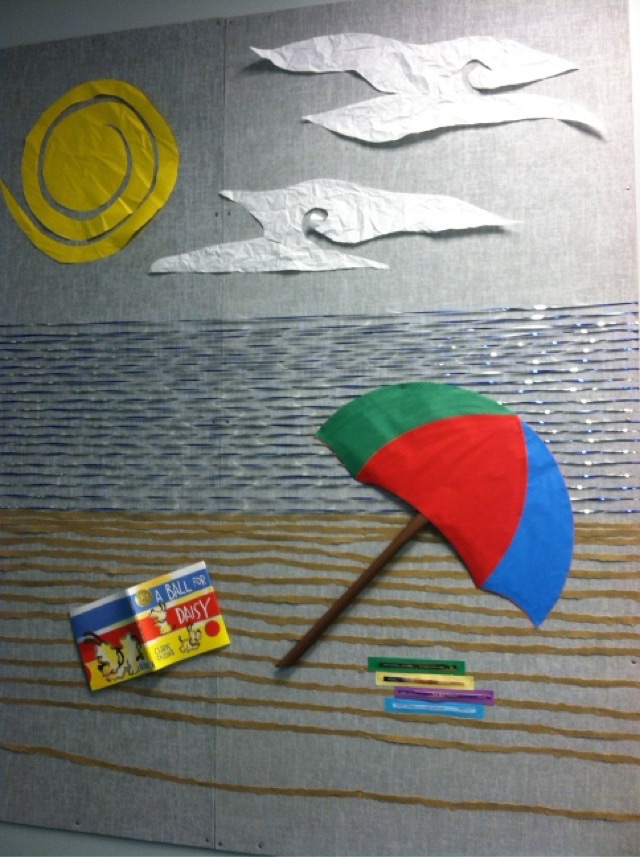
Today we look back at August 2013 and the library bulletin board to welcome kids back to school. I did a concept test on a regular sized sheet of paper, using strips of sand paper for sand, and ribbons for water. The kids love running their hands on the bulletin board, so I thought the sand paper would give them something nice and tactile.
Photo description: beach scene on black paper with paper umbrella, paper book stack, strips of sand paper, twisted ribbons, and paper sun and cloudsPhoto description: full sized bulletin board with a bonus book cover and I added a crumpled texture to the sun and clouds
The fun part of the full board is that there was a vent that blew air across the surface, making the ribbon move and giving motion to the ocean. I did not use backing paper; I was still fire shy after the previous year’s board was deemed a hazard by the fire marshal.