Photo description: scrap book page with an Egyptian cotton card from Hearthside Fibers upper left, single spun and chain ply yarn upper right, unspun fiber middle left, twined weaving swatch middle right, knit moss stitch swatch bottom left, crochet lace round bottom right
I spun this Egyptian cotton sample on an Ashford Traveller spinning wheel fitted with a high speed whorl. Egyptian cotton has a longer staple length so is less inclined to form pills. It was nice to spin and worked up into the swatches well.
I enjoy spinning cotton, but is definitely a sitting activity, either on a wheel, or with a tahkli spindle. I also avoid wearing black, as the small fibers accumulate everywhere.
Photo description: scrap book page with a Tencel Top card from Hearthside Fibers upper left, single spun and chain plied samples upper right, unspun fiber middle left, plain weave swatch middle right, stockinette knit swatch lower left, and crocheted lace round lower right
The next completed fiber study page is for Tencel. Tencel is made from wood pulp and the combed fiber is shiny and silky looking, but it is not easy to draft consistently. I want to like it because it is made from waste product, but it fought me when I was spinning. Maybe it would be better if it were blended with something. Blending fibers is another whole rabbit hole.
Despite the difficulties spinning, my swatches are more rectangular and less skewed than with other fibers. I block most of my swatches, but the Tencel really benefitted from being wet and reshaped.
Photo description: scrap book page with card from Hearthside Fiber in the upper left, single spun and chain plied yarn in the upper right, unspun fiber middle left, twined swatch middle, tatted swatch middle right, knitted swatch bottom left, and crocheted swatch bottom right
I think this was my bottle neck for assembling my fiber pages. I had several sets ready for assembly but this one wasn’t ready because the tatted swatch took a long time. I think next time I tat for the book it will be a ribbon rather than a rectangle. Or a small doily. Choices.
My favorite piece on this page is the crochet, because I used an orange peel stitch that alternates between single and double crochet and gives a beautiful texture.
The fiber is cellulose infused with peppermint, according to the description. It is supposed to feel cooler. I do not feel it. It was easy to spin thin, gives a nice drape in the knitting and crochet, is possible to tat with (but has more halo than pearlized cotton), but is not noticeably “cool”, any more than cotton can feel cool.
I might purchase this fiber if I had a light summer shirt I wanted to make, but I would be more inclined to purchase cotton or linen.
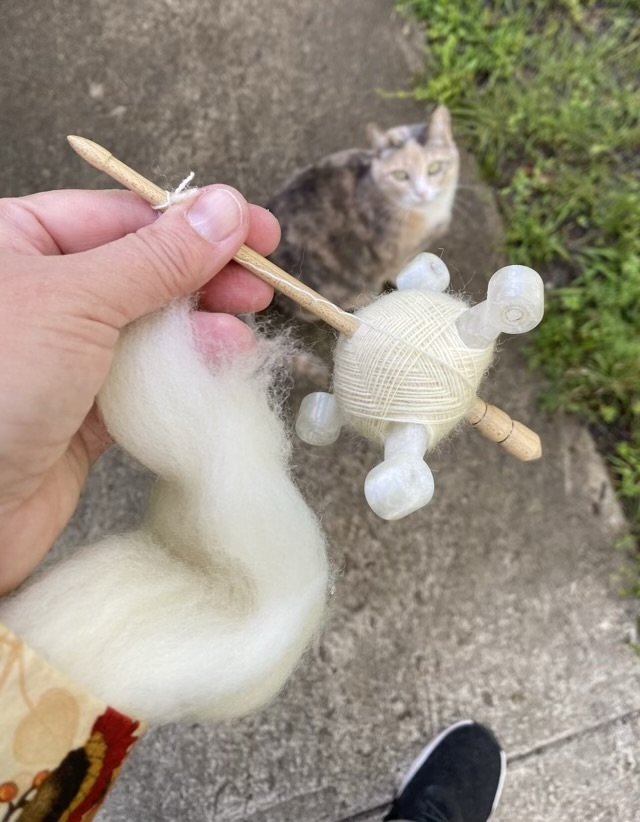
When I was in Michigan I visited the Sweetgrass Jacob’s Sheep farm and picked up a bump of two-tone roving. The shepherdess told me it a pain to separate out the colors for the mill, but I’m very glad they do because this was fun to spin. I chose to spin it with my Ashford Traveller spinning wheel fitted with the standard whorl and the sliding jumbo flyer, but with a standard size bobbin.
Photo description: two-toned bump of roving made from Jacob’s Sheep wool, next to an Ashford Traveller spinning wheel spinning a single
The standard bobbin held all the singles I spun from the bump, barely. I should have started with the jumbo bobbin, but now I know.
Photo description: standard sized bobbin very full with a single spun from Jacob’s sheep roving
I love how this yarn is coming out! The random variations in the color ratios make me happy. Now, I’m not usually a fan of knitted variegated yarn, so I’ll have to ponder the use of this yarn for a while.
In May of 2013 I was into making sculptural wood and wire photo frames.
Photo description: oak wood photo frame with wire tree and Mother of Pearl buttons as leaves
I cut the frame from hardwood, sanded and finished it, then put a peg hole and dowel in the back to function as a stand. I drilled holes for the wires, epoxied them in and shaped them. I added tabs to the back to hold the photos in. Did I take a picture of the back? Not of this one.
Photo description: back of an owl photo frame showing peg stand, metal tabs, and hanging hardware. The eyes of the owl were fused glass with iron oxide pupils that matched the tone of the wood. the back of the eyes can be seen in the photo.
My photo skills took a slip back at this time. Many of the photos for the other frames were blurry, or at a strange angle, and others were taken with photos in them. Some of the photos of photos were decent, but since I don’t post faces on this blog, it made them unsuitable for future use. In my past-self’s defense, I had two young children and I’m frankly lucky to have remembered to take pictures at all.