Inkle Loom part 1

I’ve been looking at Inkle looms on the internet since I made my first tablet woven strap. I was certain I could make one, but wasn’t sure if I would have the time. I found myself at the hardware store for sandpaper for a different project, so thought I would look around for Inkle loom parts. I walked out with a 1x12x24” poplar project board, 1/2” and 3/4” poplar dowels, a 6” carriage bolt, washers and wings nuts, oh, and the sandpaper.

Planning the design with pencil and string

I laid out the design by clasping the board between my knees and sketching with a pencil where the outer posts could go. I wanted a lap loom and thought it would be more stable with something to hold onto. I taped string where the warp threads would go to avoid interference between posts. Even though I intend on using it for tablet weaving, I included the heddle post in case I want to weave something that needs it. The outer edge I wanted to be wavy with an organic feel, rather than a straight lumber look.

Loom cut out

I cut the loom out using a bandsaw with a 1/4” blade. I made a base piece so I could stand the loom up on a table if I wished. I sanded all the edges with an orbital spindle sander to smooth out the saw blade cuts.

Holes drilled in the loom body

Using a drill press, I drilled 1/2” holes for the posts, and 1/4” starter holes for the slot for the tension post.

Sanding the tension slot

I cut the slot with a coping saw, but was conservative on the guidelines, and needed to do quite a bit of sanding so the carriage bolt would slide easily along the track. I rounded all the edges by hand with sandpaper as well.

To be continued.

WIPs

Oh dear. I decided to see what my WIP (work in progress) count was up to. Hm. I’ll share them here as a kind of accountability, although I’m not counting the ball of napkin twine in the glove compartment of my car that is for emergency craft use (that project doesn’t need an end). Nor am I including the fiber survey that also ongoing.

Spindle development

Developing a 3D printed spindle is my oldest WIP. I’m still working on the head breaking issue, but with the help of the printer, I feel we are nearer the end than to the beginning of this project.

Spinning alpaca fleece on a Befra Wily spinning wheel

My sit and spin project on my vintage wheel is also nearing completion. I have a few hours worth of alpaca fiber left in the basket (the fiber in the blue bin is waste from combing). I have another portion of washed alpaca in queue.

Spinning flax roving

My walking spinning project involves my first taste of flax spinning. The roving preparation is an odd one, but I’m finally getting the trick of it. I maybe have two or three walks left to finish the singles, then I still need to ply and finish the yarn.

Brioche rainbow scarf

My rainbow scarf knitted with the Brioche method became a car project a while back. This was the best thing for this work, as I regularly knit for about an hour on it many times a week as I sit in the car rider line. I still have many hours left to go.

Newly cast on cardigan project

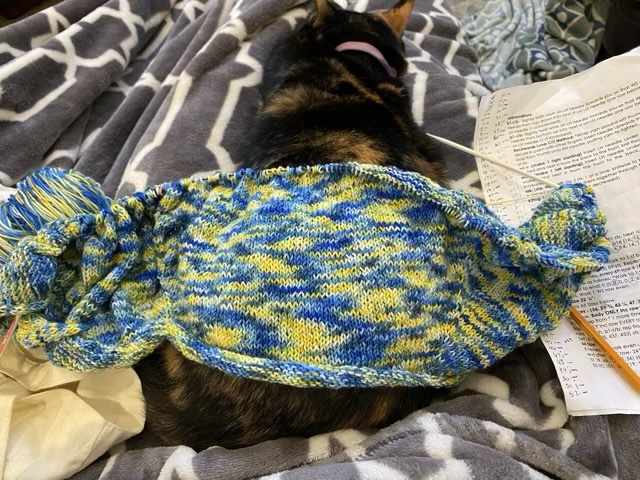
My newest WIP is a blue and yellow light-weight cardigan. This is a big step for me in knitting. I have made a couple of sleeved garments (as opposed to vests, scarves, hats, and gloves), but not many and they all have had sizing issues. I’m making the attempt again because I have grown as a knitter and am hoping the new skills will help. I have been planning this knit for months, but I hadn’t cast on yet, so it wasn’t an official WIP. It sits next to my chair at home.

Tablet weaving

I caved. I’ve been seeing bands made by tablet weaving for years, but didn’t see why I should expend the effort. It makes a strip of fabric, a small thing, what’s the point? Curiosity got the better of me, and I found instructions here to get started without buying anything. I made my “tablet” or cards from old UNO cards (we have SO many different decks), which conveniently are already numbered.

Tablet weaving cards made from an UNO deck

I used thin yarn leftover from several projects and two chairs spaced a distance apart to make the warp threads, knotted the end, then threaded them through the cards according to the directions.

Half of the tablet cards threaded with warp yarn

I used the back-strap method of applying tension to the warp threads, which means I attached one end to my belt, and the other to a stationary object. I experimented with: my toe, a door knob, and my steering wheel (when parked). When not weaving I used a cable needle (like a giant safety pin) through one hole to hold the cards together.

Starting weaving

To change the shed (which threads are on top or bottom), you rotate the cards forward or backward. This is absolutely brilliant, and a kind of weaving I can totally get behind. The possibilities for patterns are immense, the weaving goes quickly, and is done in less time than on a wide piece or a picked pattern. I definitely had learning woes, I thought I was weaving too tight, but I was actually too loose, but it was a worthwhile experiment.

Done weaving.

The ripples in my band are because I wasn’t tight enough with my weave. I knotted the ends and cut off the extra warp, then ironed the band. It isn’t perfect, but I want to do more. (I do need a better way of keeping track which way I turn the cards. Squirrel.)

Ironed band showing both sides

I have also added an inkle loom to my wish list, which would enable me to keep tension on the work at all times and not have to go looking for a stationary object.

Crocheted duster vest

I obtained a crochet pattern for a vest published in 1969 and decided I needed a duster version for an upcoming chorus show that is featuring 60s songs. I had some fingering weight cotton in my stash and I doubled it, combining three different blue colors with two different grays to get a fade on the garment.

Crocheted duster vest

It was a very easy pattern, just chains of 5 joining the previous row made of chains of 5 with a single crochet. I aimed to make it mid-calf length, but the net pattern now stretches nearly to the floor! It crocheted up fairly quick as well, because it is comprised mostly of air, which also makes it not hot to wear. Yay for netting.

Spindle size tests

I’m still working on the design of my 3D printed spindle. I’ve now had a local printer make up three sizes, and have tested them all with the same fiber blend.

Three spindle sizes with corresponding cops of single spun yarn

We aren’t there quite yet. I need some input from other spinners, and we need to change the printing density to reinforce the neck. The smallest version has never broken, but the hole in the yarn ball is too small. The largest has a great diameter hole in the cop of yarn, but is unwieldy. The middle one is the closest to feeling right, but still needs some adjustments.