I came across this wool processing video that is amazing. Good information, spectacular animation, and brief. Produced by the The Woolmark Company, it is worth the three minutes to watch.


I came across this wool processing video that is amazing. Good information, spectacular animation, and brief. Produced by the The Woolmark Company, it is worth the three minutes to watch.

The best way to see how a spindle design performs is to use it. I still think the current version of my 3D printed spindle is too large, but I’m giving it a try anyway. I can spin fairly consistent yarn with it, but the single is slightly thicker than I get with a smaller spindle. I spin over a rug to give a little extra protection in case I drop it. No way would I take it on a walk. Spinning in the house also means that Missy presents me with a ball to kick, since obviously my hands are busy.

It took a couple weeks, but my eldest’s snake is now using the new basket as a hide! He has crawled over and around it and squished it out of shape, but not crushed it. I’m calling it a successful creation.
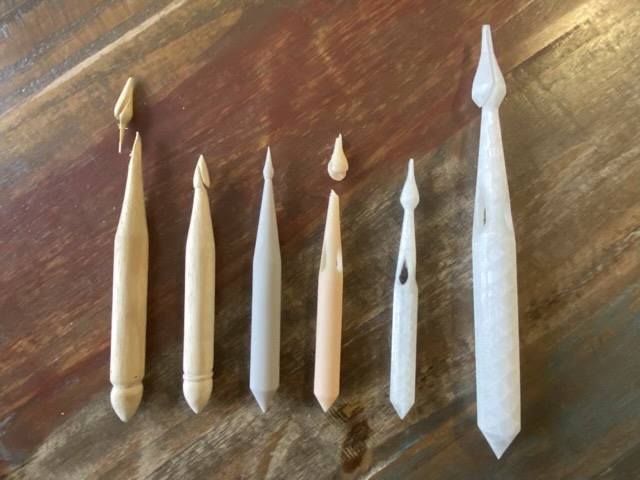
I thought I would share the current spindle development timeline. I started with wooden spindles; the first was shaped with a band sander and hand tools, the second on my lathe and with hand tools. Then I turned to computer design and 3D printing to control dimensions. Third and fourth from the left are printed in resin and very brittle, even more so than wood. The spindles on the right are printed with PETG, which in clear shows the printer pattern and looks cool. Second from the right is a little small, and the last one on the right is a little big, so I need one that is just right.

When photographing, I sent the newest spindle flying off the table and onto the concrete floor. Ouch. I have dropped the smaller one many times without breakage, not so for the larger one. Darn it. Another factor to suggest a scale down.

I glued the head back on and am spinning with it to see if there are any other aspects that need adjusting before I request another print. I am making sure I spin over a cushion or carpet.
Spinning and cinnamon rolls are two of my favorite things. When I saw a yarn preparation at my local spinning store (we have one now! Squee!) called “Cinnamon Rolags” by The Fiber Bakery by Anniewhere, I had to buy some. This particular preparation has a blend of Merino Wool, Bluefaced Leicester (BFL), Alpaca, Tussah Silk, and Finn Wool. I haven’t spun Finn wool before, so am totally going to count this spin for ticking that box.
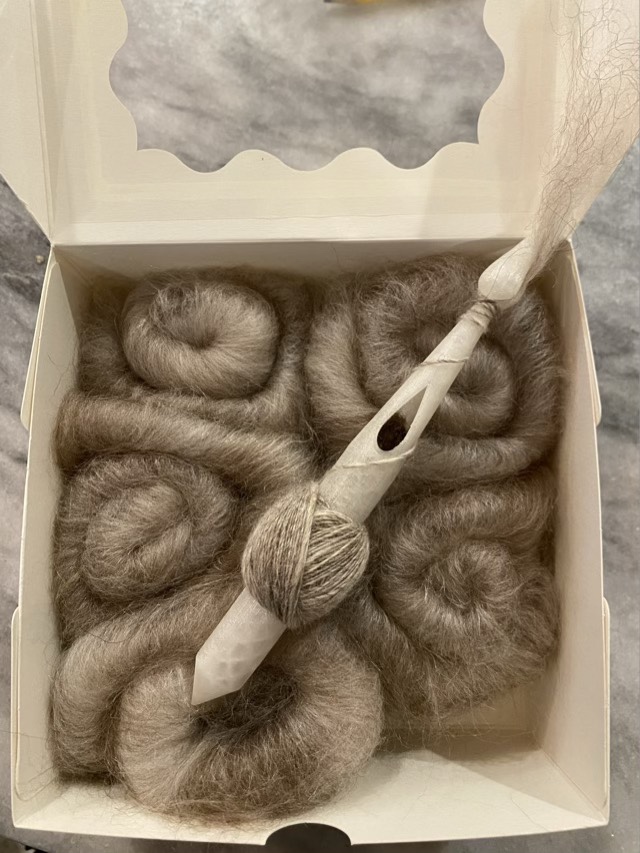
The spindle is one I designed and had 3D printed locally by X of All Trades. I’m getting larger ones made, but I wanted to start spinning. I like the rolled rolag prep. The roll fits comfortably in my hand so I don’t need a distaff or other fiber management device. The blend spins up well too; it drafts evenly, has no nebbs or tangled bits, and the spun single has a nice halo on it.
 Critters and Craft