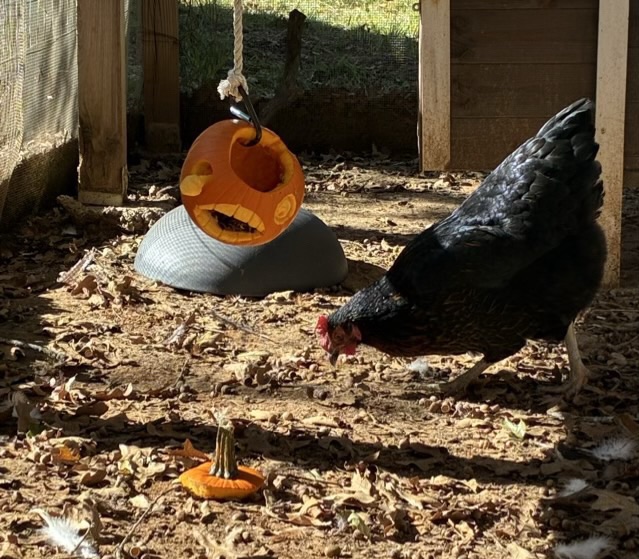
I hadn’t even finished putting new corn cobs on the squirrel-go-round when a squirrel came down to investigate.

This one has a notch out of the right ear. She may have earned herself a name.
I hadn’t even finished putting new corn cobs on the squirrel-go-round when a squirrel came down to investigate.

This one has a notch out of the right ear. She may have earned herself a name.
I finally made myself a twining loom, after returning my neighbor’s to her. I tried other shorter methods, but having the warp hang freely makes it so much easier to twine.

The boards were in my scrap pile and 18.5” long. I used my band saw to cut one board down to 1.3”, then clamped them together and drilled seven 7/16” holes, four on one side, three on the other so I could always tell how the boards line up. The wider board on the bottom gives stability. The multiple holes give me options on bag width. Ironically, the dowels have a slight bend, and line up with nonparallel holes. Hm.

My eldest gifted me some pretty green wool blend yarn for Mother’s Day, so I thought it best to make something for myself. I can never have too many project bags, and I like twining, so I just needed a loom. I had some synthetic rug yarn in my stash that was a pretty rich brown, so I used that for the warp to maximize the variegated green yarn available for the twined weft.
This will not be a quick project, but it will still be an enjoyable one.
I found a different patch of four-leaf clover in the yard!

And that’s what I have for today. We are rolling into summer which for me means a massive schedule change. There might be more plant and pet posts, or I might actually finish some projects and have something crafty to say. Hm.
In July of 2014 I was experimenting with making “viking knit” wire chains. I did a number of trials with different metals and gauges of wire. I stumbled across this picture that also showed the time it took to get a small section of work done.

I like viking knit chains, they have a nice feel and drape. The technique is looping, which years later I learned to do with yarn in a method called nälbinding. I still love nälbinding too. Neither are fast crafts, but they are satisfying.
My parents-in-law recently took a trip to South America and brought me back three hanks of beautifully spun and dyed alpaca yarn. I immediately set to opening up the hank to put on my yarn swift and use my ball winder to make a center pull ball, which is easier to use for knitting and crochet. I was met with resistance.


The hanks looked like what I was familiar with buying in the States, a large circle of wrapped yarn, twisted and tucked end in end for storage, but when I opened up the skein I did not find a continuous circle and it dawned on me that the wrap was different. I employed the arm power of my eldest to investigate.

The hanks were not wrapped in a loop, but instead used a figure 8 style wrap. Easy enough to handle with an extra pair of arms, but definitely not compatible with my yarn swift. My eldest obliged me by holding the yarn while I wound onto a wool winder.

Once I figured out how the hanks were wrapped, I was impressed with the way the figure 8 kept the strands in decent order. I am a firm believer that there are many ways, and I love finding out about other methods.
My mother-in-law also brought me a spindle; the spin on it is beautiful and it also is slightly different than what I’ve seen.

P.S. Sometimes I get my terminology swapped. The original post used the word “skein” in place of “hank”. I think I have fixed all instances.