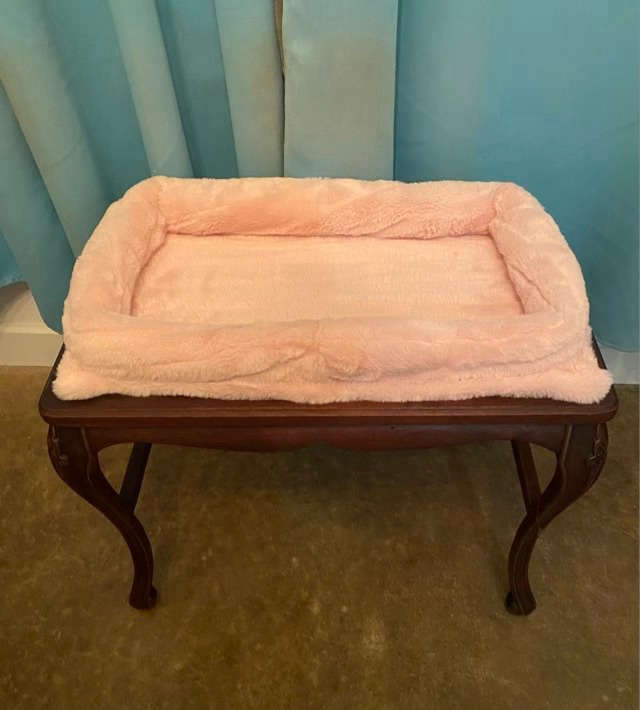
Ok, so this is probably the silliest I’ve ever made, and that’s saying something. I repaired the broken leg in an old side table that had been used as a bench (yesterday’s post), and rather than tempt fate by putting a solid top back on, I made it into a cat hammock.
Photo description: elegant wood table with curved legs with a light pink fuzzy padded edge cat hammock attached.
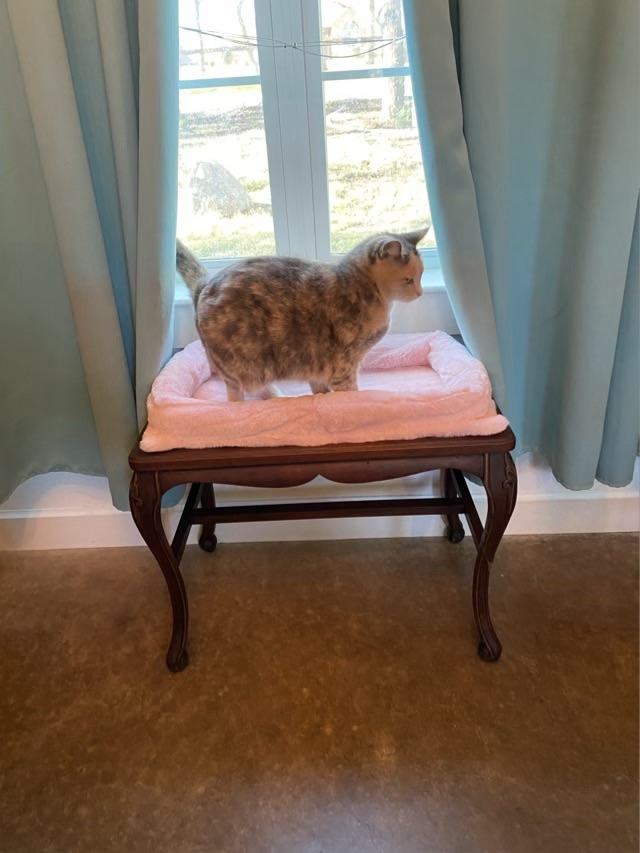
I had a pink fuzzy blanket that had already been cut into for another project (we couldn’t find the fabric by the yard, so bought a blanket), and sewed a two sided mat. I stapled the mat down to the table top, over the central opening. I then sewed a long tube of the fabric, stuffed it with polyfil and sewed that down on the mat. It is quite the sight. The cats are not too sure of it, so I put it beneath the front window where it will get some sunlight. I’ve sequentially put all three cats on the bed; all have rejected it. I’ll give it some time.
Photo description: Thor the gray tabby standing on the new fancy cat bed.Photo description: Sophie the dilute calico standing on the new fancy cat bed.Photo description: Izzy the calico sitting on the new fancy cat bed. After the photo she moved up to the window sill.
One of my neighbors put out an upholstered stool on the side of the road. It had elegant curved legs, but one of them was broken. I picked it up and glued the leg back on.
Photo description: clamp holding together the broken portion of the leg
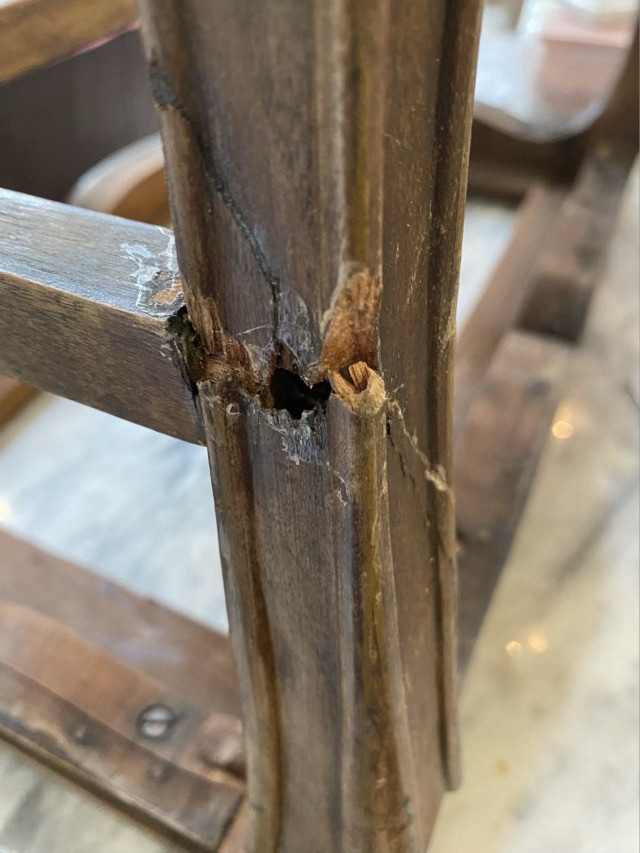
There was still a large gap in the leg after I fit it together.
Photo description: closeup of the wooden leg showing a deep hole and ragged gash.
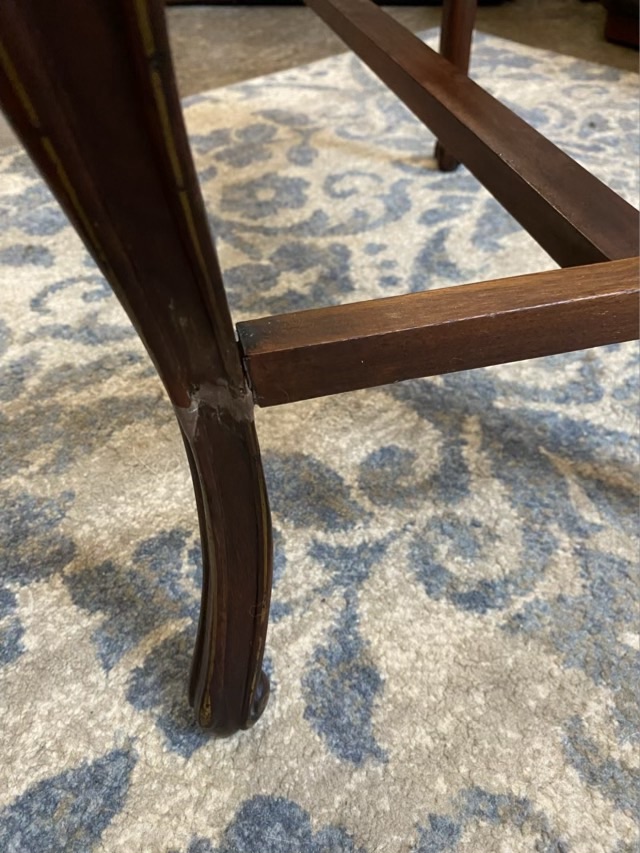
I bought some Apoxy sculpt modeling compound, which is a two-part epoxy clay that hardens without baking. I bought the color called “bronze” because I was inspired by the Japanese method of Kintsugi, or making a visible gold repair. The “bronze” was not metallic at all and actually was a fair match to the stained wood. Huh.
Photo description: same wood leg, but upright on a blue and gray rug, showing the filled hole, which is slightly lighter and more gray in color. I treated the whole base with Howard’s Feed and Wax (I love this stuff).
I removed the water stained upholstered top and found something interesting.
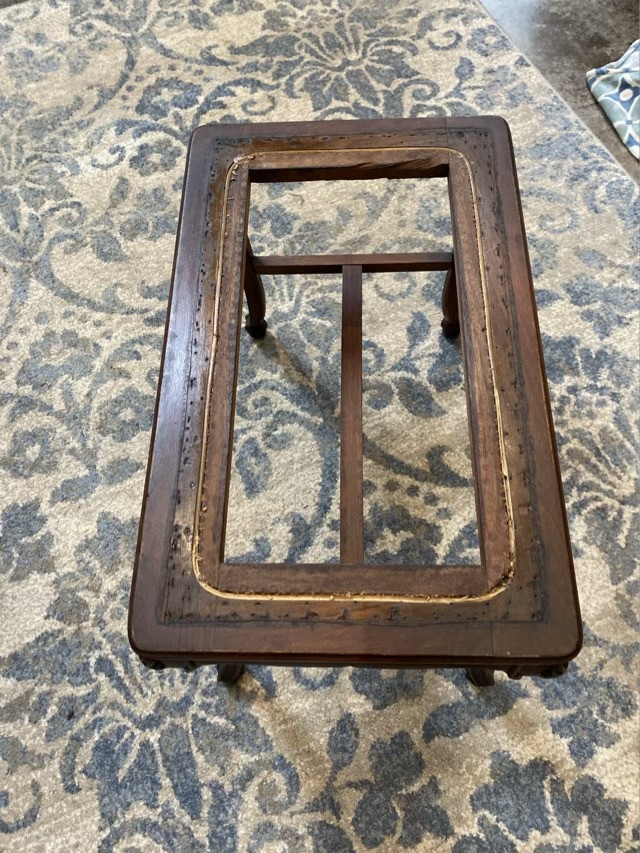
Photo description: top of the stool with the upholstery removed.
This little piece of furniture has been many things. At one point it had a rattan top that had been cut out. I’m guessing the rattan was original and this was intended to be a side table. Then there is a round of staple or tack marks around the old rattan groove, which I assume was the second and maybe even third life of the piece. When I picked it up, it had green velvet fabric stapled to a plywood board, that was then screwed in place from underneath.
I have no doubt that those legs would break again if someone sat on it. So what to do with elegant legs that can’t take much weight? Oh, I came up with something, and it is probably the silliest thing I’ve ever made. I’ll share the results tomorrow.
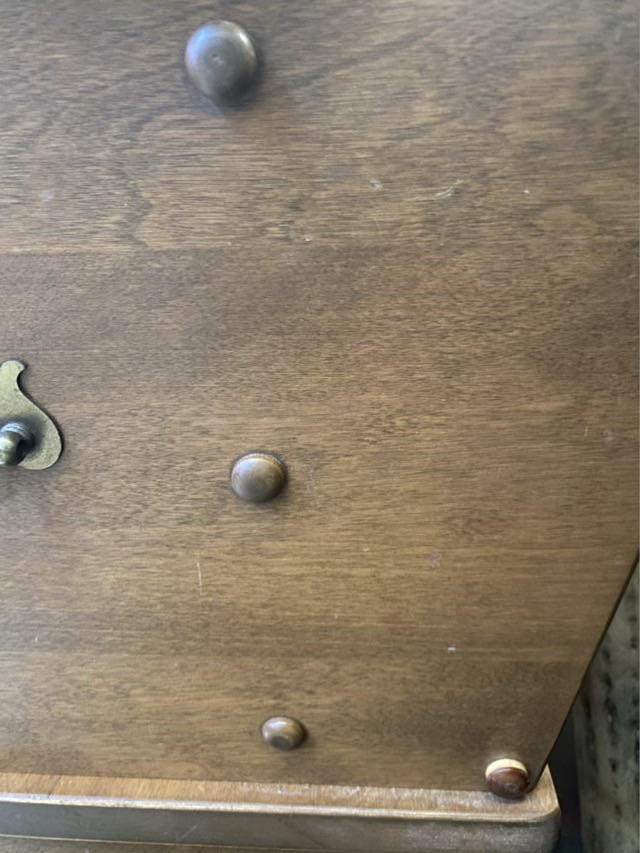
In the drawers of the Singer Model 66, that just recently came from my husband’s aunt’s house 206 miles away, I found wood plug that looked very familiar. I popped it into the open hole in my vintage side table. It fit and is a near color match. I purchased this table at an antique store in Houston TX, but my grandmother had its twin in South Dakota, and that one now resides at my Mom’s house. So it was a popular piece of furniture in the mid-1900s. Wood plugs are also common screw hole covers and furniture manufacturers would use the same size wood plug on various pieces.
Photo description: The side of a wooden end table showing four wood plugs, the bottom right is the “new” plug, not fully inserted.
So it is random but not surprising to find a plug that fits the hole in a cabinet that was around at the time this furniture was in vogue. It also shows that those devilish fat pegs like to fall out and go a-hiding across the nation. Although this one has found its home. I put it in the hole lightly, but it stuck tight, so the only thing to do was tap it all the way in. Serendipity is the word I’ve been trying to find.
Our back door deadbolt started to stick (most likely with how incredibly dry we are this summer). The bolt was rubbing on the top of the strike plate. I’ve dealt with this many times since owning a home, and it usually takes me half an hour of swearing and adjusting and fetching tools I forgot. This time I grabbed my 1/2” chisel, mallet, and the electric screw driver and had the plate off, a few millimeters chiseled out of the wood, and the plate back on in about five minutes. I’ll take it.
Photo description: Strike plate for a deadbolt moved up a fraction of an inch
The fix isn’t gorgeous, but it is functional. The deadbolt now slides smoothly into place.
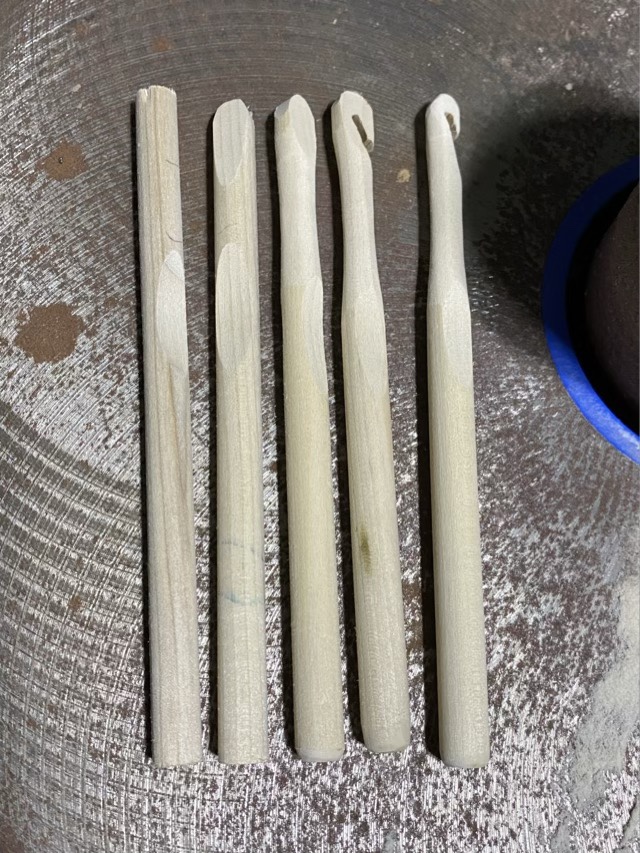
I have discovered a new method for making wood crochet hooks that I quite like. I flatten the middle of a dowel using a spindle sander, and flatten the end perpendicular to the middle with a band sander. This sets up the grip and the head of the hook at a comfortable angle. I then thin the neck to the size hook I need, and shape the head.
Stages of crochet hook shaping
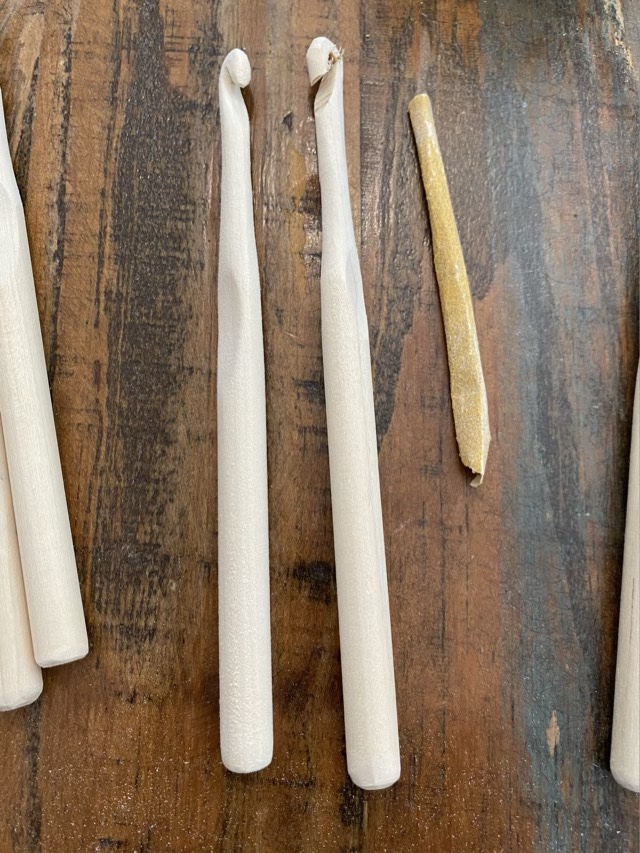
The bulk of the work goes into hand sanding the final shape. I use sandpaper rolled into tight tubes to access the inside of the hook, and flat sandpaper to smooth the outside shapes. I then use several grades of sandpaper until I’m down to 600 grit.
Hand-sanded crochet hook (left), raw shape (right)
I’m teaching an amigurumi class that uses blanket yarn to make marshmallow animals. The blanket yarn calls for a larger hook than is in most hook sets, so I’m making the hooks the students will use. The next step is to finish and make them nice and shiny so they slide through the yarn loops.






 Critters and Craft