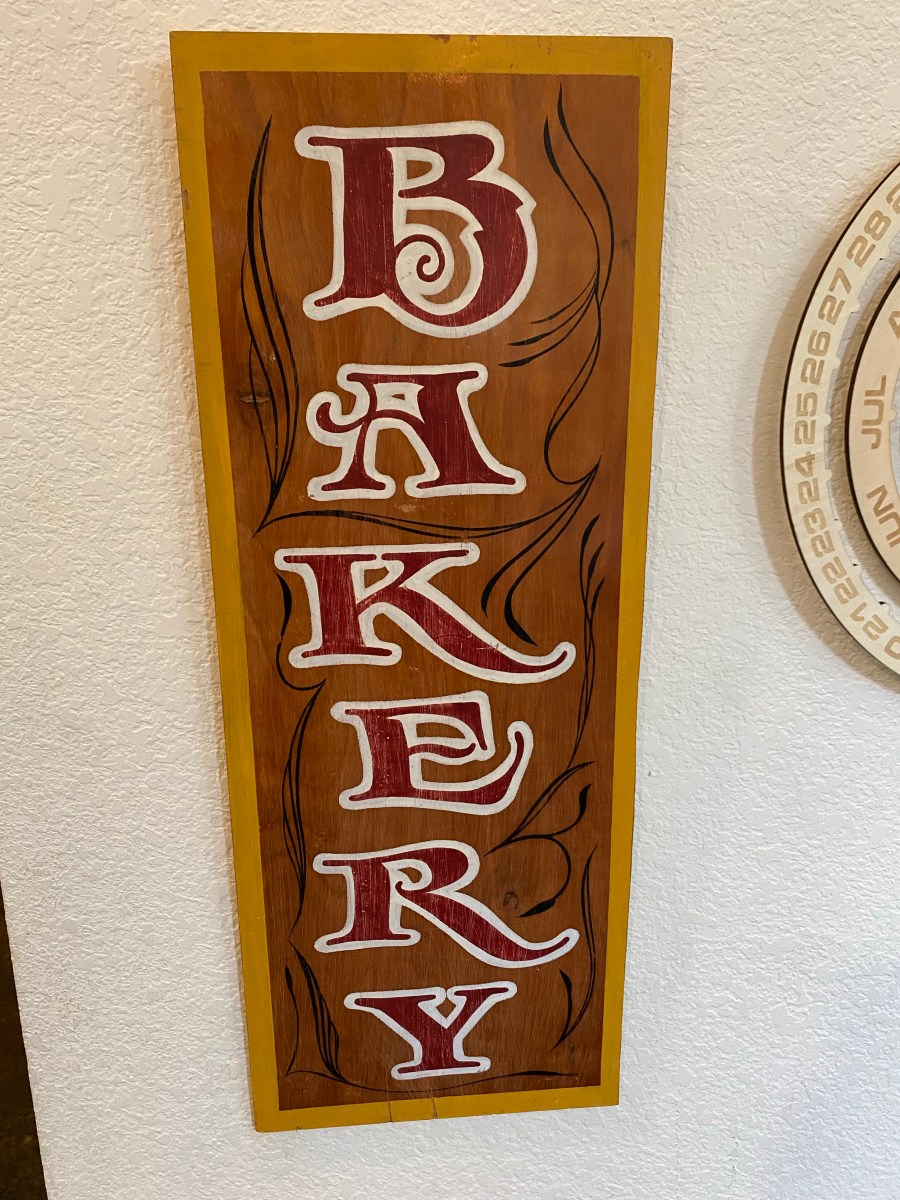
You would think I haven’t been able to go to a craft fair in years… oh wait. The high school theater group put on a craft fair and I did my part to support the theater and the craftspeople that set up their booths (and also scouted out what I might set up for next year). My favorite find? A hand-painted bakery sign! Yup. Hand-painted. Not stenciled, not cut vinyl, not printed, not laser burned. Hand-painted by someone who has been pin-striping and lettering for over 20 years. I have the utmost respect for good pin-stripe artists! The artist gave me $2 off because the hook on the back fell off, which was a solid deal. When I got it home, rather than put another sawtooth hanger in the soft wood, I took my rotary tool and a small router bit and cut a channel in the bottom of the wood block. It works perfectly with the monkey hooks I like to use in dry wall.
Channel cut in the bottom of the wood block on the back of the sign to accommodate the monkey hook (yeah, there is an extra hole in the wall. Oops.)Prized craft fair sign, hand-painted by a professional
I made this wooden cane as another prop for the play my eldest is working on. The character that needs the cane is an old woman whose husband was a wood cutter. What better than a cut branch then? I wandered through the back woods and found a suitable dead limb on a cedar tree, with a side branch at a good angle for the handle. I cut it off, removed all the twigs, then used my oscillating drum sander to remove the outer layer. I left it a little long so they could cut it down to fit the actor. After I had the rough shape, I hand sanded first with 100 grit to get everything smooth and shaped the way I wanted, then worked down in grit to 120, 220, then 400. To finish, I put on two coats of 50/50 tung oil and mineral spirits, then seven coats of pure tung oil. A final polish with 0000 steel wool put on a slight sheen. The cracks were left as is, as it gives some character to the piece and the story is a slightly scary one. Despite the cracks, the wood is solid.
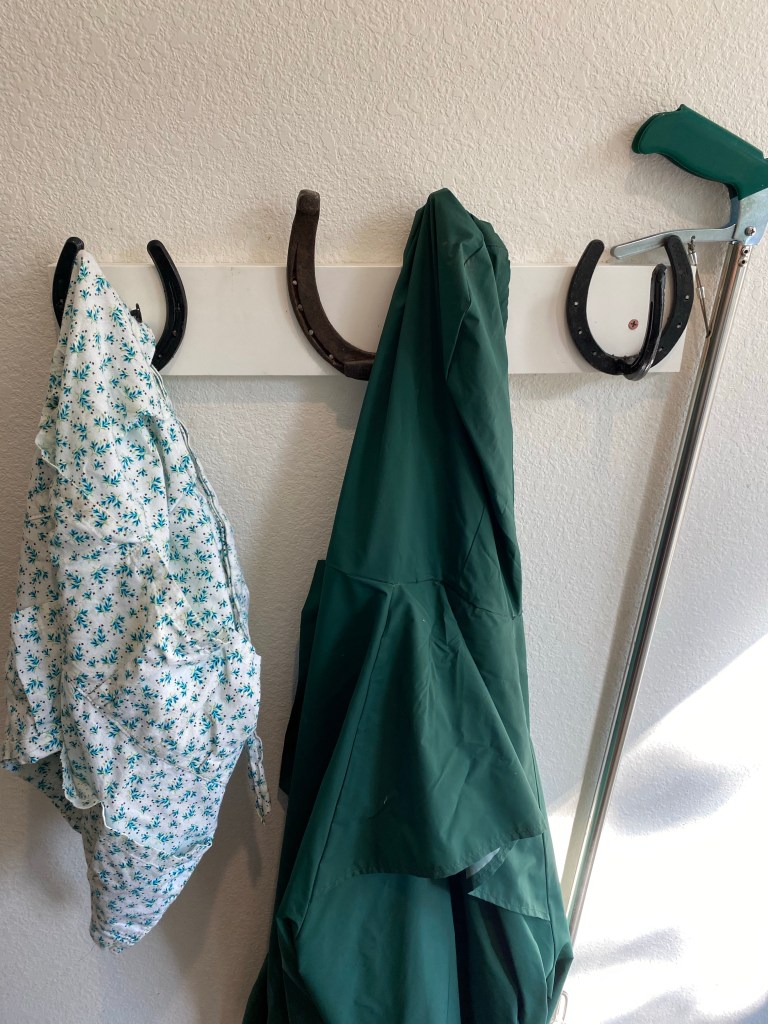
One of the good things that came from the gecko running behind the coat hooks and the coat hooks coming out from the wall as the cat, dog, and I scrambled for the critter, is that it prompted me to find a better way to secure the horse shoe hooks to the wall. I love these hooks that my husband’s cousins made when they were learning to weld. I have four of them and they work great on solid wood. I tried having two on the wall by the back door, and tried to get the tiny nails that would fit in the nail holes to reach far enough into a stud, but they consistently came loose. So now I had to do something sturdier. I combed the garage and found a nice length of 1×4” trim, already painted. But it was shorter than the horse shoes. Hmm. If I set the horse shoes up above the rail, then I would be able to use the tops as hooks as well, increasing the number of usable hooks from two to six. And if I added the other horse shoe I had sitting on the counter, then I would have eight hooks!
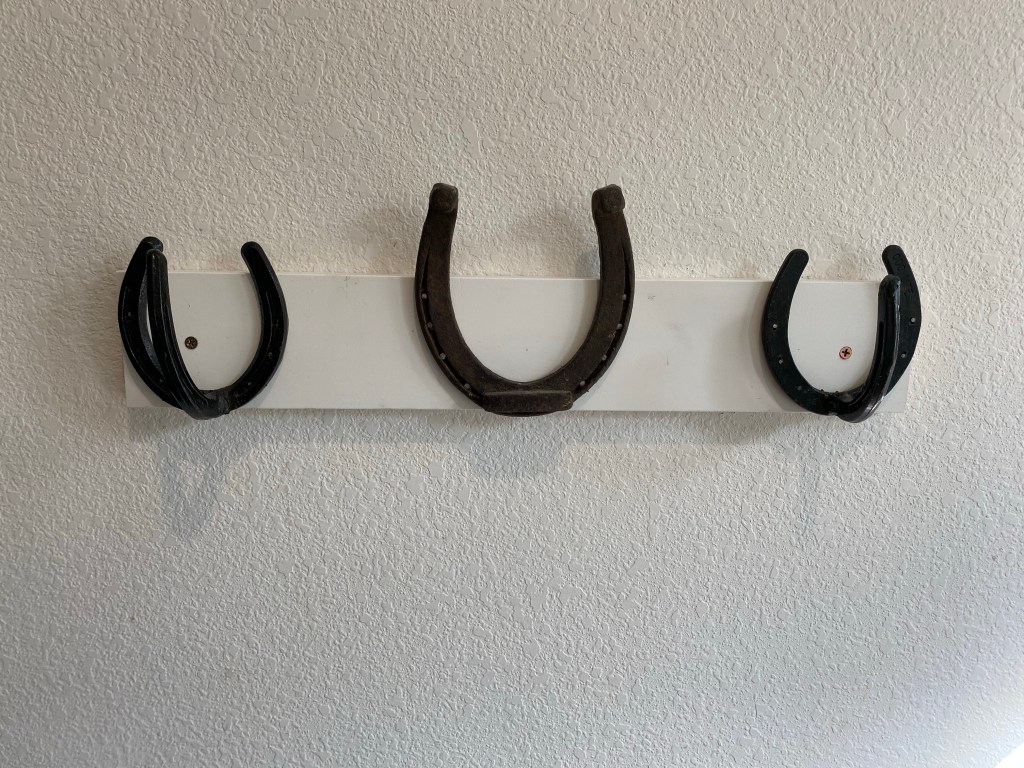
Horse shoe coat rack mounted on a painted board
I attached the board to the wall, centering it on the studs, checking level, and running two screws into the studs. Then I took finish nails that had heads large enough to not go all the way through the horse shoe holes and set the metal lined up with the bottom of the board. I used a nail set to tap the nails down into the shoe to keep it firmly attached.
Horse shoe coat rack with an egg apron on a hook, a coat on the top of a horse shoe, and my snake grabber resting on the wood
Now we have a sturdy coat rack! The best part? I only had one trip to the garage. I was able to anticipate everything I would need, gather it, and use it all. It is unusual for me not to have to make a few trips back and forth for forgotten items. (Yes, I did put everything away as soon as I was done!)
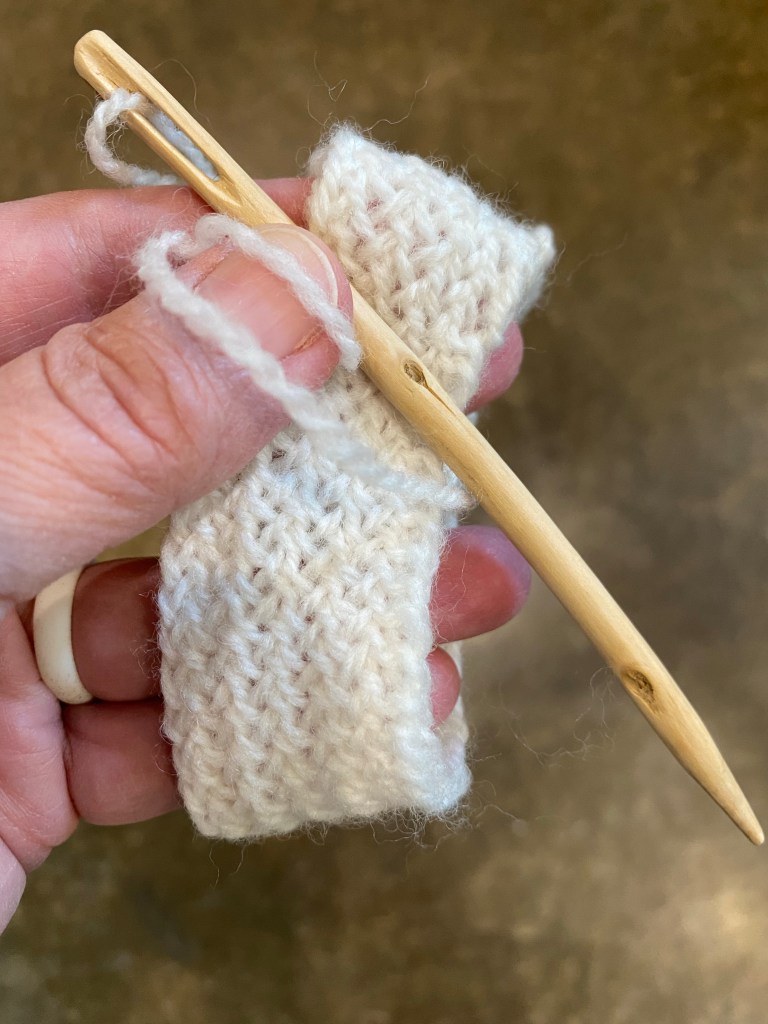
I was combing my tool stash for a nål (needle) to make smaller nålbinding stitches and found an old hand-carved diamond willow needle. My great-grandfather carved all sorts of things from diamond willow, so our guess is that this is one of his works! It had been sitting in my knitting box for quite a while, so I sanded it up a little with 400 grit sandpaper to smooth the unfinished surface. Although I’ve been partial to semi-flat oblong nåls to this point, I found making stitches with the round needle worked well. I’m learning a new stitch called Dalarna, which was used to make milk strainers in Sweden (https://www.en.neulakintaat.fi/75). I like the way that the stitch makes a fabric that appears woven on one side. I’m practicing with commercial wool sock yarn, not my own spun yarn, until I get the pattern firmly in my fingers’ muscle memory.
I’ve started to reread the book that started me spinning “Respect the Spindle” by Abby Franquemont. I don’t reread books often (Terry Pratchett excepted), and usually use books on craft as quick reference, but since I’m really enjoying spinning, and have been spinning daily, I thought I might understand the text better now. And I do.
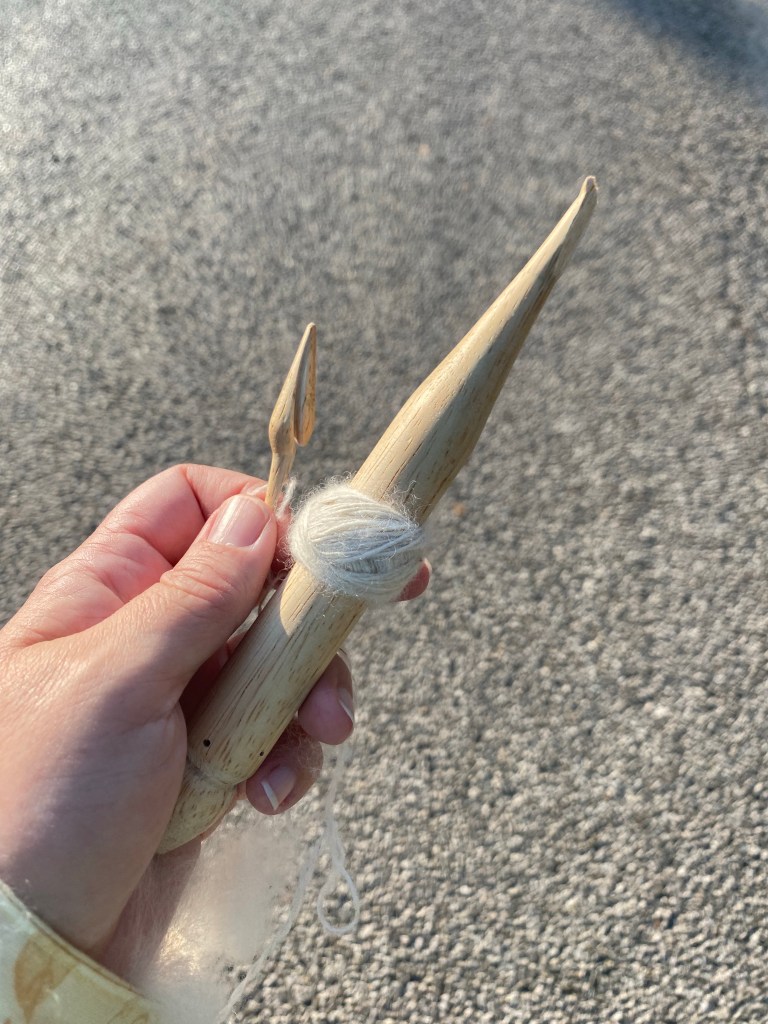
The half hitch on my bottom whorl spindle has been giving me trouble, slowing down the production and acting a a frustrating bubble in an otherwise smooth flow (for a relative beginner). In her book, Ms Franquemont mentions many different methods for securing the yarn before adding twist, including using a notched shaft. I don’t have any notched shafts. So I made one. Rather than notch the shaft of my thin olive spindle, I started with a scrap of dowel from the garage. I shaped it using my belt sander, started the notch with a small saw, and refined the shape first with needle files, then with folded sandpaper.
Drop spindle shaped from a dowel
I kept the dowel thickness in the middle to try making yarn balls as one would with a nostepinne (yup, that is new to me too, but so cool!) The shaping is like a Russian supported spindle (roughly, the pictures I’ve seen are more elegant), but I’m using it also as a drop spindle (so I can walk and spin). I had to start spinning to test the notch, so my yarn may have a bit of wood dust as I refined the shape, spun, and refined some more.
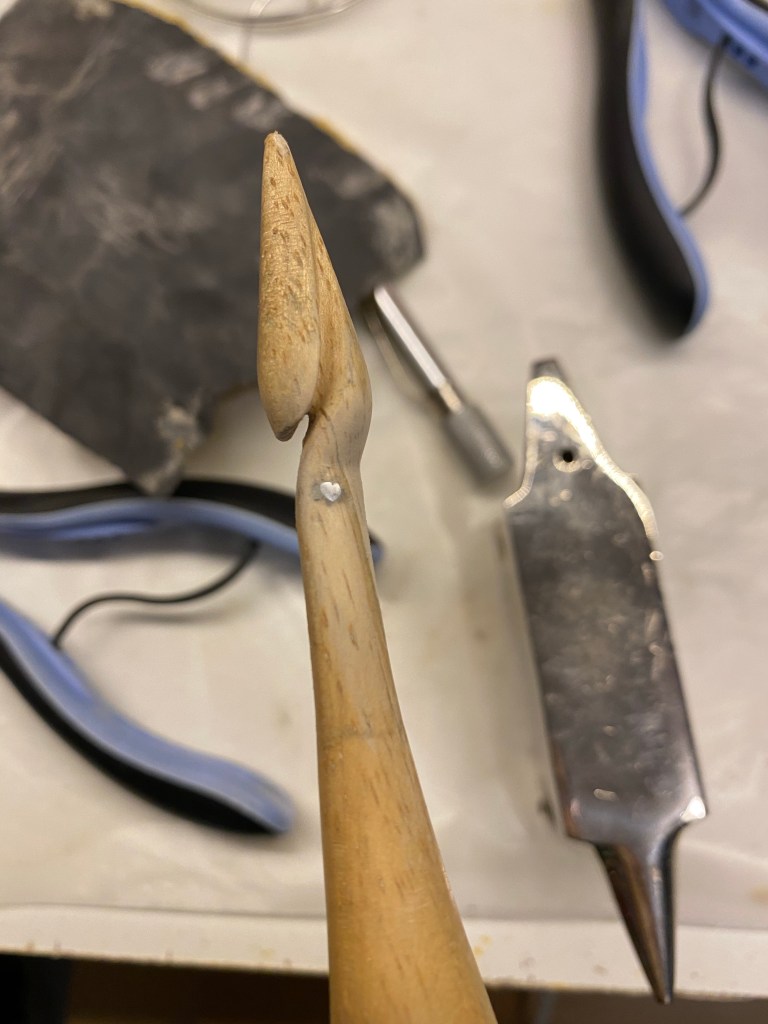
View of notch grooves from the top of the spindle
My goal with the notch was to get the yarn closer to the center of spin as well as be functional for spinning clockwise or counterclockwise. The cone tip helps with flicking the spindle to spin, and the grooves actually help with grip. I have not applied any finishing oil as I may still tweak the shape. Sanding down to 400 grit though keeps the yarn from catching on the wood.