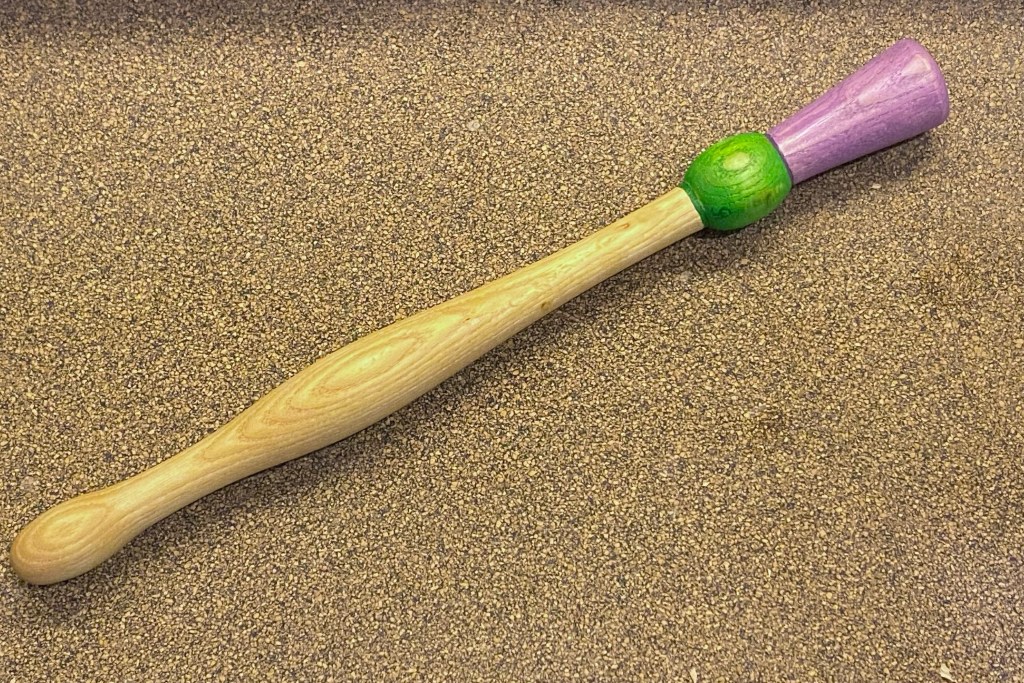
Since the Scottish Spurtle, a tool used to stir porridge and stews, is often turned with the handle in the shape of a thistle, I decided to go a step farther and paint the handle thistle colors as well. I turned the spurtle from a maple blank, sanded it down, then used thinned acrylic paints to paint the bulb green and the bloom purple. I also added a bee on top. Once the acrylics were dry, I sealed it in many layers of tung oil because tung oil is food safe.
Bee painted on the end of the spurtle handleFinished Spurtle
I thought a French-style rolling pin would be a nice easy turning project. Hm. I started with a maple wood blank and roughed in the shape, which is tapered at each end. These rolling pins do not have moving parts, but are used by rolling your palms across. I intended the center of the pin to be 2” in diameter, but it is much harder to get a long straight section than I thought! I stopped chasing the illusive straight line in order to preserve some of the diameter, which ended up closer to 1 3/4”. I finished by sanding down in increments to 400 grit, then wet the whole piece, let it dry, and sanded with 400 grit again. I then used a acrylic paints to decorate the pin with daisies for my mother-in-law. To keep everything sealed, I applied seven coats of tung oil by rubbing it into the surface in thin layers.
French style rolling pin with daisy decoration along the side
Since the lathe has been set up, I’ve been itching to attempt turning toy tops. After having my burl explode, I decided to try something small and happy. I used a bit of maple wood and secured it in my four jaw chuck with the jaw flipped around, and used my new roughing gouge to get rounded, then refined with my old skew chisel. I made little bumps because they made me happy. Making the stem made me nervous and I didn’t get it as thin as I wanted, but it spins!
Turned toy top made of maple wood
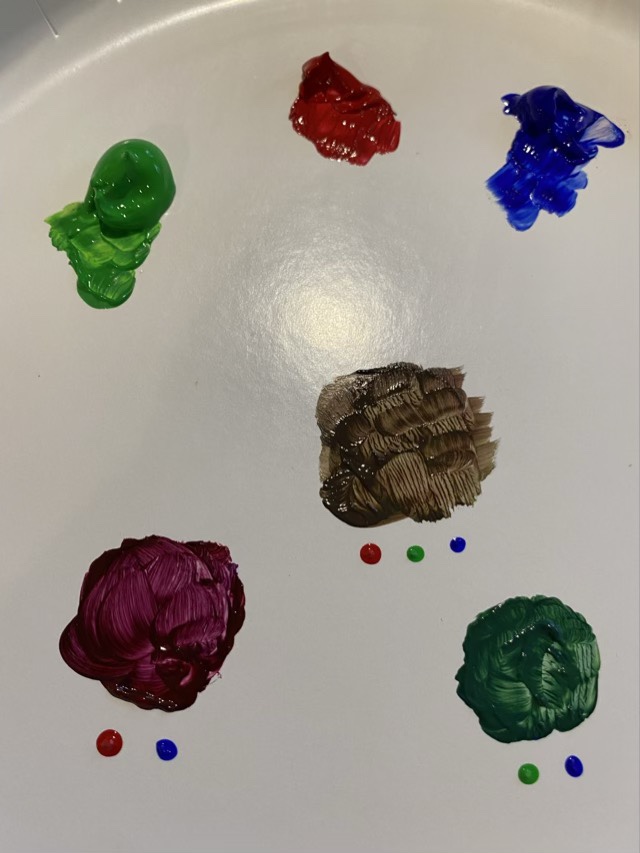
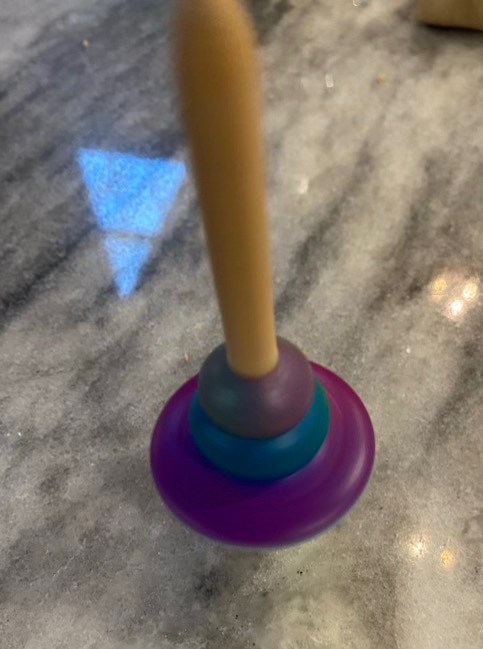
Then, because why not, I painted the bumps with acrylic paint so that when it spins, there is a gradient.
Blue and red acrylic paint applied to the topTop spinning, showing the gradient of mixed colors
I finished the top with several coats of tung oil.
I attempted to make a bowl on my lathe with my four jaw chuck. To say that I am still climbing the learning curve would be most accurate. I did use my band saw to trim the block close to round and remove the sharp corners, but I couldn’t get it set solid in the chuck, it kept slipping out of round. So I used four small screws and attached it to a face plate instead of using the chuck. That worked much better for this piece of wood. I was able to rough in a bowl shape, but then things took a turn for the worse. It turns out that the burl block had a fissure running through that split as I began to hollow out the bowl. (The turning puns will probably continue, just so you know.)
Fissure through the burl
I probably stood there with the bits in my hand for a good five minutes assessing the damage. Then I carefully removed the piece from the lathe, stored the screws, and put the burl halves in my wood bin. I cannot currently conceive of rescuing a bowl from the wood, but burls are precious and can be beautiful, so maybe there will be some future turnings that can be salvaged. I think it is time to try something else for awhile, and let the trauma of an exploded burl rest.
I found some lush purple yarn at the store that I thought my Mom would love, but it needed an S hook. Wha…? An S size crochet hook is 19mm in diameter below the neck, which is a very large hook, not quite to broomstick handle size (which is 1 inch or 25.4 mm), but still quite sizable. Hm. A hand made crochet hook would go well with gifted yarn, yes? I selected a nice length of big leaf maple wood from my hoard and turned it on my lathe. When it was a pleasing shape, and the neck and head were the right diameter, I removed it from the lathe, trimmed the ends, and cut in the hook. I found that a wooden nål, with its tapered tip, makes a really excellent sanding block to shape the hook. I worked mostly with 120 grit sandpaper to get the shape, then refined with 220, then 320, then 400 grit.
Using a nål as a sanding block to refine the hook shape
I used acrylic paints to write the name of the wood and put the “S” designation on the end, then sealed the wood with many layers of tung oil.