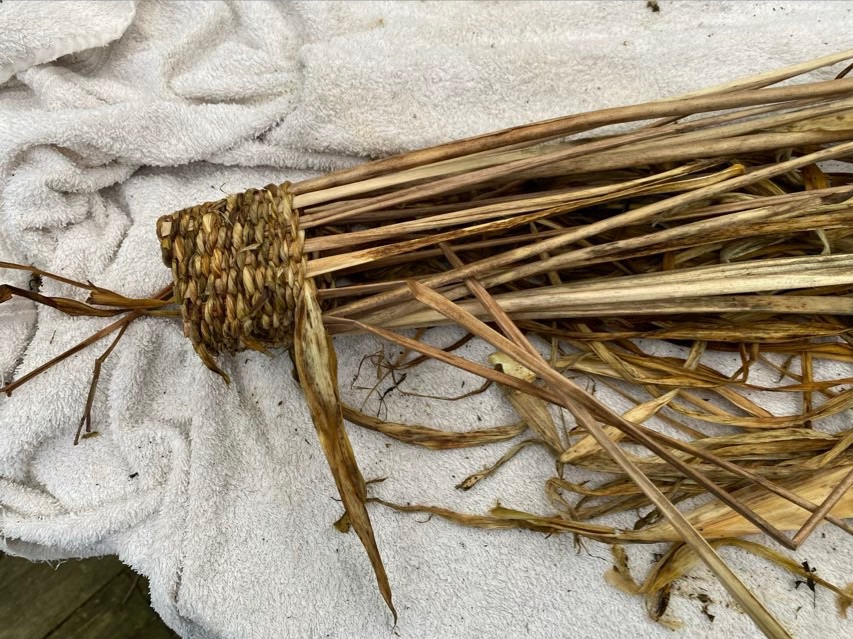
I gathered dead leaves from the base of several iris and daylily plants at my folk’s house, along with some daylily stems. To make them flexible I wet a large towel and wrapped the leaves and stems with it, leaving them in the towel for a few hours.
Photo description: gathered materials laid out in an old terry cloth towel
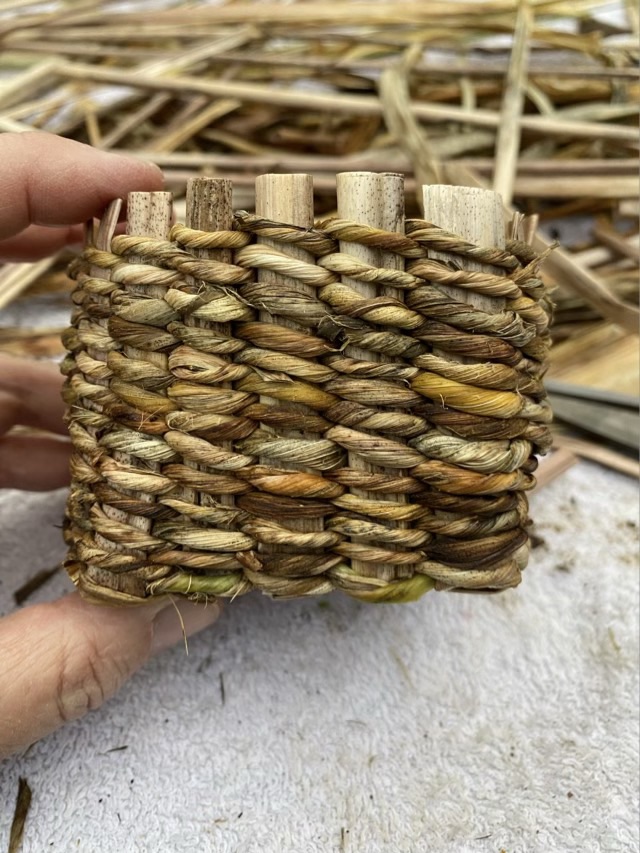
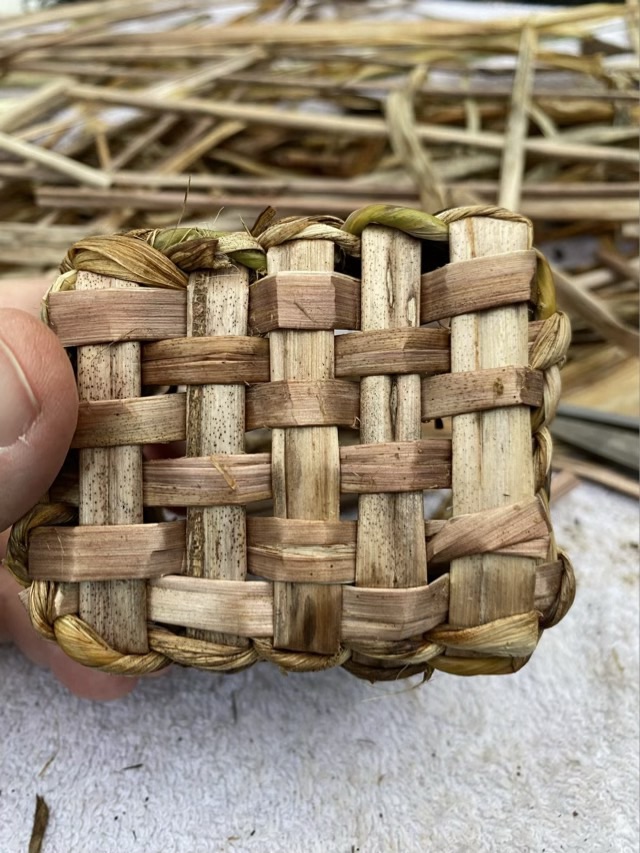
I chose ten daylily stems for my base stakes and did a plain weave 5×5. I then twined iris leaves around the stakes, creating a square basket. To add a new leaf, I folded the old leaf end into the new leaf end, twisting them together to lock it in.
Photo description: basket in progress showing very long stakes and several twined rows
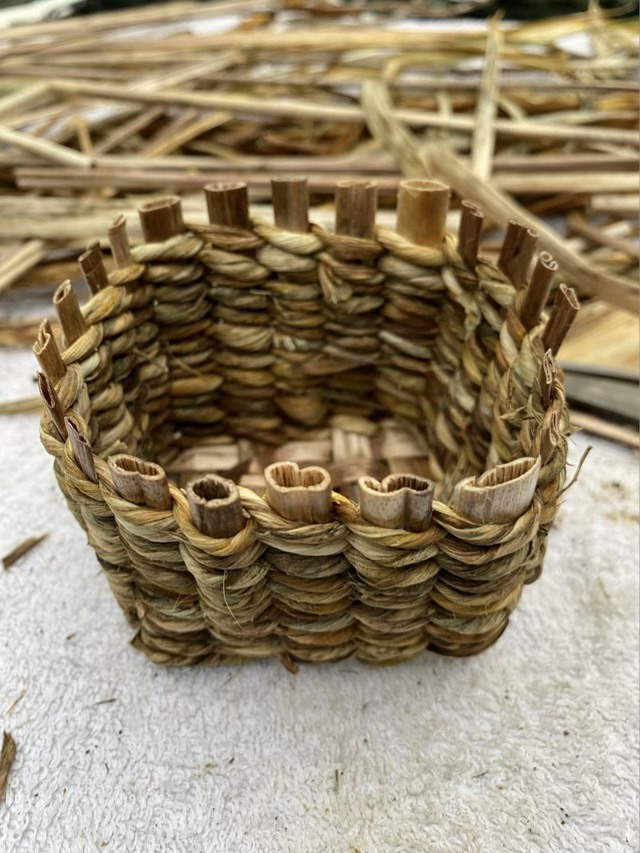
I still need to study how to do borders for the top. I ended up clipping the stakes short and tucking in the twined ends for this basket.
Photo description: twined basket with cut stakesPhoto description: side of twined basketPhoto description: bottom of twined basket
I left the basket at my folks’ place to dry. The leaves had spots of mold, so it shouldn’t be used for foodstuffs, but after a solid coat of sealer, it could be a desk basket.
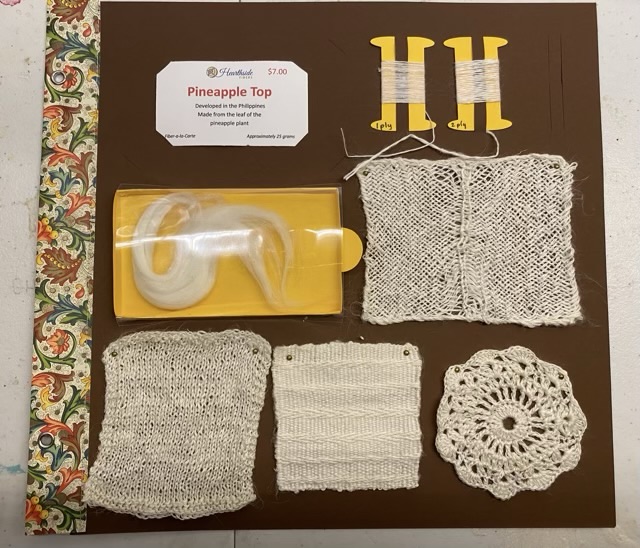
My fiber study page for my pineapple fiber sample is done!
Photo description: clockwise from top left: card from Hearthside fibers that says “Pineapple Top, Developed in the Philippines, Made from the leaf of the pineapple plant”, paper bobbins with single spun and 2-ply hand spun yarn, sprang swatch, crochet swatch, woven swatch, knit swatch, unspun fiber
The crochet round gave me fits with this fiber. I spun it so fine I was having trouble getting the right gauge for my regular coaster pattern. I think I ripped it apart three times. I ended up winging it, filling the space with stitches and numbers that fit.
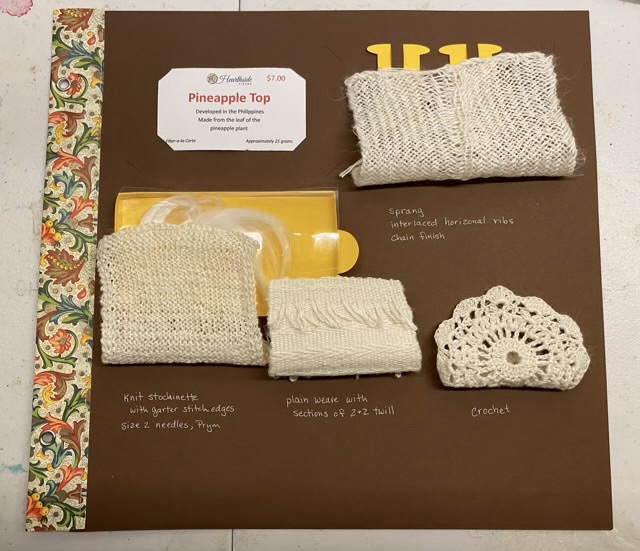
Photo description: same page with the swatches flipped up to show hand written descriptions: “Sprang interlaced horizontal ribs chain finished”, “crochet”, “plain weave with sections of 2×2 twill”, “knit stockinette with garter stitch edges size 2 needles, Prym”
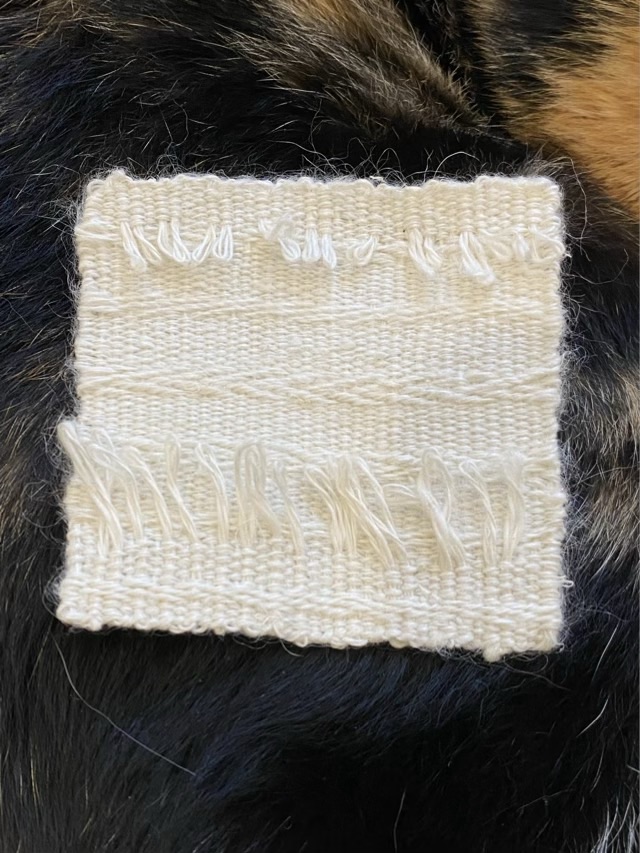
On my pineapple fiber weaving swatch I wanted to try a different method of finishing the warp ends, so wove the loops back into the fabric after taking it off the loom.
Photo description: needle inserted vertically through the top five passes of the weft, with the warp loop through the needle eye
My warp loops were quite small, so I had to insert the needle through the fabric first, then put the warp yarn through the eye of the needle, so I could pull the yarn through.
Photo description: back of the woven swatch showing all the warp threads woven through the fabric and left untrimmed
This is now my favorite way to finish my small woven swatches. The resulting edge has a nice ripple and a clean finish. I left the loops on the back to remind me what I did.
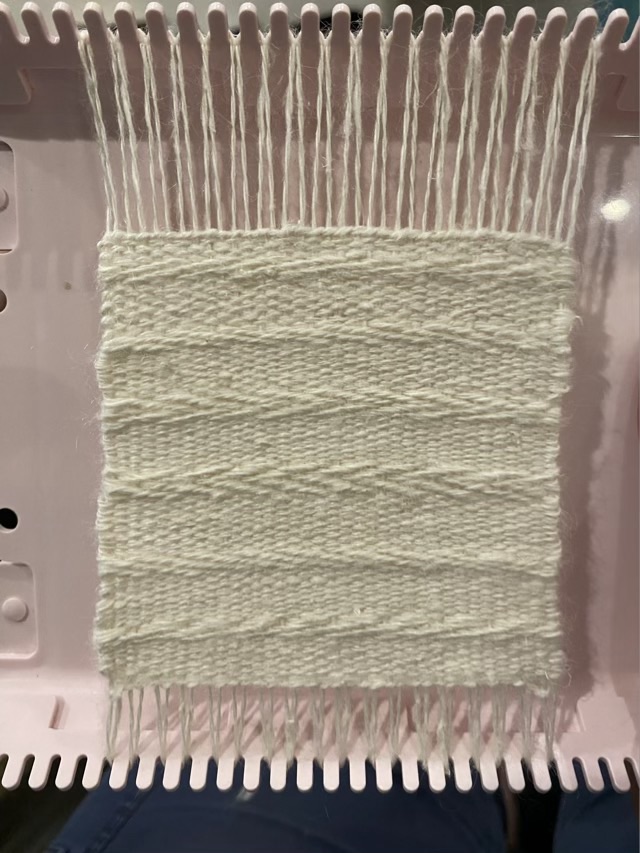
When weaving up a swatch of hand spun pineapple fiber, I decided to do a little experiment with twill. In plain weave, the weft yarn alternates going over or under one warp thread all the way across the fabric. Twill goes over or under multiple strands. You can have a pass go over two under two, or over three under one (denim), or any number of combinations. The next pass has the same pattern, just offset by one strand. The resulting twill fabric has a diagonal line going left or right depending on how the passes are aligned.
Photo description: Clover mini loom with a swatch of woven pineapple fiber showing bands of plain weave, bands of 2×2 twill at at right diagonal, 2×2 twill at a left diagonal, and 2×2 twill chevrons going left and another band going right
This was a fun experiment. I rather like twill, and it is definitely something that requires some brain power.
We picked up a fast food dinner and were given a plethora of paper napkins. I had a stash of straws. Could I make a basket? (Because that is the logical thought process with excess disposable paper products, right?)
Photo description: unbleached paper napkins and paper wrapped straws
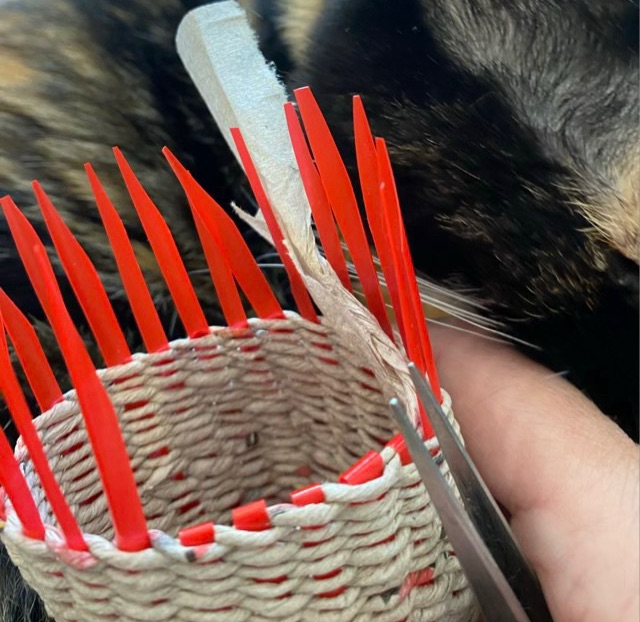
I unwrapped and split the straws by running a scissors down the length to obtain four plastic strips from each straw. I wove a square base (6×6 straw pieces). I tore the napkins into 1/2” strips and twined them around the straw “staves”.
Photo description: slivers of red plastic straws woven together and secured with paper napkin twine
It took some time to twine up the sides of the basket. The joining method I liked best was to overlap the end of a napkin strip with a new strip, fold the sides to the middle, then secure with a good clockwise twist. The two clockwise twisted strands were then wrapped counterclockwise around each straw, which isn’t as complicated as it sounds. To finish the basket, I trimmed the end of the straws to a blunt point, and used tweezers to thread them back down through the weaving.
Photo description: in process threading of the straw staves back into the twined weave, calico cat as a background
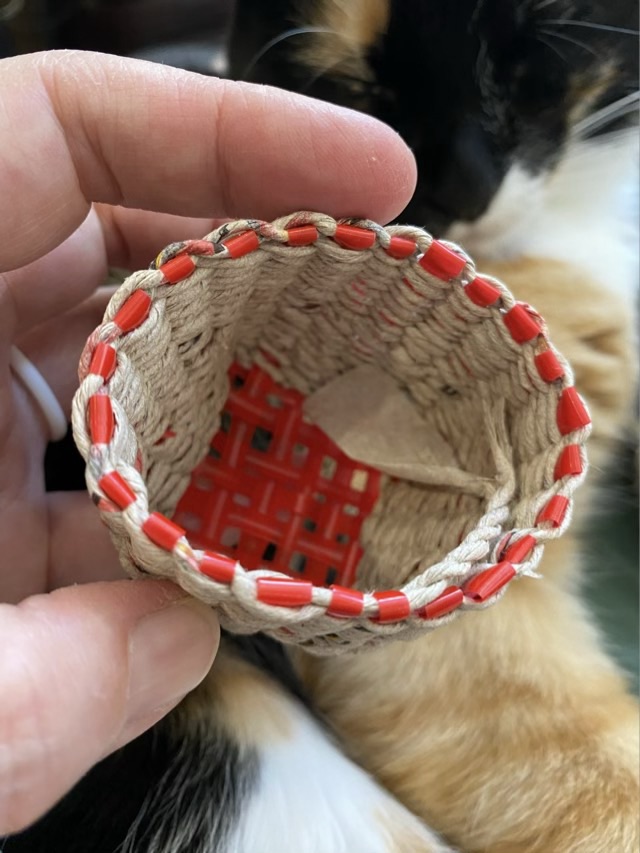
I was quite surprised that the little basket is fairly sturdy. It certainly won’t hold up to water or washing, but it is a cute little basket. I left the end of the napkin twine inside the basket to remember its humble origins.
Photo description: finished basket, top view, happy calico cat as the background Photo description: finished napkin and straw basket, side view, sitting on a calico cat






 Critters and Craft