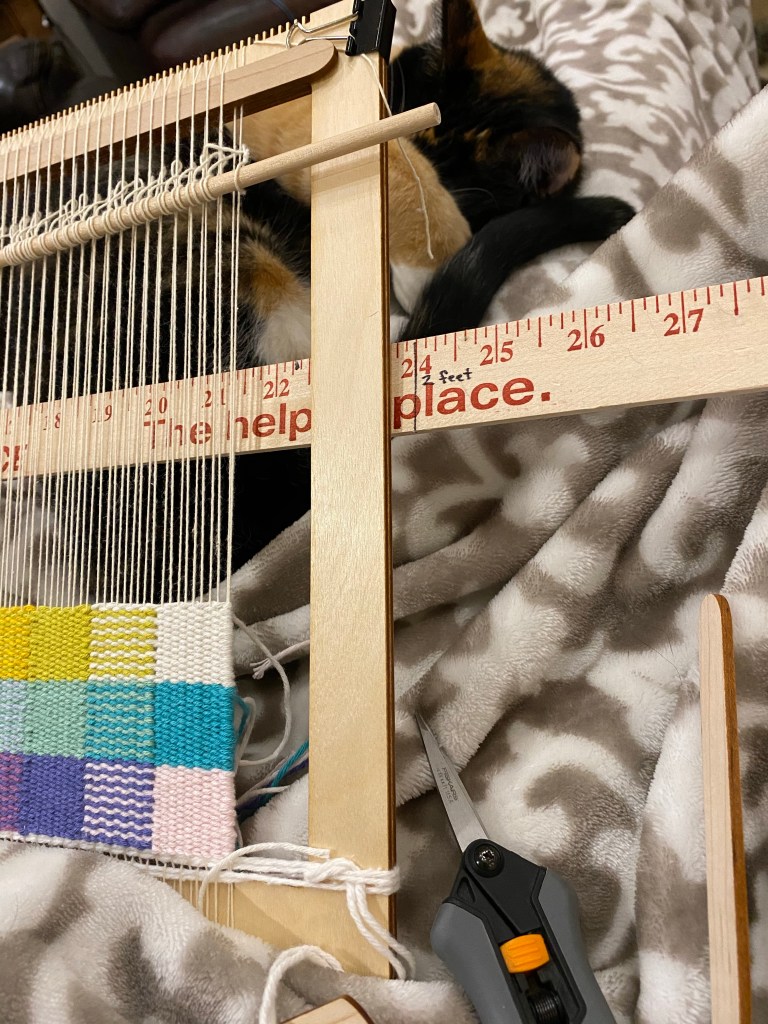
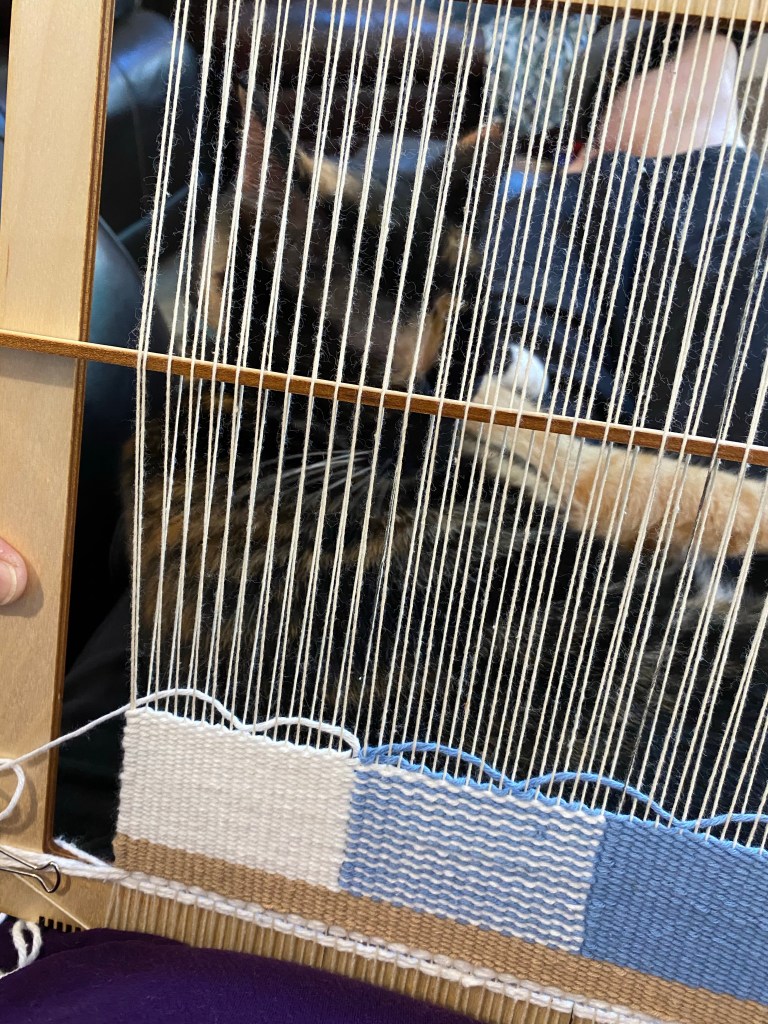
Because the cat gets a little perturbed when I rest the loom on her rump, I laid a yard stick across the arms of my chair to prop up my weaving. She is OK having her own shed (that is weaver humor, by the way).
I can neither confirm nor deny that I am doing last minute gift weaving.
Happy Holidays and good luck with last minute projects.
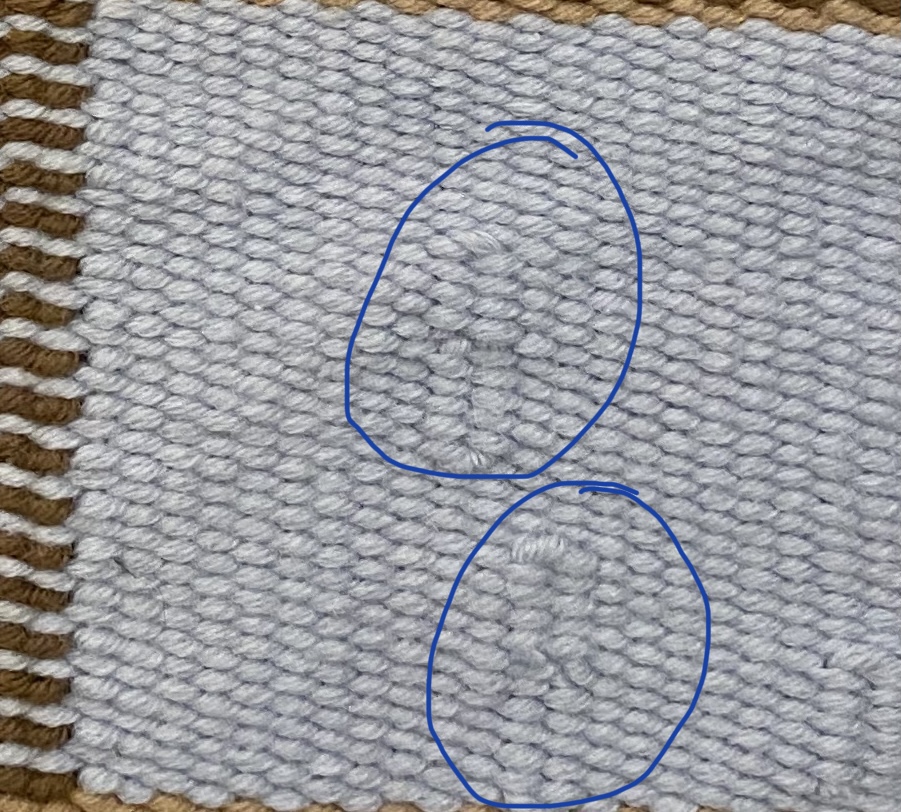
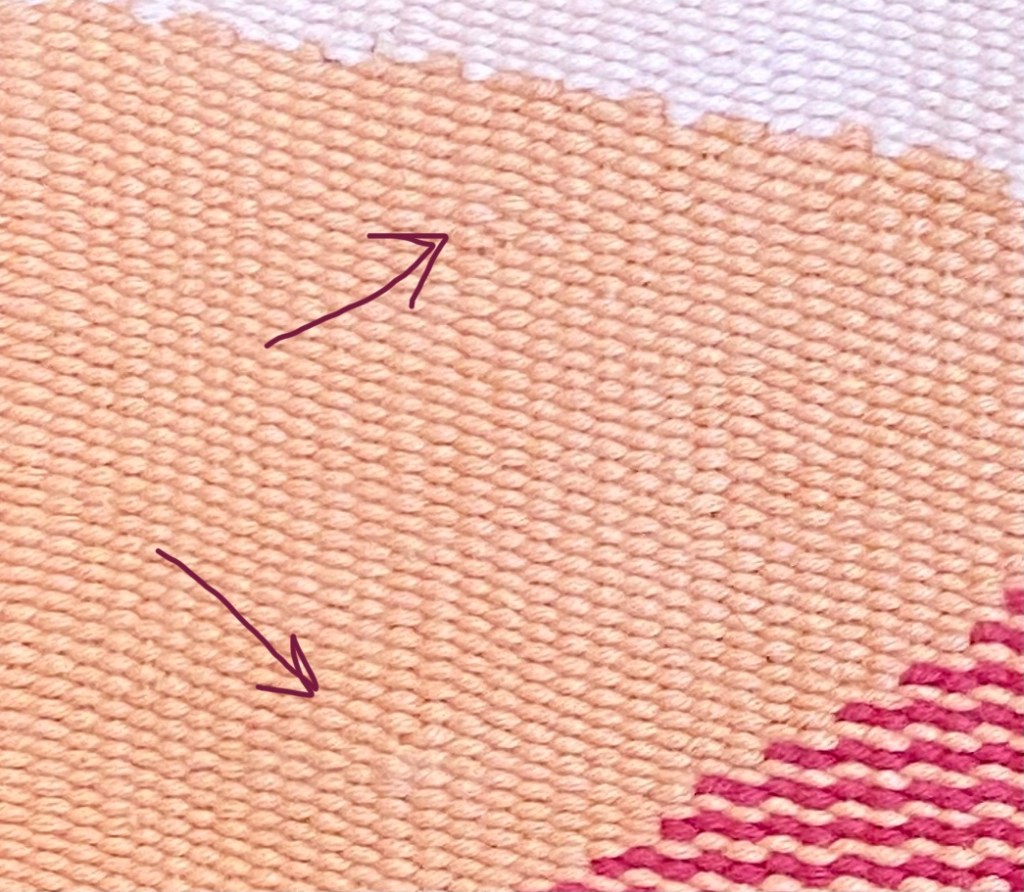
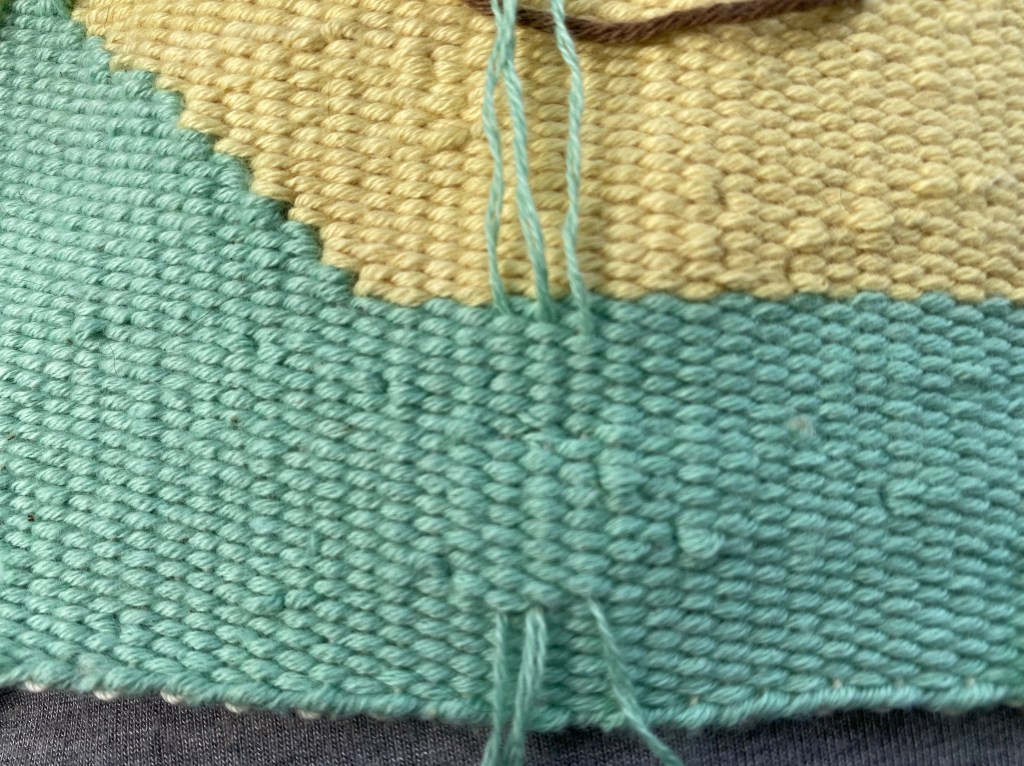
I’ve been experimenting with dealing with the ends of the yarn when weaving. I tried my standard way that I use for knitting and crochet, which involves running the end through the work and back again, which leaves visible traces. Then I tried splitting the yarn and weaving in sections, which gives a much nicer finish.
Back of cotton weaving with ends woven down and back, which makes a visible standing ovalBack of a cotton weaving with ends split and woven in, with arrows pointing to where the work was doneBack of cotton weaving with split and woven ends, before trimming
Yes, splitting the ends and weaving in the sections triples the times I thread a needle, but I think the end result is worth it.
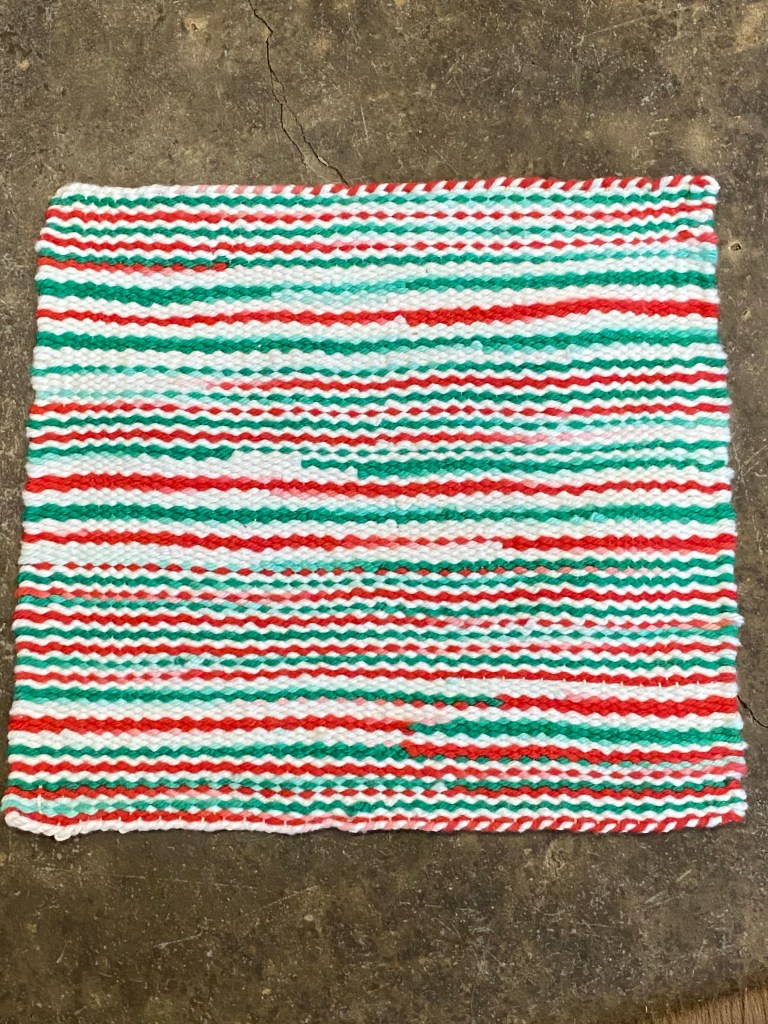
So I’m learning. I blocked (got it wet, laid it flat to dry) my variegated yarn washcloth, and although the pattern of the yarn was interesting, my edges are definitely wonky. The sides are a little better where I used the meet and separate method described in Rebecca Mezoff’s book, and it also changed the variegation pattern, which is neat. (The three sections where the lines are thicker are done with two bundles of yarn, rather than taking one bundle all the way across.)
What I liked: the way the meet and separate weaving method made thicker lines.
What I learned: adding a twined pass at the bottom helps space the warp threads. I added another twined pass at the top for balance.
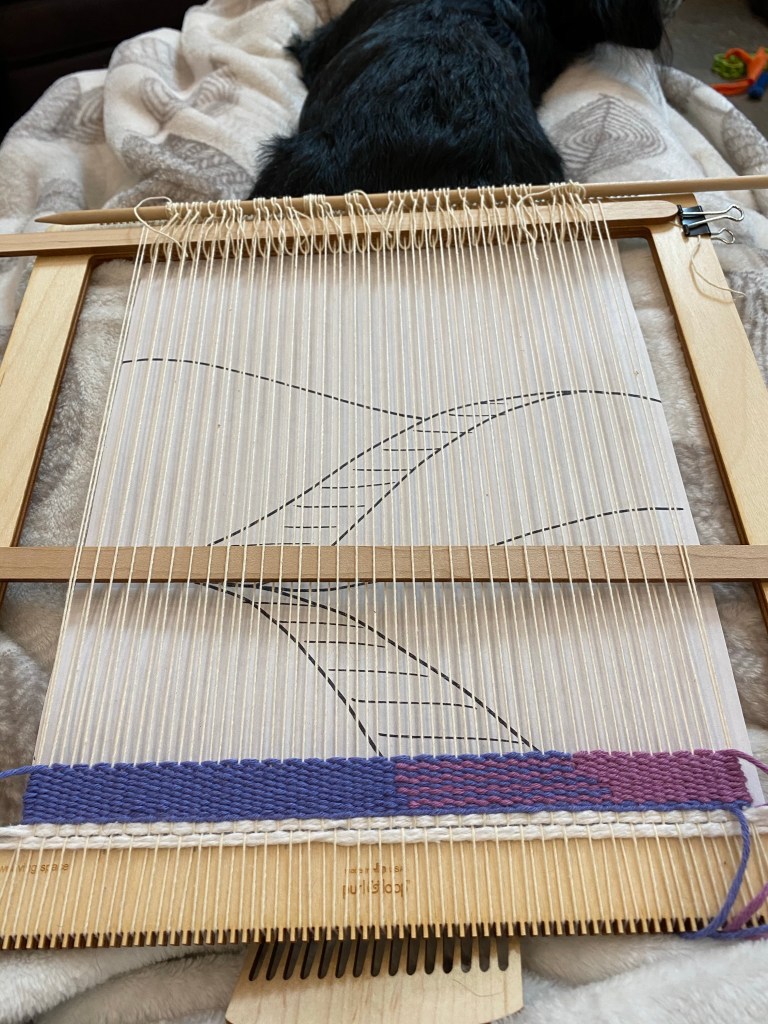
A heddle is something in weaving that holds threads of the warp to make it faster to weave. Rather than picking over and under each warp thread with the weft, heddles can be arranged to lift (or lower) alternate warp threads so the weft yarn can pass through (the tunnel created is called a shed). Heddles come in many forms, but I learned how to do a continuous string heddle when I was reading about back strap looms. I decided to try one with my frame loom.
Frame loom with continuous string heddle at the top, and a cartoon (pattern) attached behind
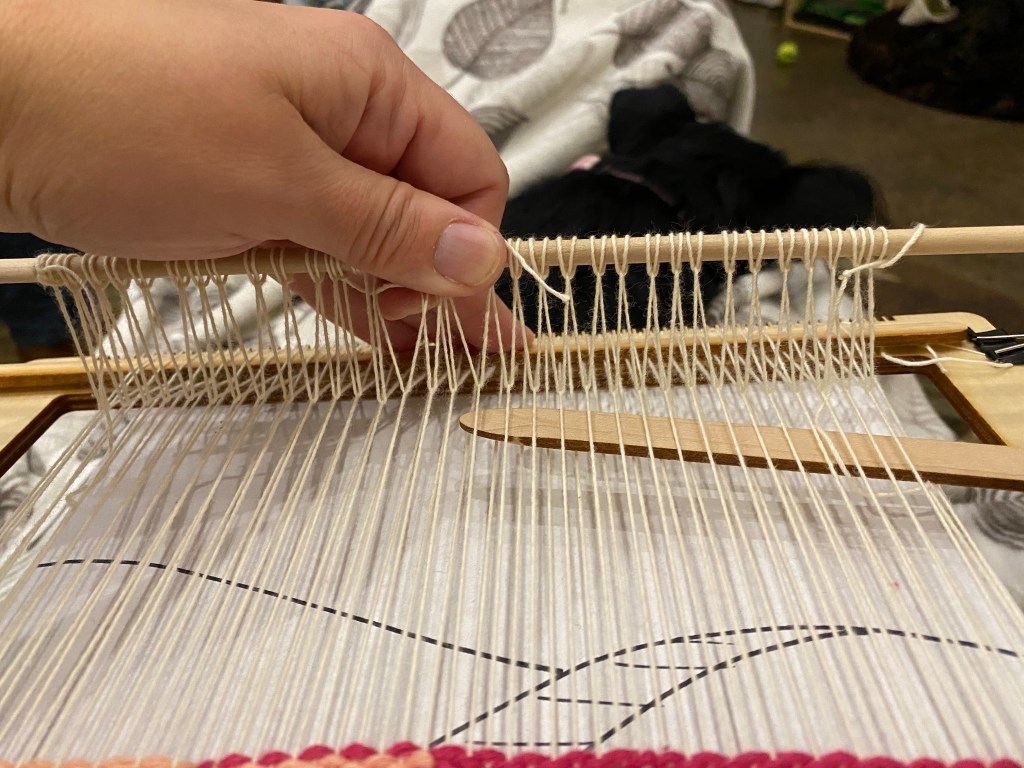
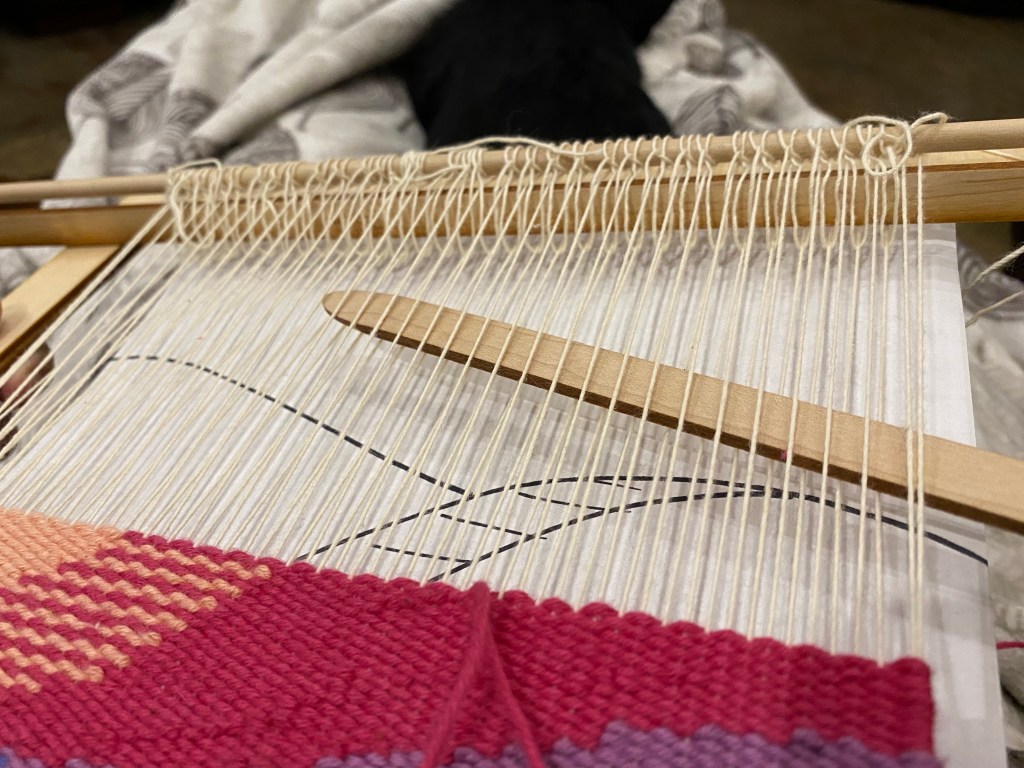
I used the same thread as my warp (I’m still working away at the found ball in my inherited stash), and used a slip knot to start, then looped the thread around every other warp thread, securing each loop with two half hitches. I used one of my pick up sticks for the alternate threads. It took awhile to secure all the loops, but now that it is set up, it is much easier to switch sheds. Weavers call the drawing used as a guide a “cartoon”. My cartoon is helping guide my curve work.
Opening a shed with a continuous string heddle, then using a pick up stick to hold the shed openShed kept open with a pick up stick to make space for the warp threadOpposite warp threads lifted with a second pick up stick
I’m trying some slightly thinner yarn on my frame loom and it is working much better with the sett (how far apart the warp strings are). I’m also experimenting with hatching (as seen in the picture above where the blue and white mix). As I consider buying or making a loom that is heddle bar friendly and has adjustable tension, I also need to consider lap space. My cat has started to reclaim lap time after the arrival of the puppy, and she doesn’t much care what I am doing as long as she can lounge!


 Critters and Craft