Twine as you go

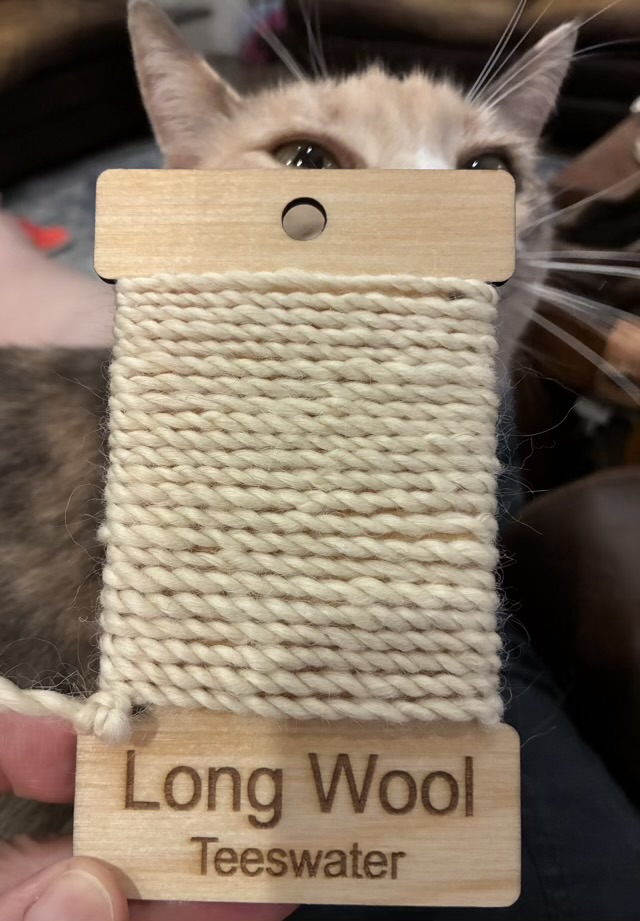
I’ve been twining with plant bast fibers (the long ones from the stems of plants), and wondered if I could twine long wool. I selected some Teeswater from my stash that has a staple length around 5-8 inches, grabbed a sponge and a spray bottle of water, and started twining. There was a bumpy learning curve, especially since I decided to learn to twine left handed to get an opposite twist. I wanted an S twist direction because my current favorite nålbinding stitch has a bias Z twist, and I thought the opposite twist yarn would help. It didn’t really.

Photo description: twined Teeswater wool and the beginnings of a nålbound pouch sitting on my jeans in the car while waiting in the pickup line

As I write this post, I’m wondering if the twist in my work is the stitch, or the method of construction I’m attempting. I’m working in the round, which is typical for nålbinding, but I’m working around a long base chain, which is a little different. I’ll keep on and see if things even out, either as I go, or after I block the finished work.

The exciting part of this project is there are no joins in the yarn, rather, the yarn is created as I go.

Twining lotus

This is lotus flower fiber, from the long stalks of the water plant.

Photo description: bundle of lotus stalk fiber (above) and a small twined rope (below)

I should have hackled this fiber to separate the strands and remove the shortest sections, but I picked it as a travel project, and figured out I should have run it over my steel combs about 30 minutes down the road. I’ll be finding tiny bits of lotus fiber in the car for the foreseeable future (along with bits of flax and yarn ends).

The fiber is enjoyable to twine. There are some very long fibers in the bundle, around 5-6 feet long. Twining goes better with a little sponge and a spray bottle of water so I can keep my finger tips moist as I twist.

Twining has become my favorite travel project because I can watch the scenery and not have to keep my eyes on my hands.

Iris leaf trivet

I recently found a tutorial from Sally Pointer on looping around a core and really wanted to try it. I look some dried and rehydrated iris leaves from my garden, twined them, then started looping. I didn’t have enough material for a basket, but the thick twine did make a nice trivet.

Photo description: trivet made of twined iris leaves with simple looping over a core construction

I did overestimate the amount of core, but rather than cut it off, I switched to just looping with the tail and was able to add some width to the trivet. I then sewed a leather label in a circle to an outer loop.

I like this method of construction. The core gives a way to tighten the stitches and fill in the density of the looping. It can also be done as the twine is created and without tools, which makes it a great skill when I am waiting and don’t have a project with me.

Iris leaf basket

I made a small basket entirely from dried iris leaves. The spokes are large iris leaves, and I twined multiple smaller leaves together around the spokes.

Photo description: starting the twining with dried then rewetted iris leaves
Photo description: finished basket made from iris leaves gathered from my yard

The leaves were soaked more than was ideal for weaving, so to dry it I put it in the oven on low and weighed the basket every twenty minutes until the weight was constant, indicating all the water was gone. Air drying a basket that wet would have given too much time for mold to set in.

I found some iris printed fabric and lined the basket. It took me two tries to sew a liner that fit the shape of the basket, and I ended up with a single layer that wrapped over the top lip of the basket.

Photo description: iris printed fabric liner on the iris leaf basket

To finish off the basket, I added one of my new leather tags to the edge of the liner.

Photo description: laser engraved leather sewn-on tag that says “iris leaves”

I like twining, so plan on harvesting more iris leaves in the spring, drying, and practicing on more twined baskets.

Photo description: basket in use holding sewing tools

Blocking transformation

Photo description: linen loop and twist net bag

I finished twining and stitching a linen string bag using long line flax and a loop and twist construction. I would twine a section, then loop that section, so the bag was made with a continuous length of string. I did not used any tools other than my fingers. As you can see in the photo above it looks a little wonky. I took it to the sink, gave it a soak in tap water, then laid it out to dry. The transformation was remarkable.

Photo description: same bag after blocking

The bias twist in the stitches eased and it straightened out nicely. What wasn’t nice was the rust colored stains on the top.

Photo description: discoloration at the top of the bag

I used a different batch of flax for the last few rows, and I think something on my well water reacted to something in the flax, which is disappointing. I washed it with gentle laundry soap and laid it out to dry again.

Photo description: same bag after washing with gentle detergent

The rust color lessened, and now it looks more like a different batch of flax at the end, rather than a stain.

I’m also not pleased with the string ties. They are functional, but would be terrible to use to carry anything with much weight. The flax would hold, but the thin cord would cut into the flesh holding it. I do have an idea how to fix it.