School is back in session, so I’ve started up my spin walks again. Really it is a matter of the temperature coming down and walks being pleasant in the morning, instead of a hot sticky mess.
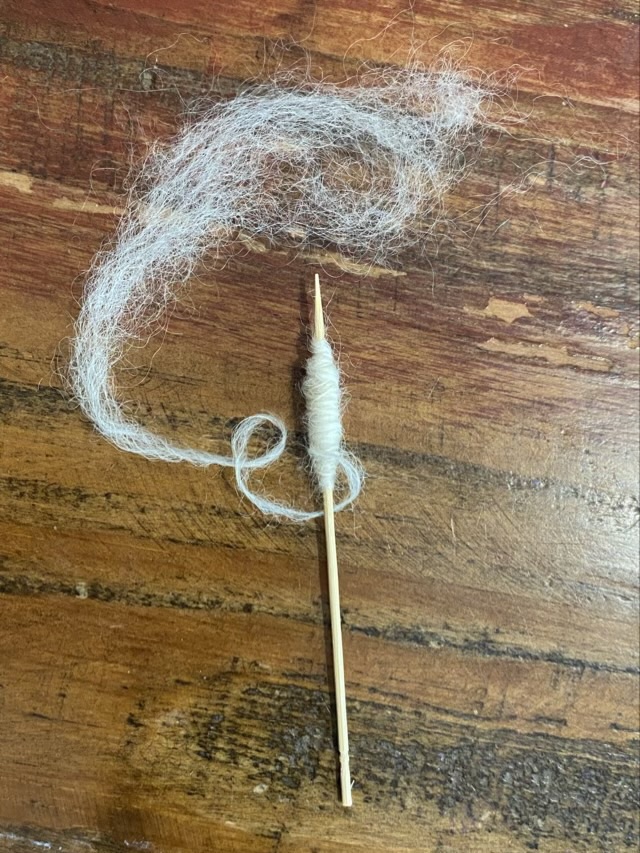
Photo description: spinning Southdown wool on a 3D printed Turkish style spindle while walking a city park
I found two drop spindle projects in progress when I went to pick up my spindle. Hm. I decided to start with the Southdown, because this little Turkish style spindle is one of my favorites. If I drop it, the rubberized arms bounce, and the yarn is protected from contact with the ground due to the jacks like shape of the arms and shaft.
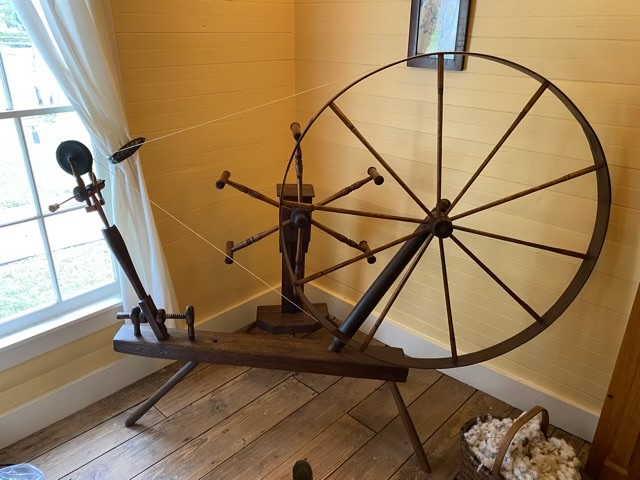
Photo description: 1800s Great Wheel at Man House in Mansfield, TX, yarn weasel in back corner, basket of raw cotton (bottom right)
Y’all, I get to demonstrate spinning on a great wheel, also known as a walking wheel, in October. I recently took a drive out to meet the wheel and see if I could spin with her. We are compatible. I took some Teeswater wool roving to give her a spin, and she has been kept in good working order. There is a little slip in her drive band, but I have permission from the museum to use beeswax if necessary. She has an accelerator head, so was probably used mostly to spin cotton, especially since they were growing cotton in that area in the 1800s. I will take two kinds of local grown cotton sliver to spin in the demonstration. I’m so excited.
Photo description: close up of the spindle head showing the cotton drive bands, accelerator head, and spindle with 15 minutes worth of spun Teeswater wool, and a cork on the spindle tip for safety
The wheel is potentially 200 years old, or at least approaching her 200th birthday. It is a humbling experience and an honor to spin with her.
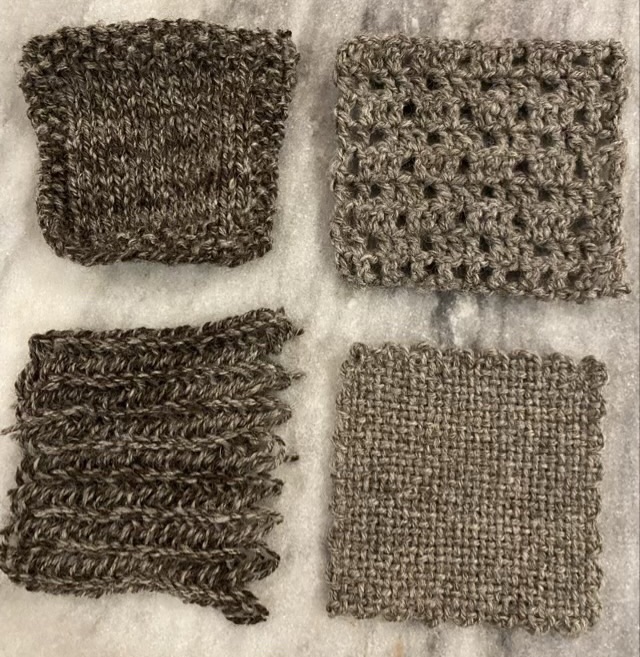
I started on the swatches for Jacob’s wool, and then finished them all in a day, even the nålbinding. I must have thirty other projects I’m not working on. Hm.
Photo description: four squares made from hand spun Jacob’s wool: knit (top left), crochet (top right), cut open nålbinding (bottom left), woven (bottom right)
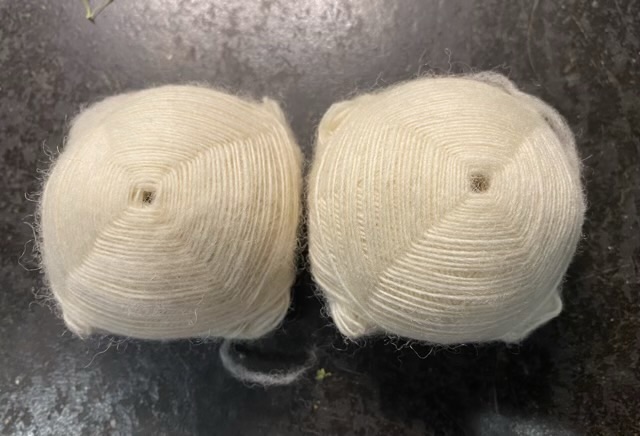
I had two large cakes of yarn, and two small nostepinne balls, so I used the smaller amounts to make the swatches. I hope to make something wearable out of the larger cakes of yarn.
As a Thank You to Sugar the Samoyed’s family for sharing Sugar’s fur for my fiber study, I sent them a crocheted heart and the remainder of the yarn.
Photo description: small hank of Samoyed yarn and a crocheted heart with a leather center with the name “Sugar”
I designed the leather heart using Adobe Illustrator, then cut it from vegetable tanned tooling leather. Having precision cut holes was awesome to make a blanket stitch around the edge. I then crocheted into the stitches using a single crochet in the back loop.
In May I received a mysterious fiber package. There was a tickle in the back of my brain, a shadow of a memory from the previous summer, when I talked with a woman who said her dog’s fur looked just like the Shetland sheep roving I was using for a spinning demonstration. She said she would send me some dog fur, and I gave her my address. I reached out to confirm, and yes! My mysterious package did contain the results of numerous brushings of her Samoyed dog, Sugar.
Photo description: Ziplock gallon bag full of Samoyed dog furPhoto description: Sugar the Samoyed photo from her owner
Samoyed dogs have a thick double coat that is usually white and naturally dirt repellant with very little smell. The fiber was very clean, and did not have much VM (vegetable matter), so I decided to comb and spin it straight from the bag, without washing or scouring. The staple length of the undercoat wool is about 2-3 inches, but the guard hairs can be much longer, I measured one guard hair at 9 inches long. I did not attempt to de-hair the wool.
Photo description: using wool combs to align the fibers for spinning on my Ashford Traveller spinning wheelPhoto description: Missy the dog is very interested in the smell of the dog wool, she can smell what I cannot!
The Samoyed wool was very easy to spin, and I was able to get a relatively consistent single. Combing produces more waste than carding, but the results are worth it. The waste fiber goes outside for the birds and squirrels as nesting material.
Photo description: single spun Samoyed dog wool
I chose to chain ply my singles to make a three ply yarn. The Samoyed wool also performed well in plying and I didn’t have any breakage.
Photo description: Samoyed dog wool three-ply yarn on the spinning wheel bobbin
I’m going to give the three ply yarn a gentle wash and hang it up to dry!