Fancy cat bed

Ok, so this is probably the silliest I’ve ever made, and that’s saying something. I repaired the broken leg in an old side table that had been used as a bench (yesterday’s post), and rather than tempt fate by putting a solid top back on, I made it into a cat hammock.

Photo description: elegant wood table with curved legs with a light pink fuzzy padded edge cat hammock attached.

I had a pink fuzzy blanket that had already been cut into for another project (we couldn’t find the fabric by the yard, so bought a blanket), and sewed a two sided mat. I stapled the mat down to the table top, over the central opening. I then sewed a long tube of the fabric, stuffed it with polyfil and sewed that down on the mat. It is quite the sight. The cats are not too sure of it, so I put it beneath the front window where it will get some sunlight. I’ve sequentially put all three cats on the bed; all have rejected it. I’ll give it some time.

Photo description: Thor the gray tabby standing on the new fancy cat bed.
Photo description: Sophie the dilute calico standing on the new fancy cat bed.
Photo description: Izzy the calico sitting on the new fancy cat bed. After the photo she moved up to the window sill.

Some things don’t change

Running out of thread on the sewing machine bobbin two inches from the end of the seam happens on antique machines as well as modern machines. Sigh.

Photo description: empty bobbin on a Singer model 66 treadle sewing machine along side an unfinished seam on yellow and red quilting fabric.

Despite the frustration, this was good practice to see if I remembered how to wind the bobbin and rethread the machine. I didn’t. I rethreaded the machine three times, wondered why the feed dogs weren’t moving, so took off the foot and the needle to look, forgot to disengage the bobbin winder, and put the needle in backward. After another few minutes of troubleshooting I realized the stitch length knob was set for teenie tiny stitches, so fixed that (feed dogs work fine). Then I disengaged the bobbin winder (which is easy to accidentally bump into position). It took seven practice seams before I finally went looking online for reasons for skipped stitches and then discovered the needle was in backwards. Oh for crying in the mud. The machine works great, the operator still needs some training.

Still sewing

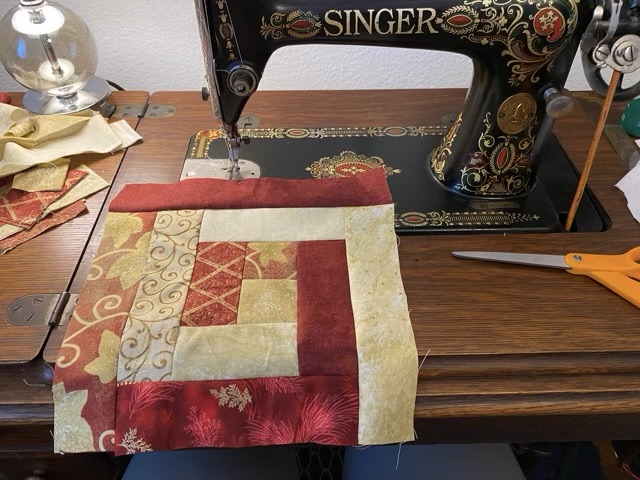
Now I’m sewing strips of scrap fabric together with the Singer model 66 treadle sewing machine. I’ll figure out something to make with the pieced together fabric later (probably bags, I like bags), but for now it is an easy way to exercise the machine. My treadling is getting better as well; in those long straightaways I can really get the speed up!

Photo description: Singer model 66 treadle sewing machine from 1916 with strips of red and cream fabric sewn together lying on the work surface.

With an electric sewing machine there isn’t quite the thrill going top speed as there is with a treadled machine, knowing you are providing the power boost.

Another way

Here is another way to reduce the likelihood that machine sewn stitches with unravel: tiny stitches. On a sewing machine that doesn’t have a reverse stitch, like my Singer model 66 treadle, turning the knob to the left to make the stitches smaller for a few stitches, then back right to increase the stitch length for the rest of the seam, is a little extra insurance. It also helps work the sewing machine oil (SMO) into the threads of the knob. Bonus.

Photo description: seam stitched on the diagonal of a light colored fabric strip showing smaller stitches at each end of the (wavy) stitch line.

This actually takes about the same time as turning the fabric and making a “reverse” stitch, currently. The stitch regulator knob of the 107-year-old machine is still a little stiff.

Yes, I can sew a straight line. I just need more practice sewing a straight line while turning a regulator knob and controlling the balance wheel so it doesn’t go backwards and break the thread. Goals.

Piecing

I bought a grab bag of scraps from the local quilt store because it had fabric that matched what I have in my stash. I set it on the sewing table of the Singer model 66 and later decided to try sewing some squares together. I haven’t pressed the seams yet, but I love the way the machine works. It is the advice from The Treadle Lady to take these old machines on a “Sunday drive”. Using them weekly encourages proper regular maintenance, and keeps everything moving.

Photo description: Four squares of red fabric sewn together on the surface of a Singer model 66.