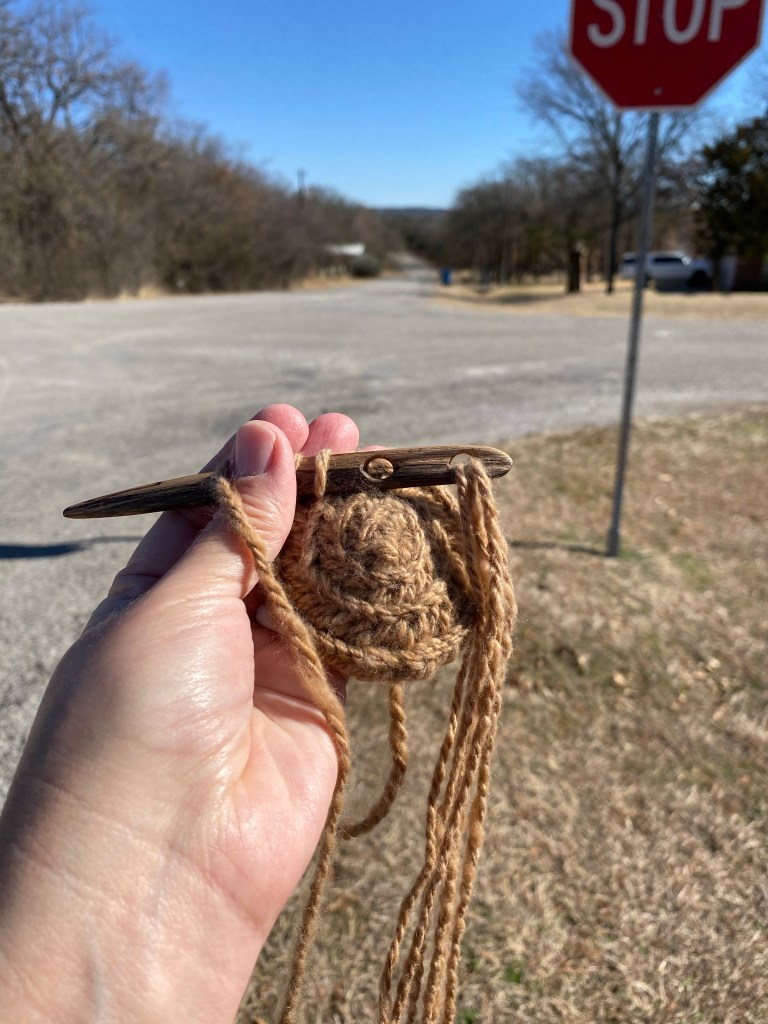
Unlike knitting and crochet, nålbinding (which I have heard pronounced as nawl-bending) is made by passing lengths of yarn through loops. Since the yarn must pass through, the crafter works with sections of yarn, rather than from a ball. A way to increase the amount of yarn that can pass through a thumb-sized loop is to use a nål (needle) with two or more holes. I also carve a channel along the holes to reduce bulk. In the picture above I have the nål loaded as much as I dare! I made 4 four-foot loops and threaded two loops through each hole. As you work, you can pull the working yarn through the hole and keep the loops neat. If you would like to see a short video on an in-process piece, here it is.
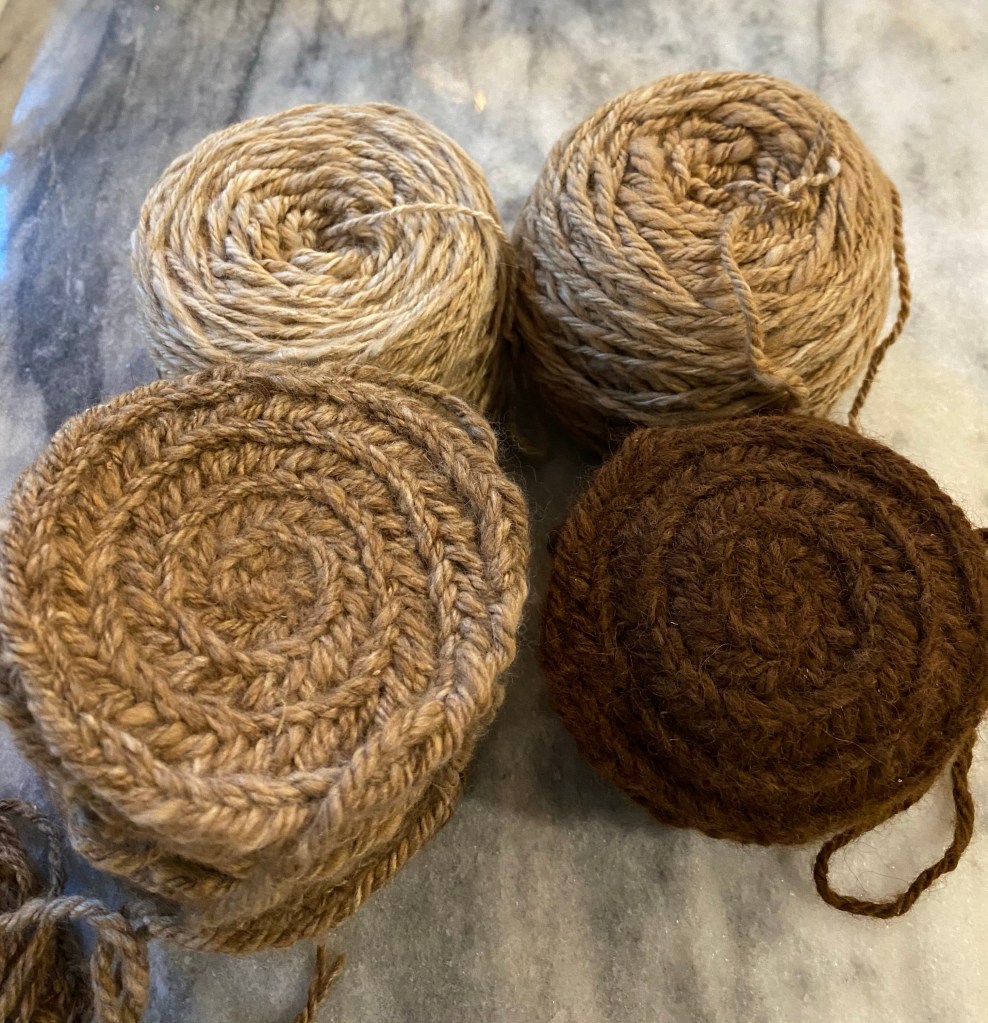
This is my forever project. I’m making something for me, so it is on the bottom of the priority list and I use it to fill the gaps between other projects. I decided to make spirals (I like spirals), and sew them all together, because it gives me flexibility if I change goals mid stream. Current goal is to make an ombre vest. I have made two hand spun yarn cakes into nålbound spirals, and have two more yarn cakes ready for nålbinding.
Nålbinding spirals (Mammon stitch) with yarn cakesOne spiral fell to the floor and the puppy found it. Ugh. I’m going to have to watch her for intestinal distress. It looks like she chewed off loop halves, which should pass OK. If this had been crochet or knitting, she would have been able to pull off and consume long strings in the same two minutes of chewing. So, yay, nålbinding.
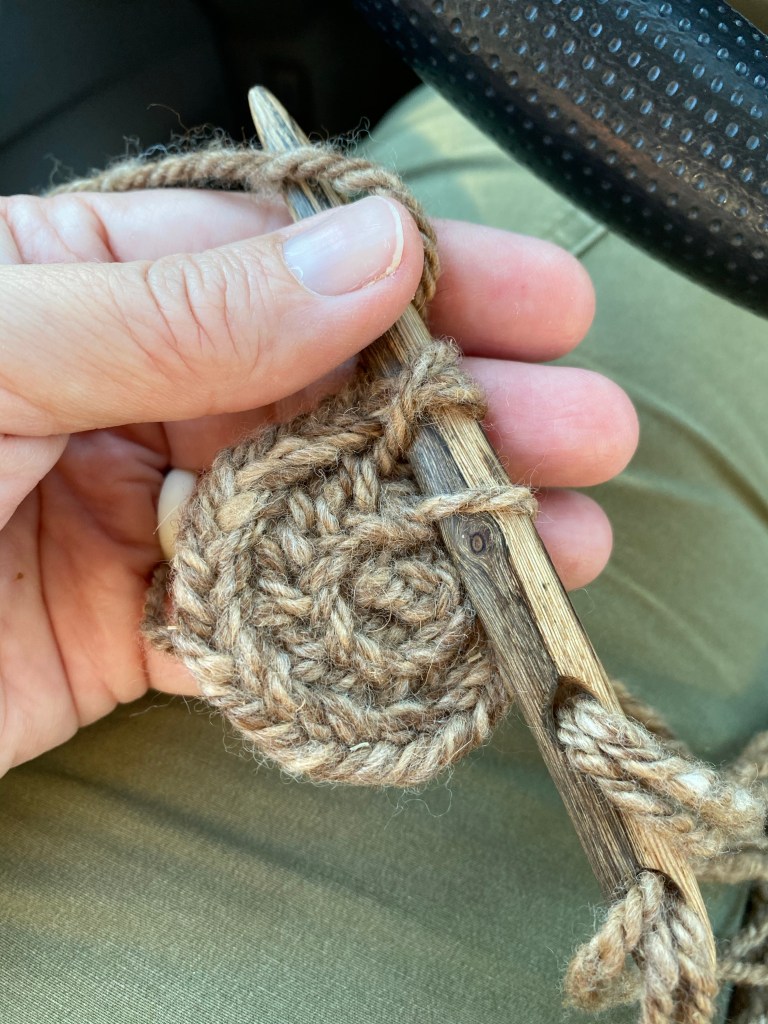
Aw, look how nicely the blended colors in the yarn go with the needle! I’m still plugging away at making a gazillion nålbound circles to construct a larger piece. I can usually do one spiral per car pick up line session. It is going to take awhile. The yarn is spindle spun undyed local alpaca, and the needle was carved from an aged grape vine and sealed with tung oil. I just enjoyed the color play today.
With virtual learning and a puppy to watch it has been hard to find the time and energy to do any needle craft, but I did find some space to get back to a nålbinding project now that my youngest is F2F (it probably dates me that I am using this abbreviation for the first time). Not only did I get to stitch, I did so outside in beautiful weather. Bliss.
This is drop spindle spun undyed alpaca and the plan is to make many small spirals and stitch them together to make … something. The plan is in flux, but if the technique works, I will probably make many things using the method. I like spirals, and I dislike making large boring blocks that never end. Somehow a large stack is different than a big rectangle.
Nålbinding spirals with a grapevine nål and hand spun alpaca yarn
As we sat and watched the fire around the artist’s charcoal (see yesterday’s blog entry for more on that), I had extra lengths of grape vine stick, which happened to be a good length for a nålbinding nal. I had my pocket knife and decided to give carving a nal entirely by hand a try. Previously, I used a drill press for the holes, and a band sander for shaping. It was quite easy to carve the grape vine, and although it does have some flex, it is sturdy. I was able to carve out the eyes of the nal, which was the trickiest bit. I also added a channel along the eyes, which helps the loops of yarn pass through easily with the needle.
Grape vine nal, initial carving
After roughing out the shape with my knife, I took 120 grit sandpaper and refined the shape and the eyes. Then I used 220, 320, and finally 400 grit to smooth the wood. Rolling the sandpaper into a tight tube helped sand out the holes.
Nal sanded smooth
At this point I tested the nal with some scrap yarn and found that it had an unpleasant bump in the middle. I went back with the 120 grit and sanded out the lump, then smoothed it out again. To be sure I had all the wood fibers smooth, I ran the nal under water. This raises the fibers that want to raise, and is an important step in wood finishing, especially for hand tools. If this step is skipped, those fibers still raise, but do so when the sealant is applied. It is much easier to use water first. When the nal dried, I sanded again with 400 grit. It needed it! I repeated the water treatment, then I had a nice smooth nal.
Raised wood fibers after rinsing with water
I usually leave my nals uncoated, letting the natural oils of the yarn and my hands condition the wood. Since the grape vine had so much raised fiber after the water treatment, I decided to apply a couple coats of teak oil to seal the nal.
Finished nal
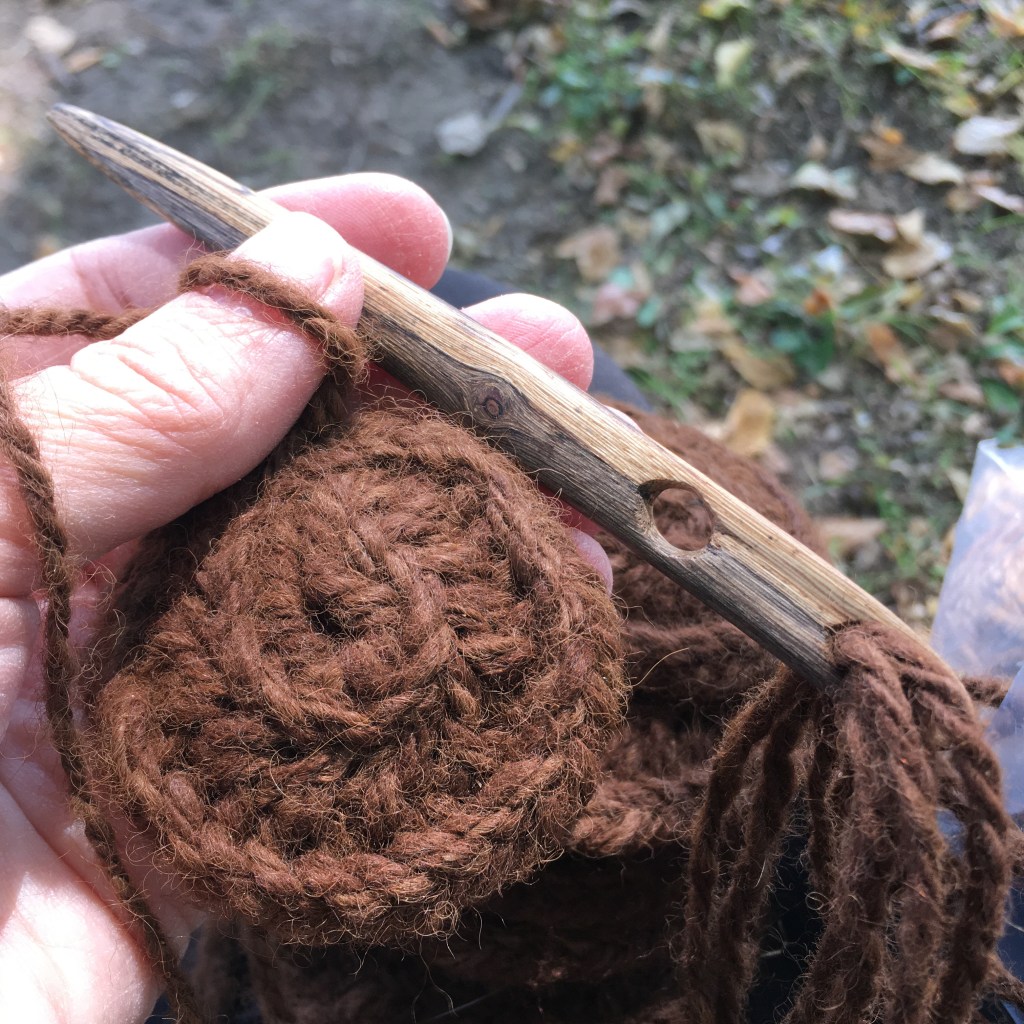
The love the light and dark color of the wood and the slight curve!
Test round with hand spun merino wool and grape vine nal, Mammen stitch