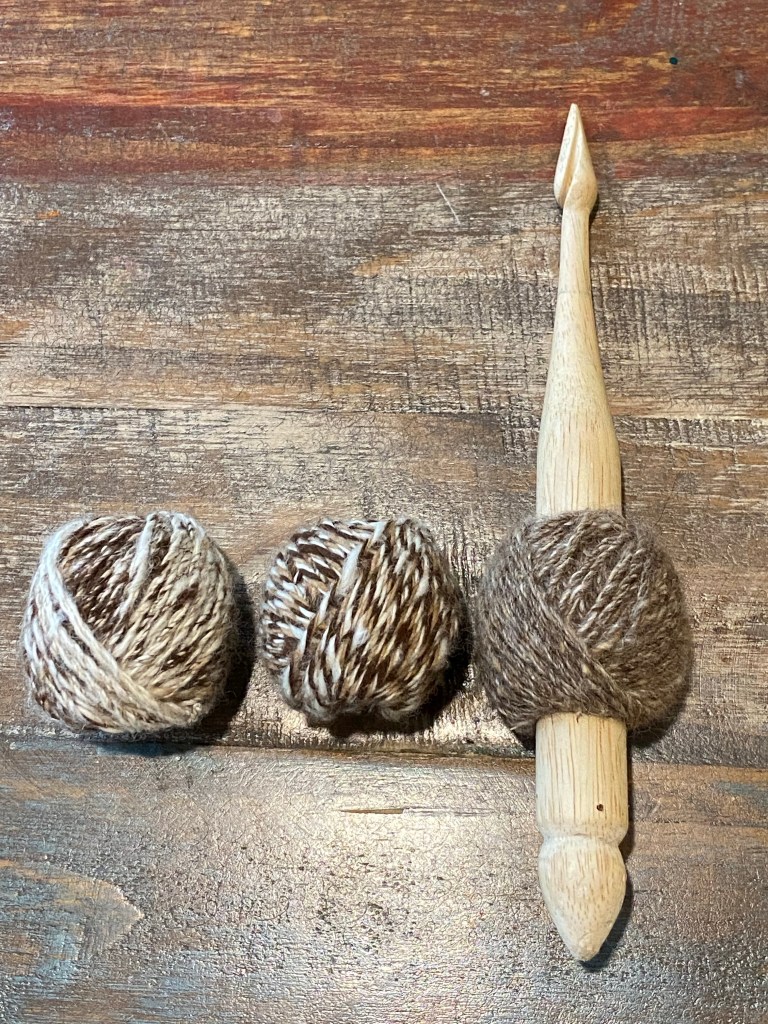
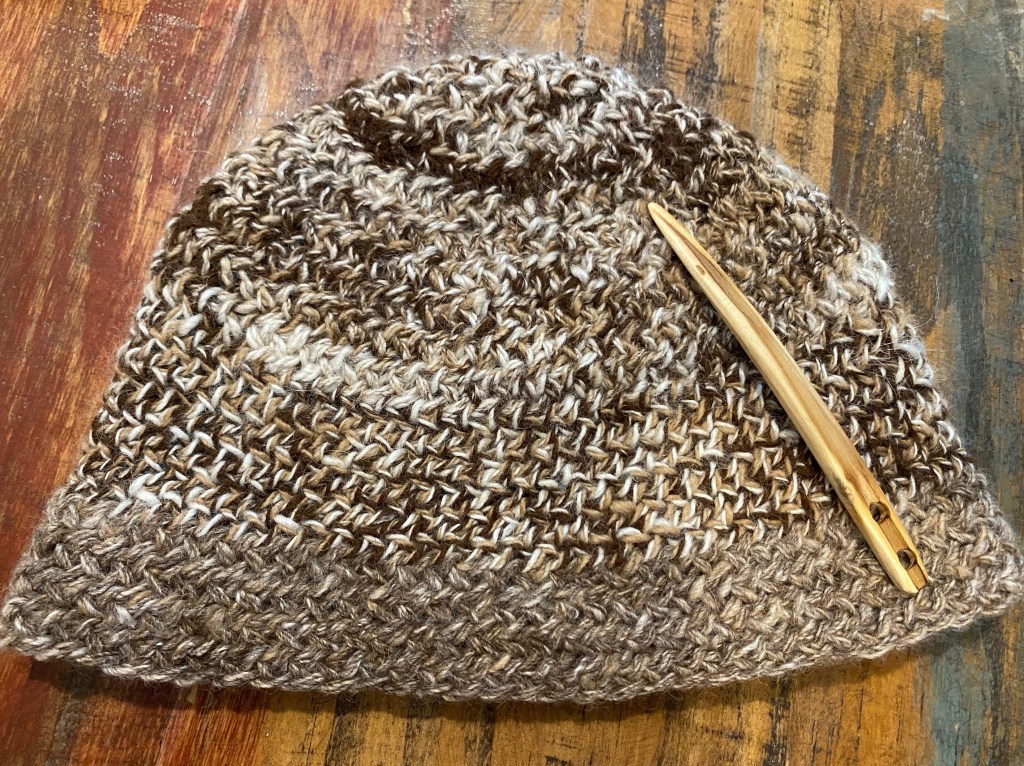
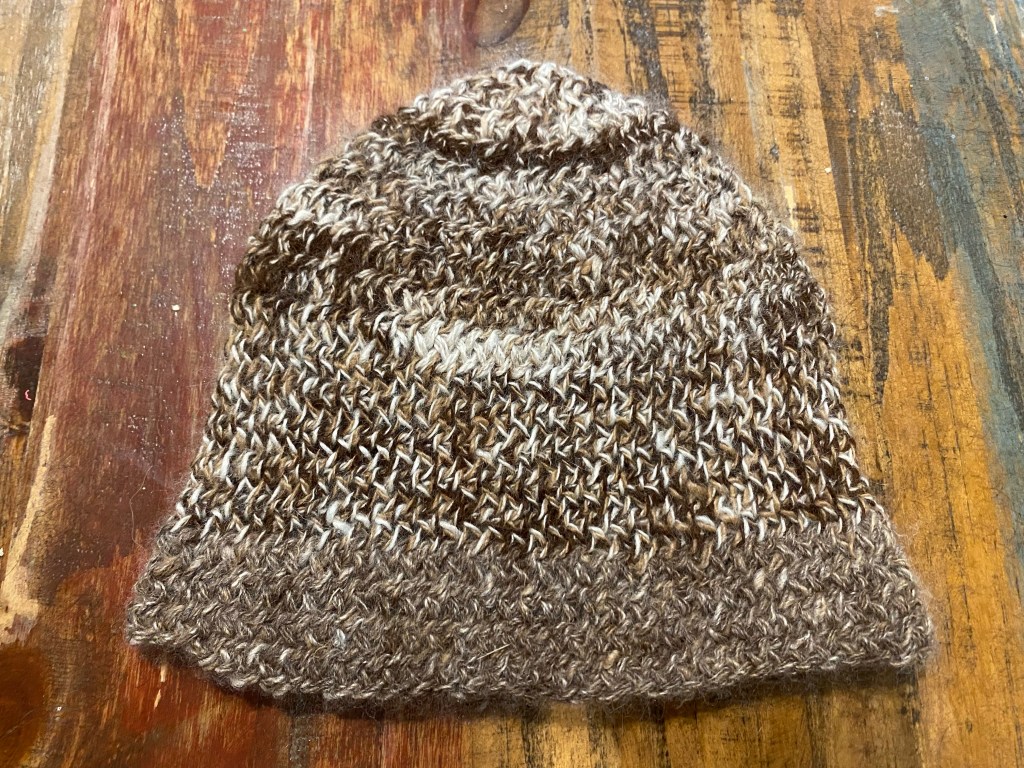
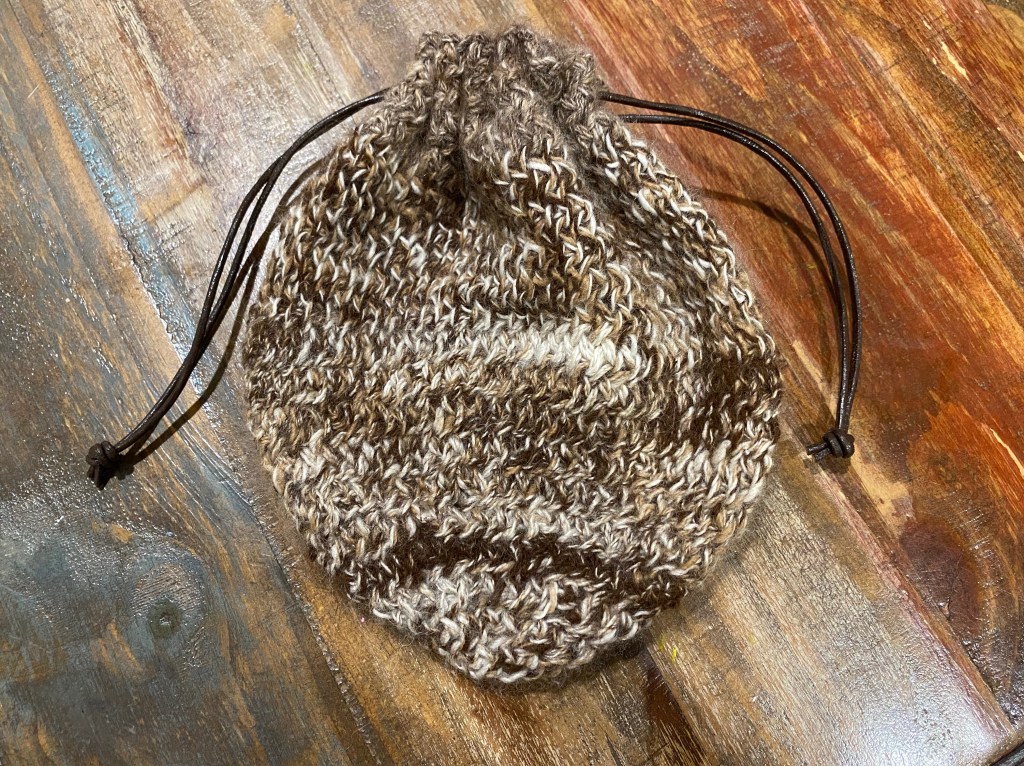
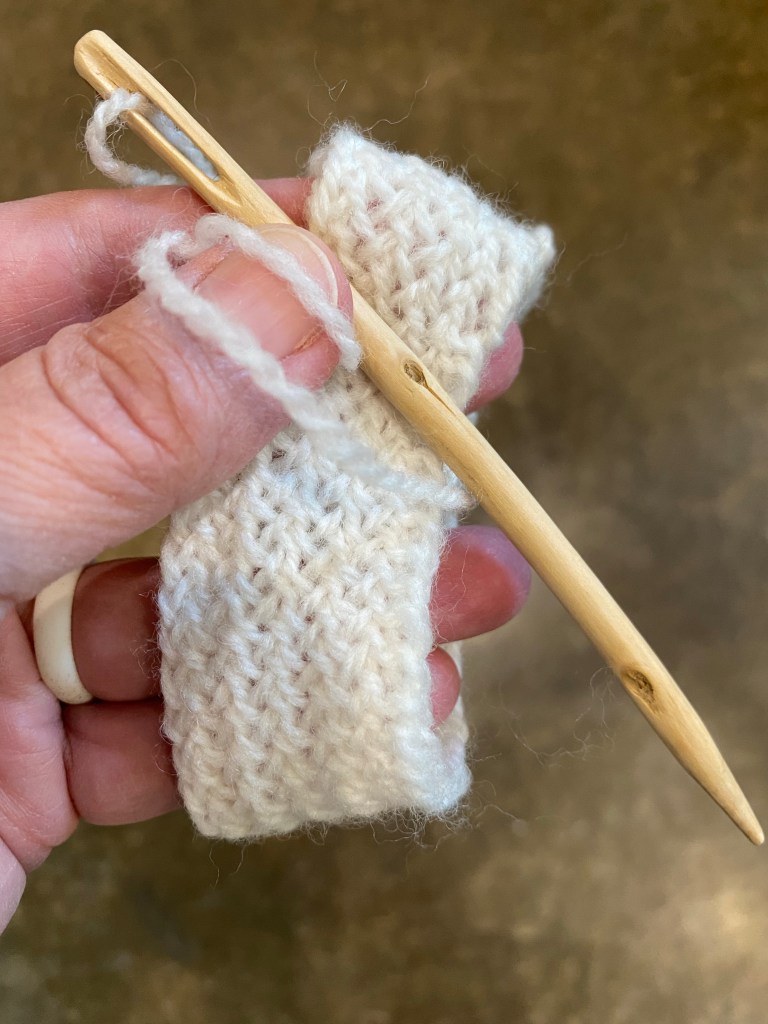
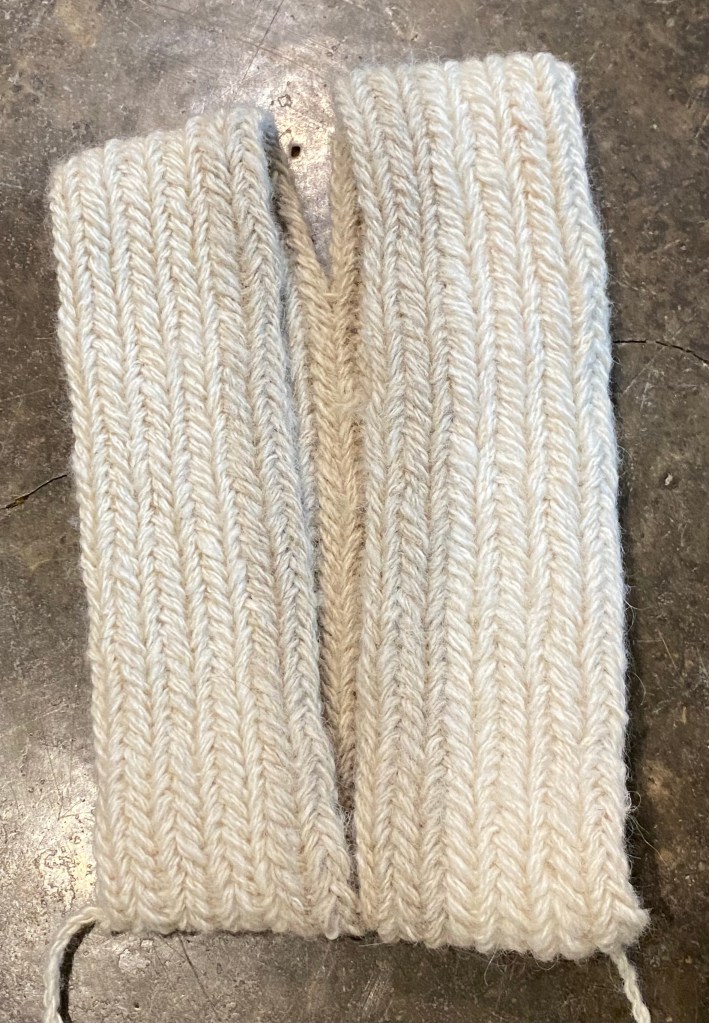
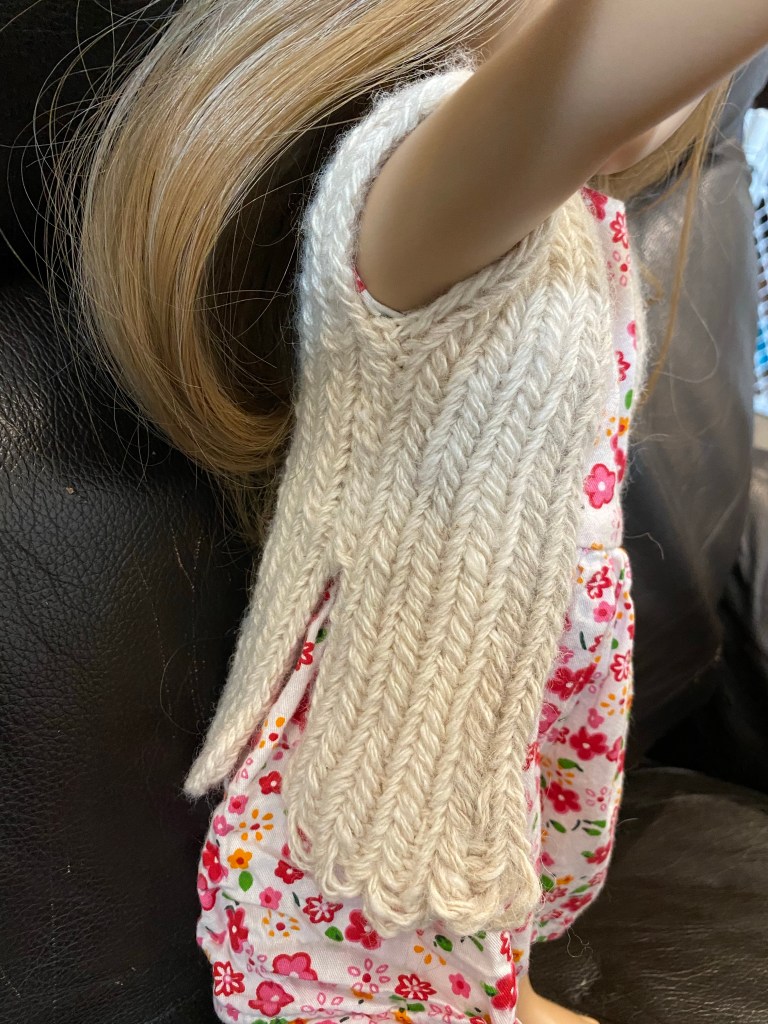
I was combing my tool stash for a nål (needle) to make smaller nålbinding stitches and found an old hand-carved diamond willow needle. My great-grandfather carved all sorts of things from diamond willow, so our guess is that this is one of his works! It had been sitting in my knitting box for quite a while, so I sanded it up a little with 400 grit sandpaper to smooth the unfinished surface. Although I’ve been partial to semi-flat oblong nåls to this point, I found making stitches with the round needle worked well. I’m learning a new stitch called Dalarna, which was used to make milk strainers in Sweden (https://www.en.neulakintaat.fi/75). I like the way that the stitch makes a fabric that appears woven on one side. I’m practicing with commercial wool sock yarn, not my own spun yarn, until I get the pattern firmly in my fingers’ muscle memory.
As I was contemplating what to make with the mini balls of test alpaca that I spun, my youngest announced that her other doll needed a new jacket. Ok, that can be done. I chose to nålbind (because I like it best) and used a Finish 2 + 2 stitch with an F2 connection. Because the three skeins were different colors, I decided to put the darkest in the center. I also tried a different construction technique, working in vertical rounds, rather than horizontal. Making the neck and front slit was just a matter of chaining along, rather than connecting, as long as I needed.
Doll vest before cutting
Once I had the sides of the vest even, I cut the bottom, pulled out the loose threads, and tightened and wove in the attached ends. I then sewed up a section of each side to form the arm holes but leave side slits.
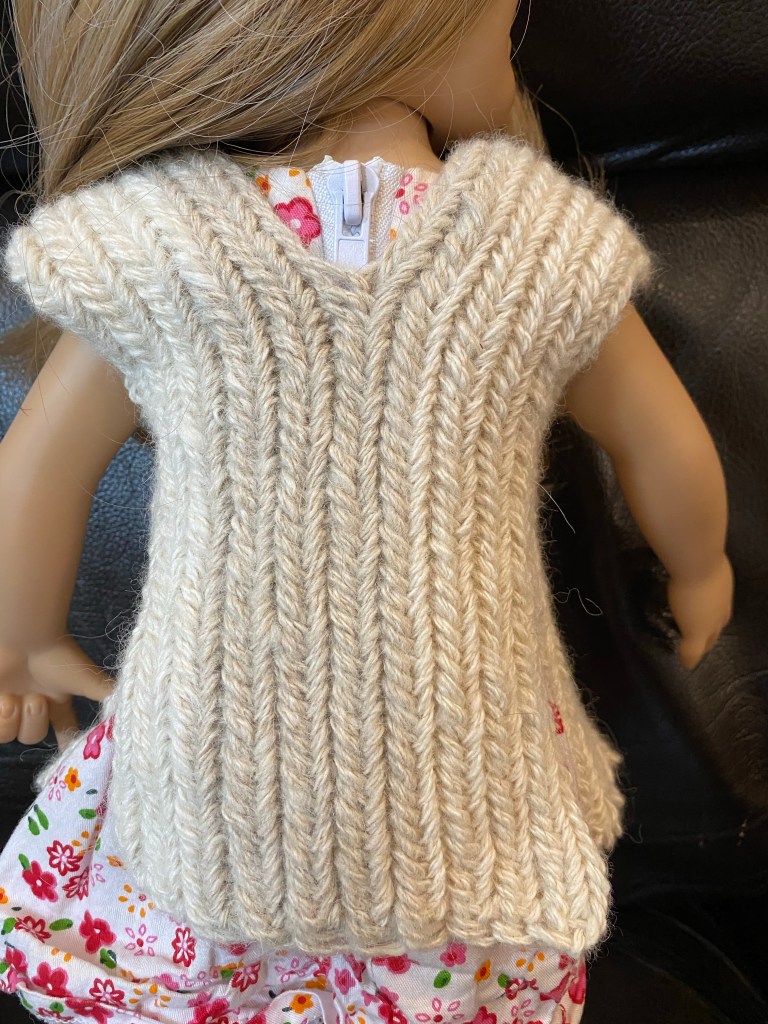
Bottom edge neatened (I like the scallops), and sides sewnBack of doll vest showing all three preparations of yarn
Really there was no difference in the three preparations of fiber after the initial single spinning. Even the finished fabric just has color variations, but is otherwise consistent in texture.
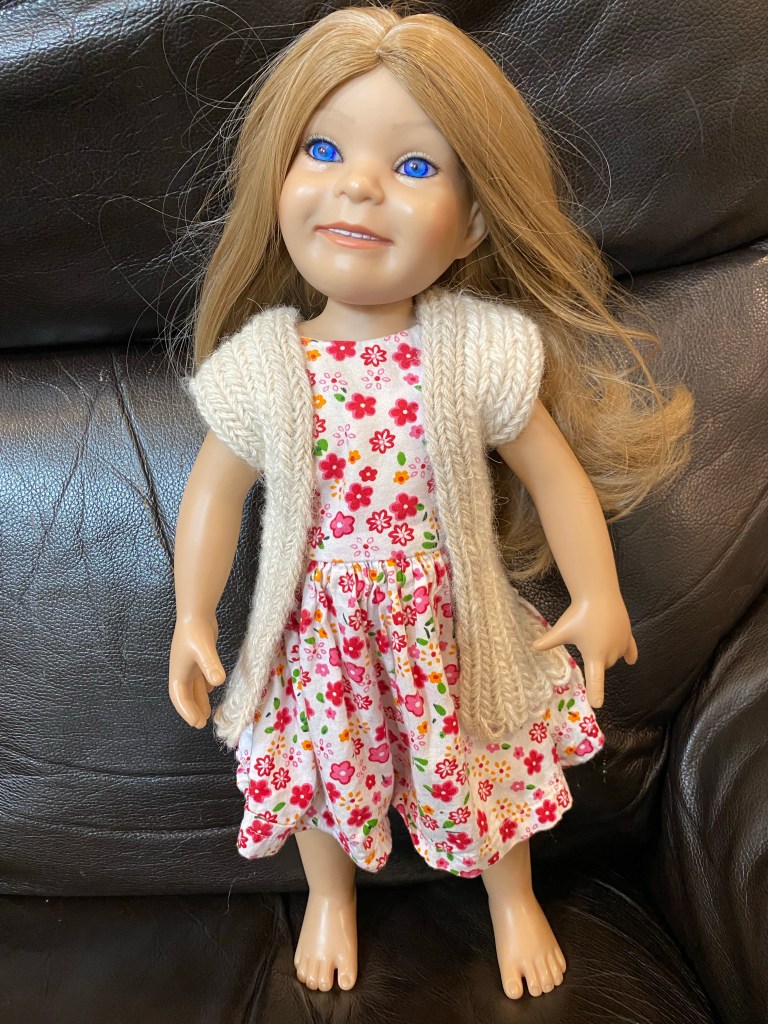
Front of doll vest
This was an excellent test. The alpaca yarn combined with this stitch made a very dense fabric. I think a human-sized version would be quite heavy.
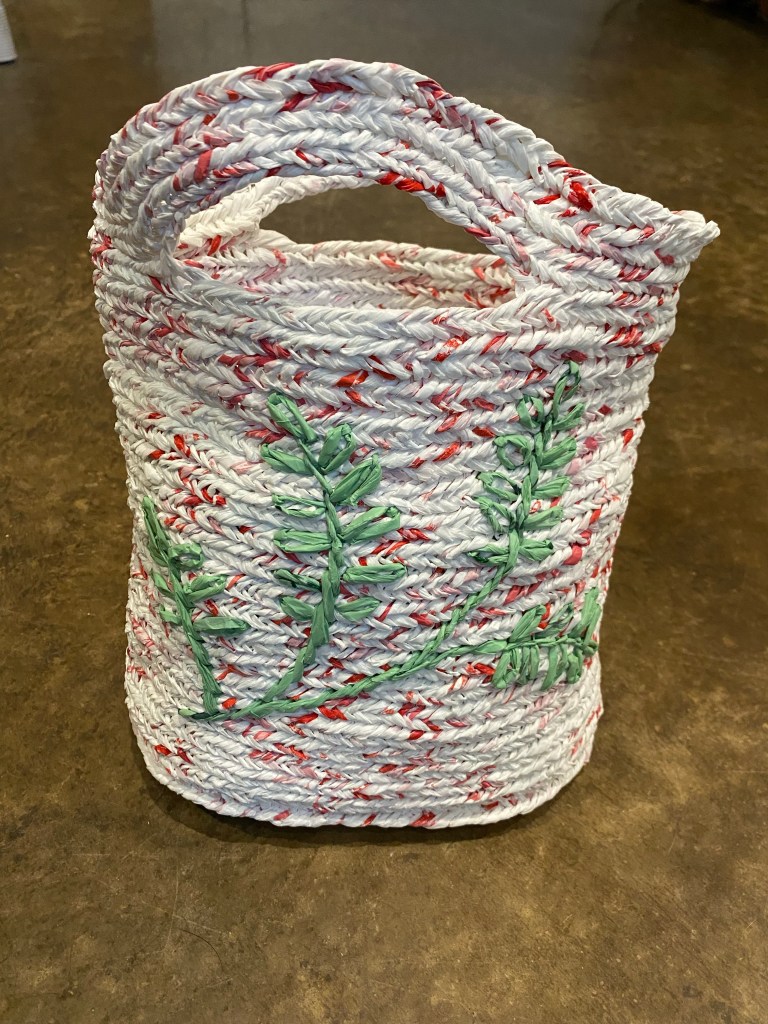
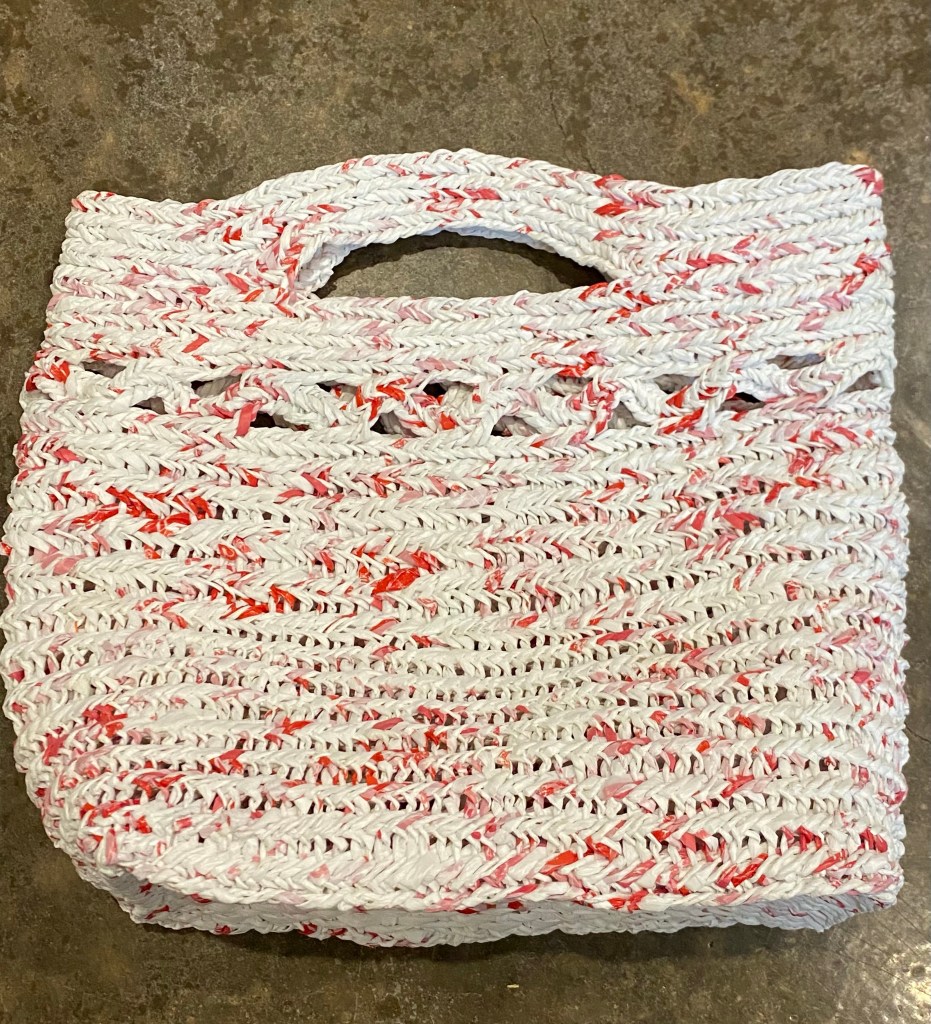
I finished the plarn bag! Or maybe it is a basket. It can stand on its own, but is still flexible. Hm.
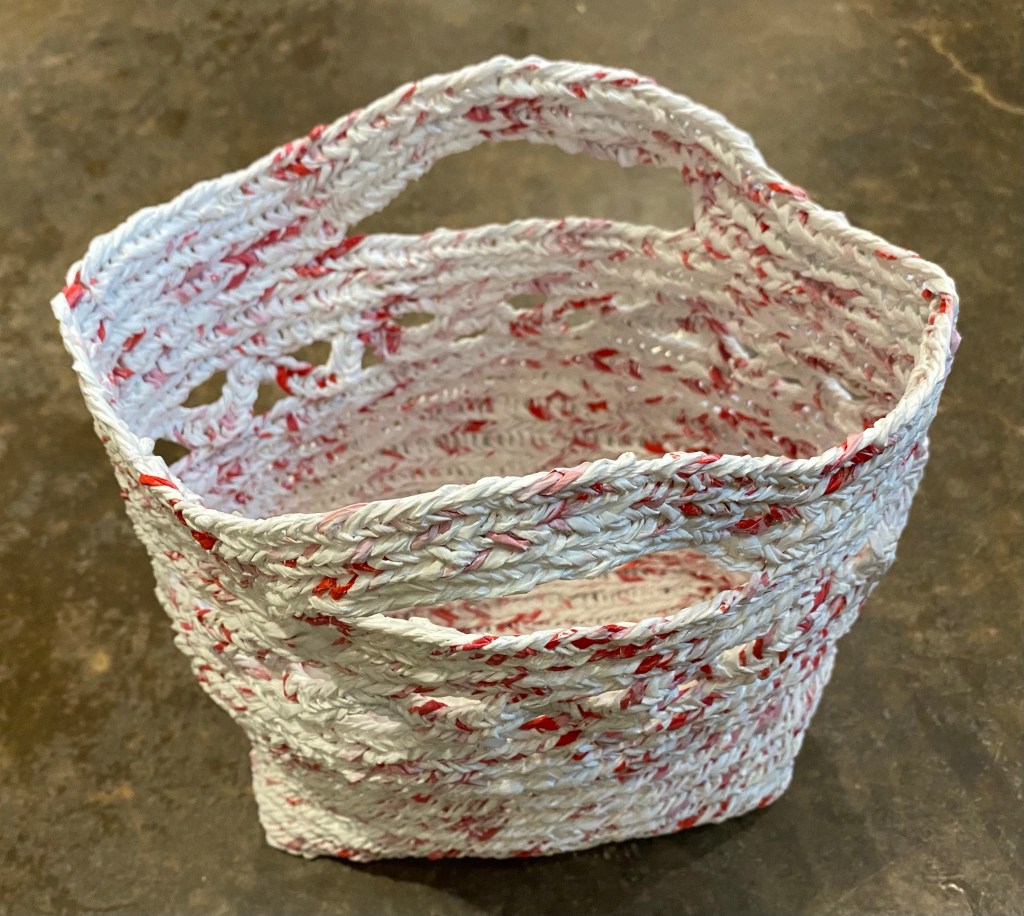
Nålbound bag made from plastic grocery bags
I changed connection stitches mid-bag (we’ll just call it a bag, yes?) because I was aiming for the tight braided look I’ve seen produced with the Finnish 2+2 stitch. I figured out my tension at the 2/3rd mark, and the stitches finally achieved the look I wanted, so I decided to also try some decorative work (since it is an experimental object anyway).
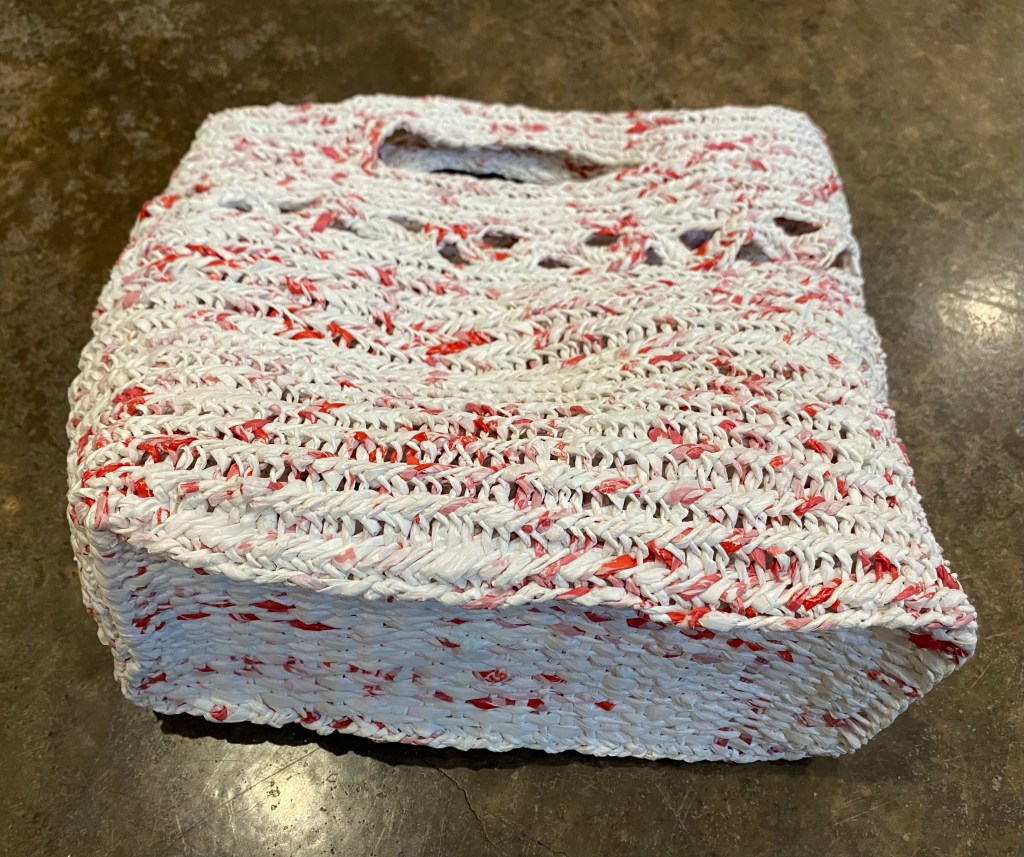
Woven bottom of the nålbound bag
It turned out quite functional and sturdy. The handles with the three rounds are comfortable, and I made it to be large enough to hold my longest spindle. I can tell where I changed connections (from M1 F1 to F2, note to self), and where I achieved even tension, but I’m going to claim them as design choices.
Nålbound bag made of plarn
Whether the finished project is considered a bag or a basket, it is done!
P.S. This took me three weeks to complete, working in bits and pieces. The magic of the blogosphere made it seem like a few days, but it wasn’t!
P.P.S. This bag used the plastic from approximately 43 grocery bags. (And it drives me crazy when I hit “publish” instead of “save as draft” on a post.)
Back to talking about plarn. Yesterday I posted about how I connect and spin loops of plastic grocery bags as I stitch. I wanted to learn a new nålbinding stitch and using plarn was a perfect way to practice without wasting expensive fiber. The stitch is a Finnish 2+2 stitch as described here (this page also talks about how different connections affect the finished texture, I chose M1 + F1 because it looks more braided). I started my chain, and made it long enough that I could make a beach mat, if I so chose. It is easiest to do nålbinding in the round, so I continued in the round (nålbinding can absolutely be cut and tidied up later). As I progressed, I felt the texture would be better suited for a bag than a mat (it has a rough feel due to the twist). So then the dilemma was how to deal with the base of the bag. I could stitch it straight, as a tote bag, which wouldn’t stand on its own. I could sew an oval piece of hard plastic in, but what plastic, and would it still be recycling? I could nålbind an oval, which is downright tricky. What about weaving? It is an experimental piece anyway, could I weave a base? I found a box that fit snugly in my nålbound tube and connected the first loop by threading it through the edge and looping it back on itself (as you do for connecting loops).
Starting the weaving
I then gave the loop some twist and ran it the long way along the box, out through the edge, then back in through the next stitch. I added loops and twist as I went, making the warp threads for the weaving.
Setting up the warp threads with plarn
When it was time to start the weft, I realized that I didn’t have to break the plarn, I could just turn the box and keep going. I used a plain weave (over, under, over, under), and used a pick up stick to hold one shed, and a longer wooden needle to pick up the alternate threads. My nålbinding needle was best for connecting to the edge because it is smooth and doesn’t abrade the plastic.
Weaving the weft on the bottom
I had to adjust my spacing as I went; I started off putting the weft through every edge stitch, then ended up every third stitch to get the weft to be straight. At the end, I wove in the tail and clipped it on the inside of the bag. (Only one tail to weave in, hurray!)
Woven base for nålbound bag (in progress)
This was a very pleasing experiment. I really like the woven base: it feels nice and is sturdy. I will continue to build up the sides with nålbinding, but that will take awhile. I’ll post an update when it is done!
Even I am not immune to project fear, which leads to bundles of yarn in various states of assembly moldering in a corner because I’m not sure what to do. My forever alpaca project has been that way for months (I started it over a year ago) because I had an inkling that I didn’t have enough to make a vest. I was right.
Nålbound spirals laid out on my favorite vest
The idea was to lay out pieces on a vest that fit well, then sew the bits together to form a new vest. I’m not really wanting a bolo vest, and I spun all that fiber at one time, so I would be more consistent. I’m not sure I could spin it up the same now. So. Time for a new plan. I laid out the spirals in several different configurations, and when I had one I liked, took a picture and started sewing using the tails I left after nålbinding. To sew, I used a mattress type stitch, where the needle points the same direction for each stitch, just switching sides.
Two images showing stitching the circles together, picking up loops on the left and right respectively
I was planning on a scarf, but when I did a test fit (as you do), I realized I could shape it more like a shawl or large collar.
Nålbound circles connectedBack of shawlFront of shawl
I also realized that I may still be able to turn it into a vest by adding a body section. Hmm.