Best for last

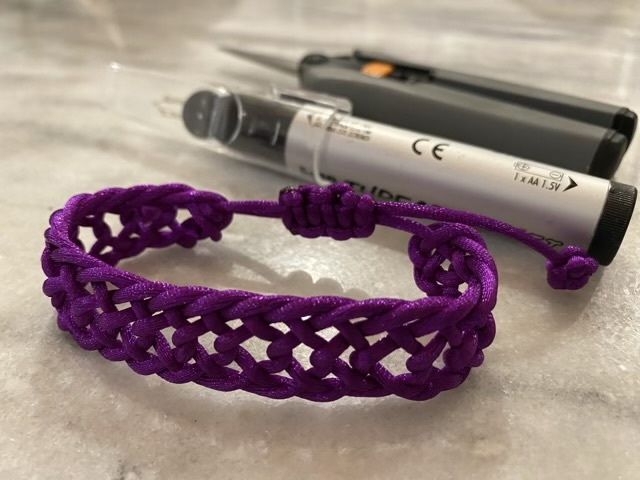
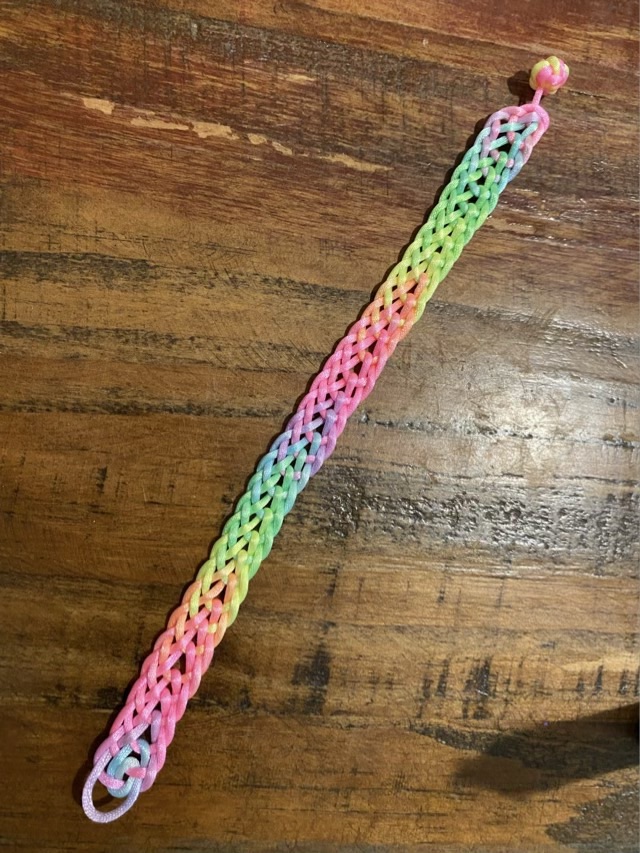
The colored bracelet experiments continue, and this one is a winner. I tried a nålbinding stitch with the neon rainbow satin cord, specifically the Telemark stitch in the Russian stitch family. It works beautifully. Not only do the interwoven loops look pretty, the color transitions are aesthetically pleasing.

Photo description: neon rainbow satin cord looped into a wide woven band using a Telemark nålbinding stitch, finished with a loop on one end and a celtic button knot on the other

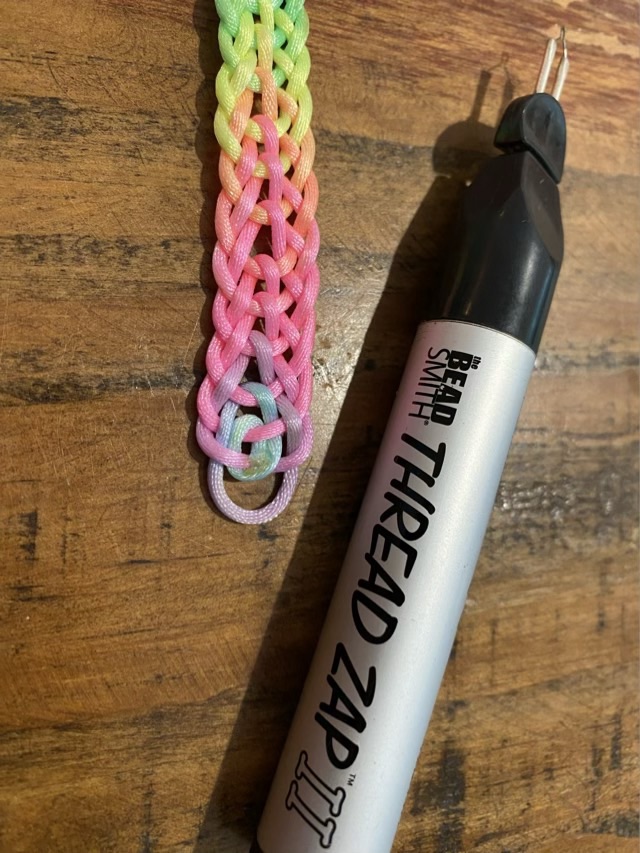
The nature of nålbinding also makes finishing the ends less awkward. For the looped end, I pulled out the beginning stitches (which for me are always weird), and spiraled the end into the weave, securing it by melting with the hot wire Thread Zap.

Photo description: loop end of the bracelet showing the end of the cord melted to the neighboring cord and the Thread Zap II tool

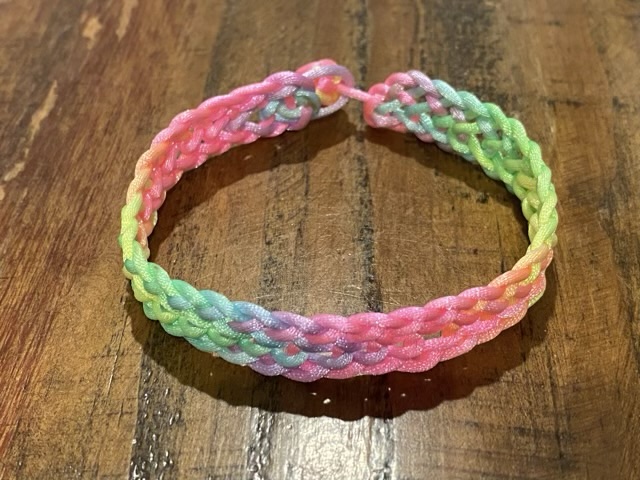
The other end I pulled the loops closed, leaving a tail end which I tied into a button knot. The loops are stable, the clasp mechanism elegant, and I’m already planning additional projects!

Photo description: same bracelet shown closed.

Pyrography on antler

We had a little pyrography on wood with yesterday’s throwback, so today is my new obsession: pyrography on antler. I recently made nåls for nålbinding from the tines of deer antler. I’m experimenting with different shapes and curves and am quite pleased with the results. I was thinking of inking them for decoration, but the dried ink literally just wipes off the slick bone surface. I turned to pyrography instead. I have a Colwood Super Pro II wood burning unit, which can be fitted with a vast array of tips. No more messing with old soldering irons. I can also control the degree of heat, which makes a difference. For wood I use the detail setting around 5-6. For the antler I had to crank it up to 9. Even then, it took several back and forth motions to burn the color into the fine lines. I achieved the color without cutting into the bone, which left a silky smooth surface after a light sanding and buffing. I finish each nål with a coat of Renaissance wax. Here is a video short of a thicker nål with a wrap-around pyrography vine.

Photo description: four antler nåls, two with pyrography. The left most nål has four foot prints: alpaca, rabbit, bison, and sheep. The second from the right has a line drawing of a flax stem and bloom. The other two are plain, because people are different.

My nåls sold well at a recent Earth Day Market. The ones that remain I will be selling on Etsy.

Soybean top page

I have finished a new fiber page for my spinning book! I mounted all my samples from hand spinning soybean top (top is the description of the fiber preparation, involves combing, and produces parallel fibers) on prepped black card stock. I would definitely use this fiber again, it is very strong, yet so soft.

Photo description: Soybean top fiber page. Clockwise from top left: original card from Hearthside Fibers reading “Soybean Top Developed in the USA in the 1930s by Henry Ford Used in Ford car upholstery pre-1940”, single spun, 2-ply, and 4 ply yarn samples, woven swatch, nålbinding swatch, crochet swatch, knit swatch, combed fiber.
Photo description: same page with swatches flipped up to show the writing underneath: plain weave on Clover mini loom, nålbinding Dalarna O/U O:U O, crochet 1.75mm hook, Stiockinet size 2 needle knit.

Blocking Soy

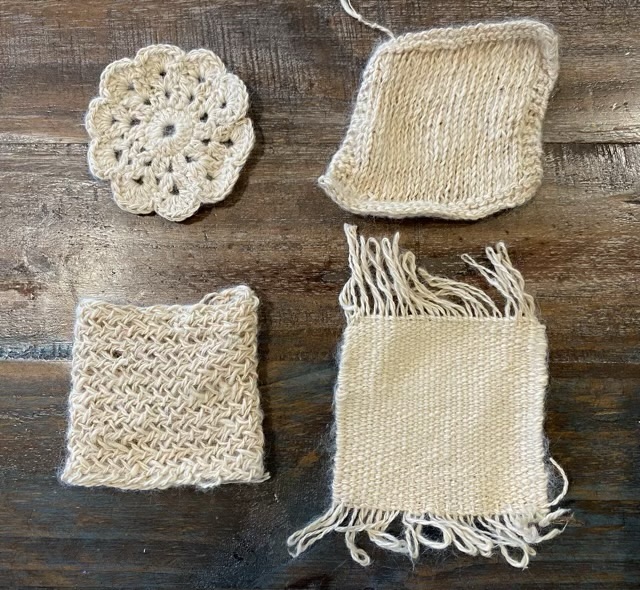
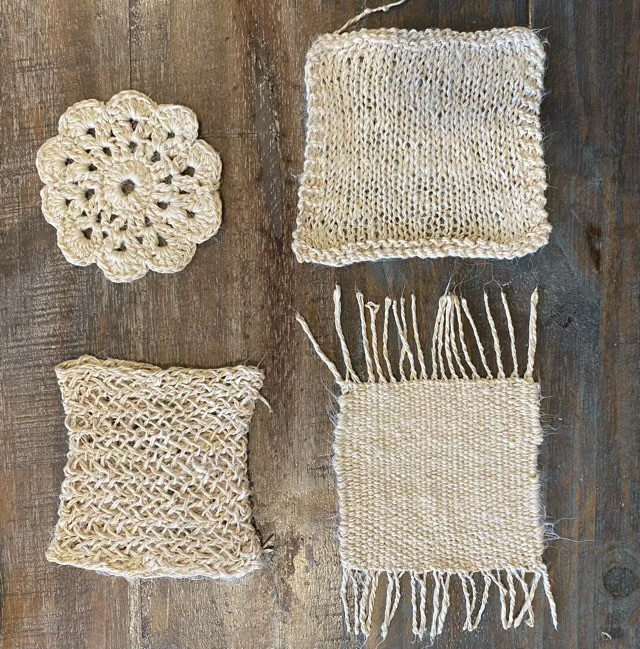
I made four example swatches from my spun soybean fiber: knitting, crochet, weaving, and nålbinding.

Photo description: swatches before blocking, clockwise from top right: stockinette knitting, plain weave, nålbinding Dalarna stitch, and crocheted lace round

The knitting swatch tells the most about the yarn, the obvious skew is because my singles have more twist than my ply. This bias does not have a significant impact on the other swatches. The nålbinding has several small knots because I could not get the fiber to felt together. I used a 1.75mm hook for the crocheted coaster, which was on the small side because the stitching is dense and stiff. The soy yarn is incredibly strong; I can’t break a single strand with my hands, but it is also incredibly soft even with the amount of twist I put in the single. There is good reason that it also carries the name vegetable cashmere. It also blocks well. It was very easy to shape when wet, and kept that shape when dry.

Photo description: same swatches after blocking

I was able to square up the knitting, and give the woven swatch some more twist in the fringe. The nålbinding swatch stitches opened up, but the crochet didn’t have much change, probably due to the density of the stitches.

The next step is to mount the swatches in my fiber book.

Antler nål

I have made my first nål for nålbinding out of antler bone! I have made several out of wood, and was hesitant about bone, but it turns out it is easy to work. I do wear a dust mask at all times because I don’t want that bone dust in my lungs. I like how well it buffs to a shine without applying a finish coat.

Photo description: thick bone needle with two holes on a table with scraps of sandpaper.
Photo description: side view of the same nål, showing the natural curve from the antler tip.

This nål came out a little thicker than I care for, so I’m going to experiment with some other methods of construction. I just sanded this one down to shape; for the next one I’ll try cutting it lengthwise then sanding down, and I will try a different curve.