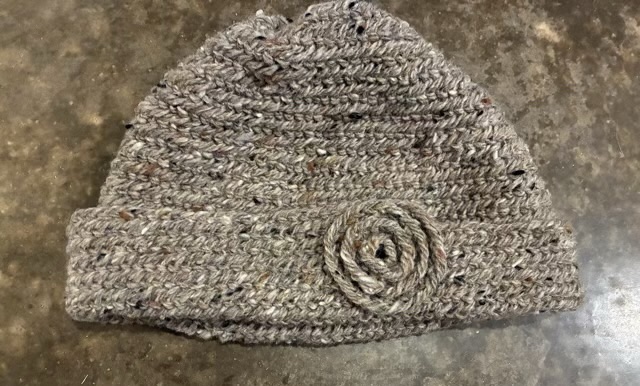
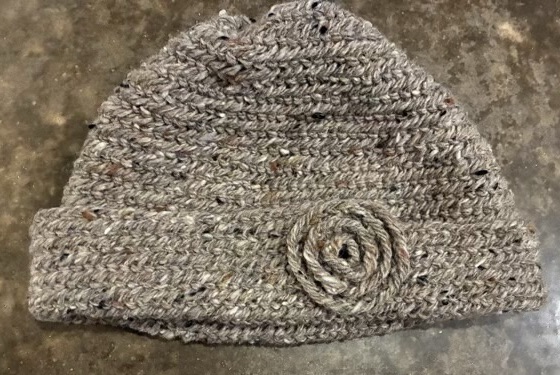
I wet down my recently nålbound hat with soap and water to do light fulling (locking wool fibers together in fabric) and was quite surprised when the stitches relaxed and the hat lengthened.
Photo description: nålbound hat before fulling and blockingPhoto description: same hat after lightly fulling and blocking
I intentionally made the hat larger because I know that wool hats shrink with wearing because of the natural fulling process from moisture and movement. I agitated the hat in the gentle soap and water to deliberately start the felting process, not expecting that much change with the Oslo stitch I used. I wanted the hat to be a slouch hat with folded brim, so really it came out remarkably well, serendipitously.
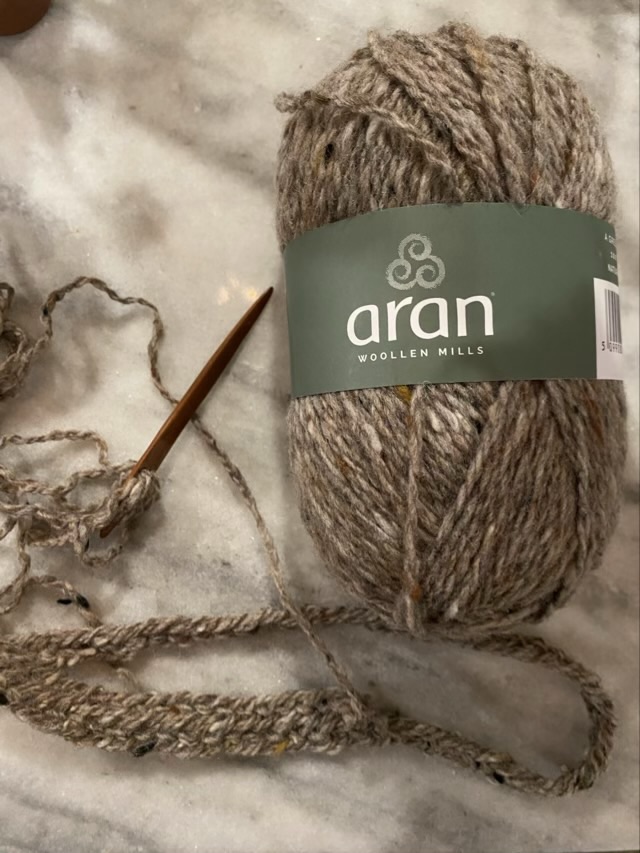
I spent last week watching as much of the Sweet Adeline International Convention webcast live as I could. This gave my fingers long stretches of idle time, which I filled with nålbinding a hat. My parents-in-law recently visited Ireland, and brought me back some Aran wool, which is lovely to nålbind because it tears apart easily and felts back together well.
Photo description: starting a hat with a cherry wood nal, Aran wool, and an Oslo stitch
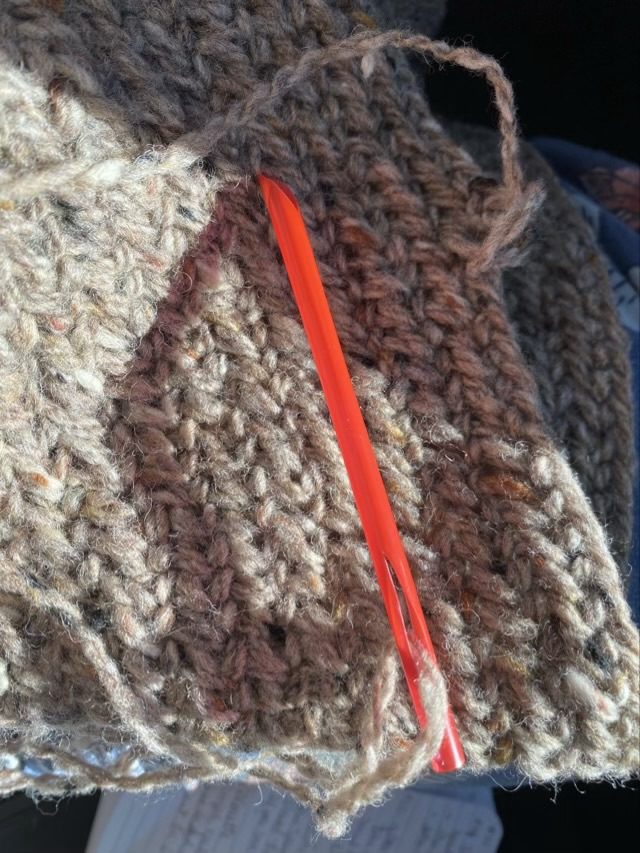
At one point I ran out the door for school pickup and dropped my nal somewhere. Waiting in the car I crafted one out of a straw by cutting one end at an angle and making two slits at the other end to hold the yarn. It worked, but wasn’t as pleasant as my wool polished cherry wood nal. I’m glad I found it when I returned home.
Photo description: nal made from a plastic straw, convention notes in the background
I know to make wool items bigger than intended because as it is worn it will naturally felt and shrink some. I thought my initial circle was oversized, but as I stitched the band contracted, so I switched my plan and added increases, and decided to gather the first rows together to form the crown. Aran wool is very lightly spun Merino, and does not have the strength to draw together and hold, so I made a length of flax cord instead. The flax won’t break and will probably outlast the wool.
Photo description: long line flax twine on the nålbound surface of the hatPhoto description: crown of the hat gathered together tightly with flax twine
I didn’t want to finish the hat with decreases, so I stitched a free length of Oslo chain, spiraled it into a rosette, and stitched down the bottom edge.
Photo description: nalbound chain spiral with a steel yarn needle in the process of a securing stitchPhoto description: finished hat, before blocking
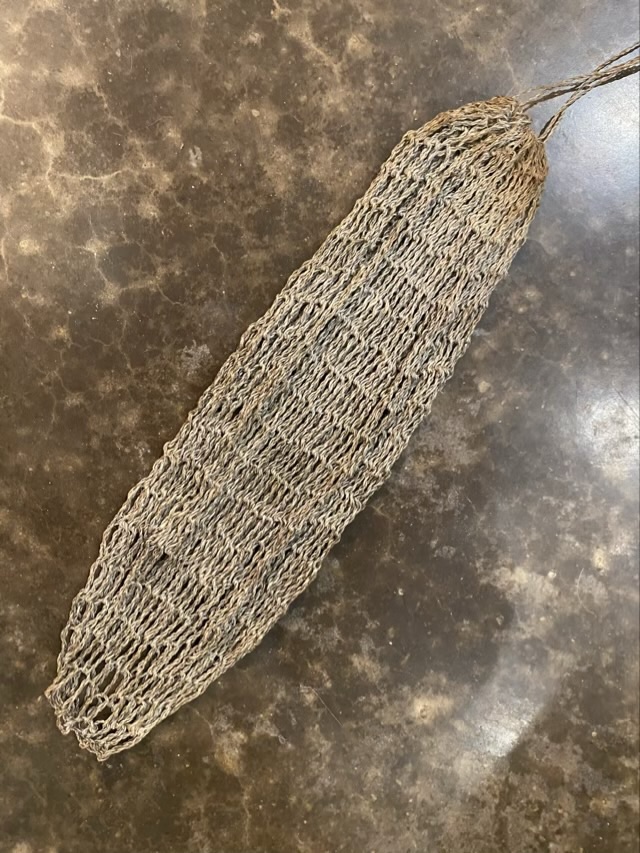
I finished twining and stitching a linen string bag using long line flax and a loop and twist construction. I would twine a section, then loop that section, so the bag was made with a continuous length of string. I did not used any tools other than my fingers. As you can see in the photo above it looks a little wonky. I took it to the sink, gave it a soak in tap water, then laid it out to dry. The transformation was remarkable.
Photo description: same bag after blocking
The bias twist in the stitches eased and it straightened out nicely. What wasn’t nice was the rust colored stains on the top.
Photo description: discoloration at the top of the bag
I used a different batch of flax for the last few rows, and I think something on my well water reacted to something in the flax, which is disappointing. I washed it with gentle laundry soap and laid it out to dry again.
Photo description: same bag after washing with gentle detergent
The rust color lessened, and now it looks more like a different batch of flax at the end, rather than a stain.
I’m also not pleased with the string ties. They are functional, but would be terrible to use to carry anything with much weight. The flax would hold, but the thin cord would cut into the flesh holding it. I do have an idea how to fix it.
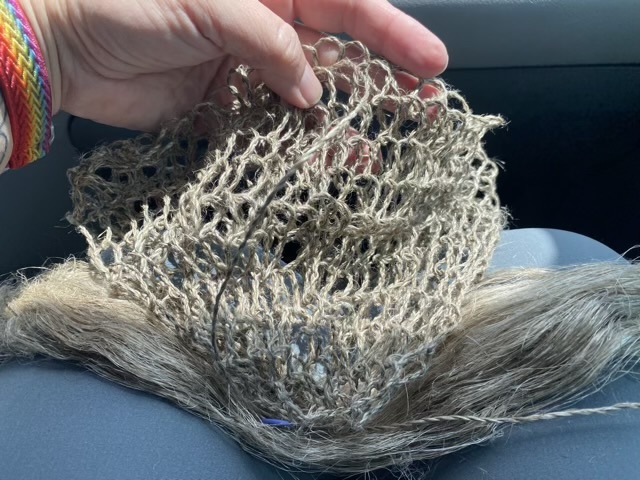
Photo description: loop and twist bag in progress next to flax fiber
After about 14 hours of riding in the car, I figure I have put about 12 hours into my loop and twist bag that I am twining from flax fiber as I go. I like the work because I can enjoy the scenery as we drive. I can both twine and loop mostly by feel (I do look when I join in new fiber.) I’m drawing my fiber from the center of the bundle, which I don’t think is the best way, because I’m getting tangles that have to be pulled out. I tried from one end, but the tangles were worse. I should lay out the fibers like flax spinners do, but space in the car is limited, and flax fibers can be over three feet long. The plan is to continue to twine until I run out of untangled fiber, then clean up the tangles and twine the string for the closure.
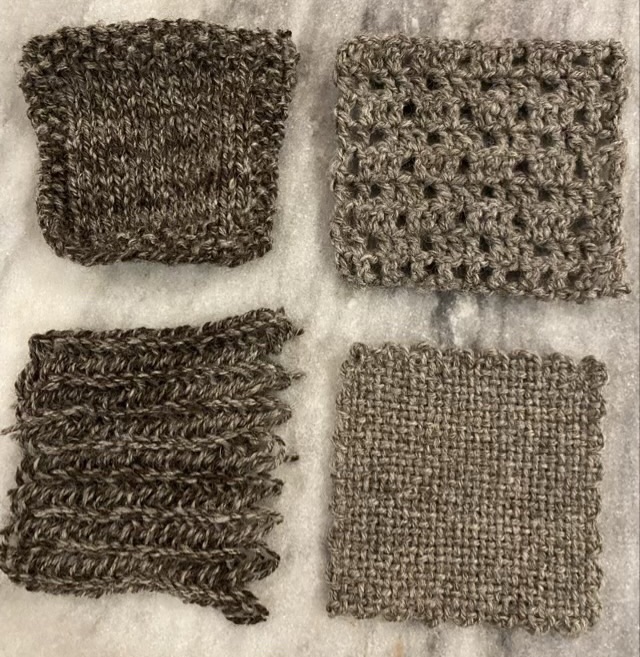
I started on the swatches for Jacob’s wool, and then finished them all in a day, even the nålbinding. I must have thirty other projects I’m not working on. Hm.
Photo description: four squares made from hand spun Jacob’s wool: knit (top left), crochet (top right), cut open nålbinding (bottom left), woven (bottom right)
I had two large cakes of yarn, and two small nostepinne balls, so I used the smaller amounts to make the swatches. I hope to make something wearable out of the larger cakes of yarn.