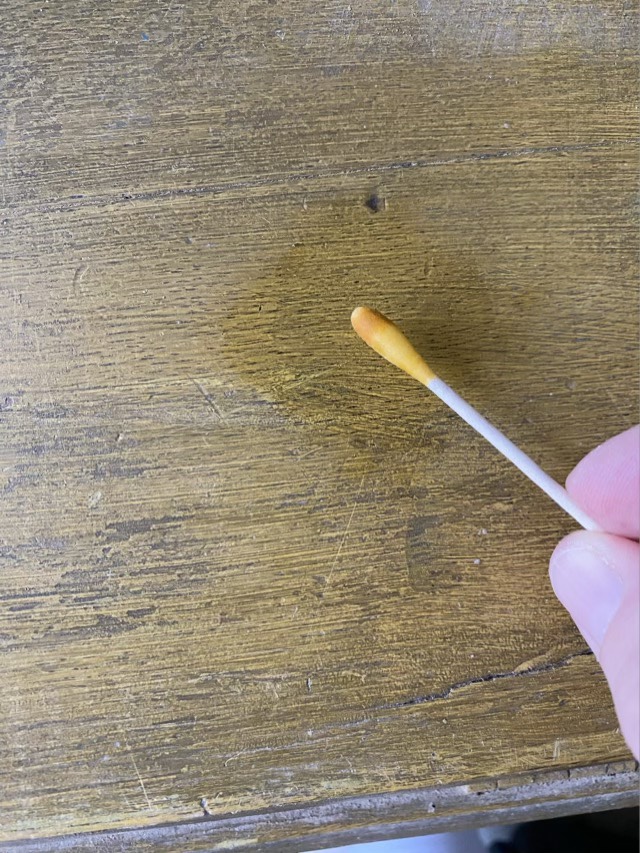
The cabinet of my 1907 model 27 Singer Sewing Machine is yellow. Hm. Pinging online groups, there is a general consensus that they didn’t come in yellow. Prompted, I looked at the hinges, and yes, the hinges and screws also had yellow paint, so someone, during the life of the machine, had thinly painted it yellow. Sigh. The next question, how long ago? Was there lead in the paint? I purchased a lead test kit, followed the directions, and happily, no pink. If the swab or surface turns pink or magenta, it indicates the presence of lead. Since it isn’t lead paint, and it is not original, when the weather cools off here I’ll strip the paint and refinish.
Photo description: Antiqued yellow wood surface showing a wet round area and a yellow swab.
My husband and I removed the sewing machine head from the base (there were two small set screws that were not seized) of my Singer model 27-3 sewing machine so I could start the cleaning process.
Photo Description: Antique, worn, and dirty sewing machine head on cardboard on a work table.
I’m following the advice in the book “Treadle Sewing Machines: Clean and Use an Iron Lady” by Donna Kohler. I have also found digital scans of the owners manual and an adjusters manual for a 127-128, which I’m told by YouTube is close enough to my 27. I’m photo documenting as much as I can along the way. I’m also not in a rush, this is going to take some time, so the machine has a dedicated table in the craft room and I’ll post about interesting observations along the way.
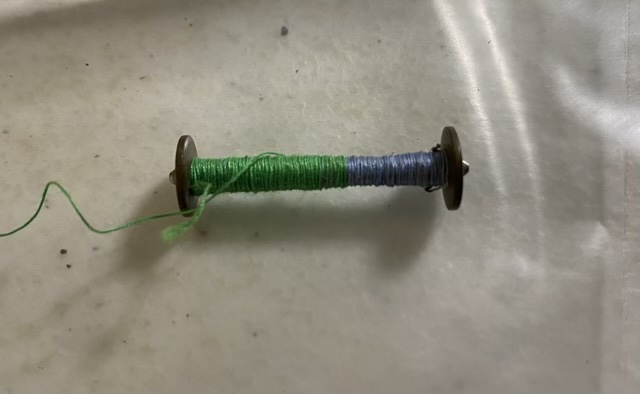
My first discovery was that the previous user of the machine didn’t remove old thread on the bobbins before winding on new thread, which blows my mind. I see how it would save time in the short term, not unwinding, but it reduces the amount of space for new thread, so the bobbin has to be wound more often. An interesting choice for certain. Some of the bobbins had four different colors of thread.
Photo description: Long bobbin wrapped with green thread over blue thread.
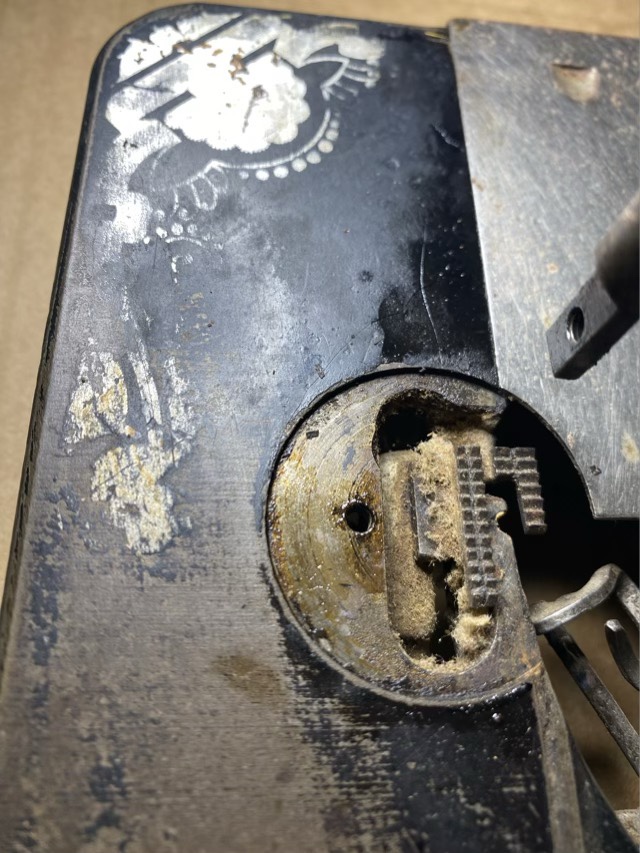
To give you an idea of the level of grime I’m dealing with, past the spider webs and mud-dauber nests, below is a photo of the underside of the needle plate. To remove the needle plate I needed to add PB Blaster and let it sit for about five minutes, then the screw backed out smoothly. Underneath was a build up of lint, oil, and dirt.
Photo description: Round area around the feed dogs where the needle plate was removed, with brown dried oil stains and a thick build up of lint.
There are YouTube videos of machines in worse states. I know this one was well used, and I want to keep as much of the patina as I can. The black finish flakes off when it is touched, so I need to be very careful not to remove what decoration is left. This will definitely be an ongoing project, and I’ll post about interesting things as I find them.
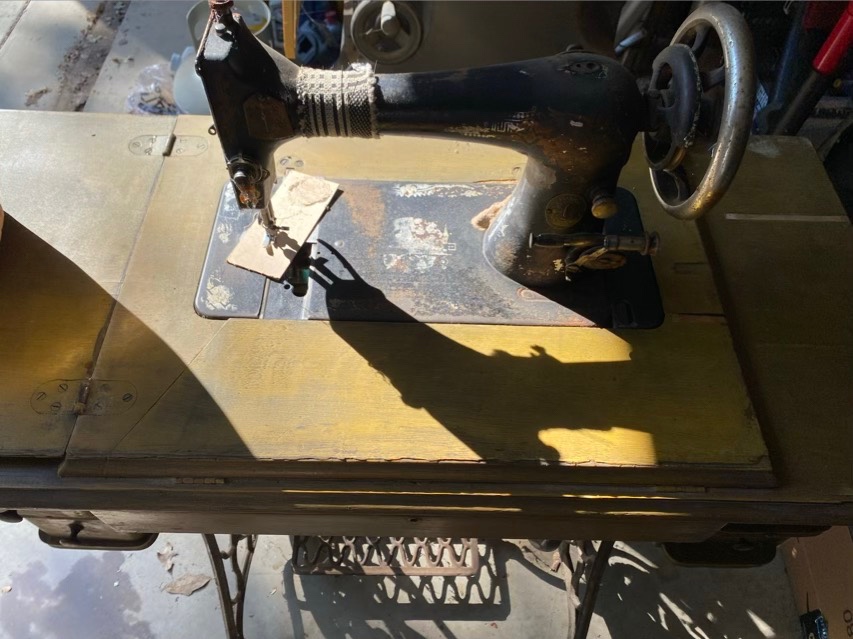
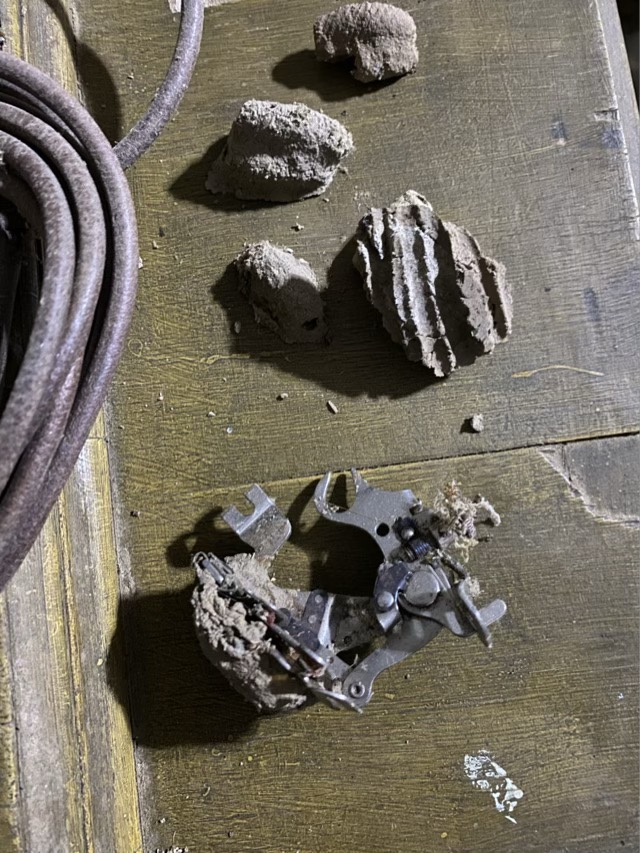
I have recently moved my craft supplies into a new space. I did have everything in one side of a master closet with a small work bench. I’m not sure how I fit it all in that space, as it now fills a regular bedroom. No pictures yet, I’m still sorting and evaluating, but I have setup three folding tables, and decided I had room for a fourth. Before I could go buy another folding table, I spot a working treadle sewing machine for sale for $50. Hm. I’ve actually wanted one of these for a long time, but either didn’t have the car space, or the floor space, or the money (restored sewing machines can be pricey). But at that moment I had the space, and I had the cash. I bought it and my husband helped me fetch it. There is a reason it was reasonably priced. It was stored in a feed room in a barn. Yup. But the wheel turns. The owner bought it from the original owner a few years back (I’ll let you do the math here in a moment), but didn’t get around to using it. It had a bag of parts that went with it, and I’m still counting the wasp nests that hitched a ride. It is living in the garage until I can do a basic clean.
Treadle sewing machine that has seen much use and neglect
I found the serial number and looked it up. This machine is a model 27 and on May 1, 1907, 70,000 machines were allotted. So it is 116 years old and I am the third owner. Hm. It definitely needs some TLC and oil. My plan is not to restore it to new, I rather like patina and that it shows its age, but I will remove the rust, stabilize what I can, and see if I can get it functioning well. This should keep me occupied as the kids head off to school. Oh, and I’ll post updates of course.


 Critters and Craft